
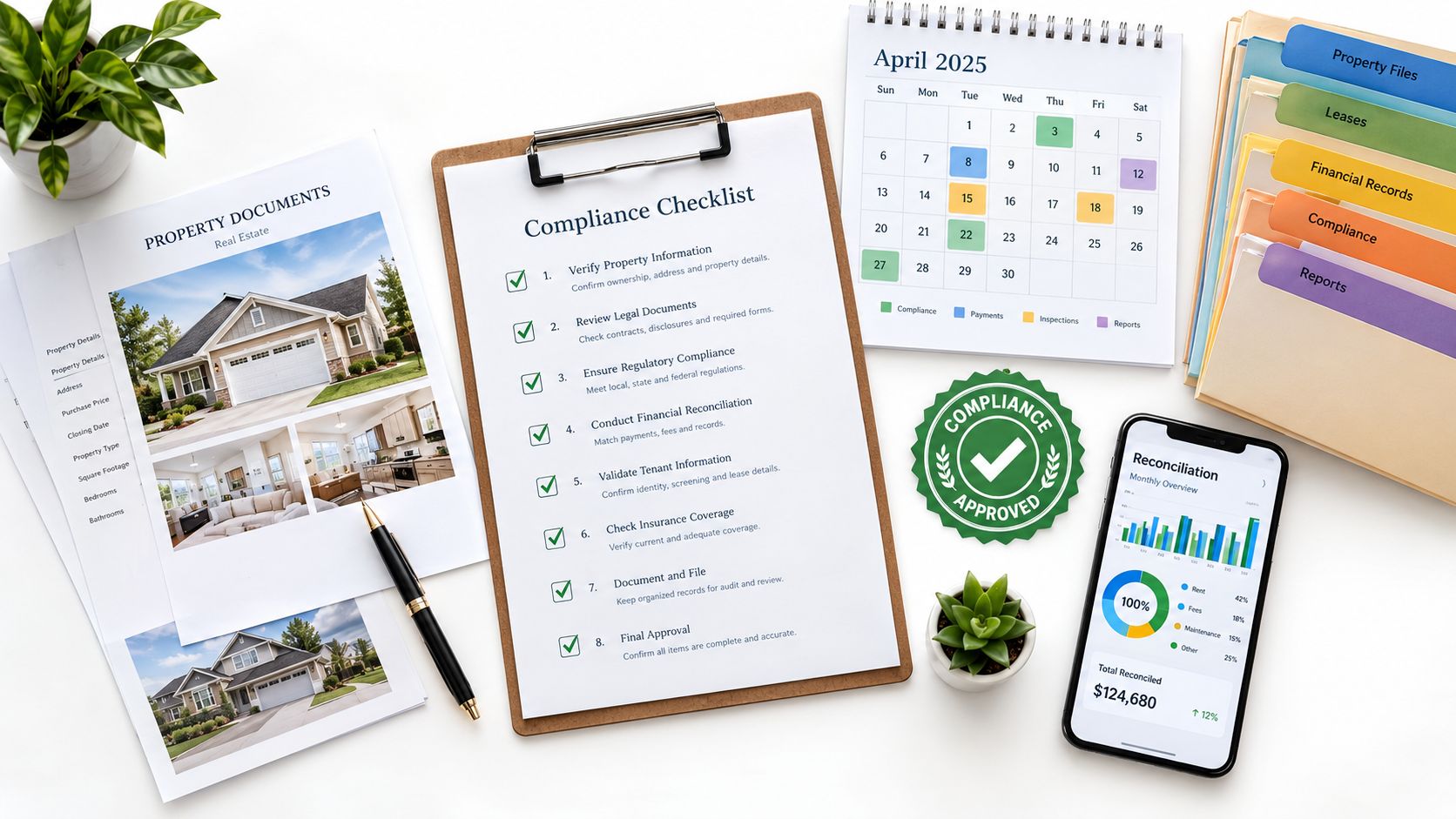
A real estate compliance checklist can fail even when transactions look correctly entered. In a 2026 NSW compliance operation, regulators identified 41 overdue trust-account audits, more than $200,000 in fines, 34 businesses placed on notice, three industry bans and six mandatory training orders. One agency lost its licence and received a $22,000 fine after repeatedly failing to provide mandatory audits, according to the NSW Government compliance operation report. The point is simple: compliance is not an annual catch-up. It is a control cycle with clear ownership, evidence and escalation.
The checklist below follows that cycle, from receipting and reconciliation to payment approval, settlement distribution, month-end review and audit-ready retention. Requirements differ across Australian states and territories, so each agency needs a jurisdiction-specific calendar. Reliance Property Accounts is one example of outsourced support for reconciliations, payment preparation and organised records. Final payment approval and statutory responsibility should remain with authorised internal personnel.
Table of Contents
- 1. Trust Account Bank Reconciliation
- 2. Trust Account Receipting and Ledger Management
- 3. Disbursement Authorisation and Payment Batch Preparation
- 4. Client Trust Ledger Statements and Account Reconciliation
- 5. State-Specific Compliance and Legislation Adherence
- 6. Monthly End-of-Month Processing and Account Balancing
- 7. Sales Settlement Trust Accounting and Fund Distribution
- 8. Audit Preparation and Regulatory Documentation
- 8-Point Real Estate Compliance Checklist Comparison
- Make the Checklist Part of the Operating Rhythm
How healthy is your trust account?
Book a complimentary 30-minute Trust Account Health Check and see where your processes could be improved.
Book a Free Health Check →1. Trust Account Bank Reconciliation
Bank reconciliation is the agency's earliest warning system. It compares the trust-account bank statement with the internal trust ledger and confirms that deposits, withdrawals and balances align. Differences may come from timing, incorrect entries, duplicates or unauthorised payments. Every difference needs investigation.
Set a fixed routine and assign both a preparer and reviewer. The preparer should record the bank balance, ledger balance, outstanding items and explanation for each variance. A principal or designated reviewer should then sign off, especially where manual adjustments or unresolved items appear.

Make exceptions visible
A suspense or clearing account can separate timing differences from unexplained discrepancies, but it should not become a holding area for old items. Give each item an owner, explanation, target resolution date and review status.
Useful controls include:
- Match every movement: Compare receipts, EFTs, cheques and withdrawals against the ledger and bank record.
- Investigate small variances: Minor gaps can signal duplicates, coding errors or access issues.
- Restrict adjustments: Require documented approval for journals, reversals and corrections.
- Retain evidence: Store statements, reconciliation reports, reviewer sign-offs and investigation notes together.
For agencies using PropertyMe, PropertyTree or another trust-account platform, automated matching can reduce repetitive entry, but it does not replace review. Outsourced support can prepare reconciliations inside the client's approved system, while internal staff retain oversight and authority.
Could outsourcing save your agency time and money?
Book a complimentary 30-minute Trust Account Health Check and see where your processes could be improved.
Book a Free Health Check →2. Trust Account Receipting and Ledger Management
A trust ledger should show who paid, why the money was received and whose funds are being held. That supports settlement work, client communication and the audit trail. A total without a payer, purpose or beneficiary creates problems later.
Treat each receipt as a controlled transaction. When a buyer's deposit, rental payment, bond or other trust money arrives, staff should identify the payer, check the reference, allocate the funds to the correct ledger and save the supporting evidence. Local rules may set specific receipting and deposit requirements, so the routine should match the agency's jurisdiction.
A useful receipt record contains:
- Source details: Payer, amount, date received, payment method and transaction reference.
- Beneficiary allocation: The relevant sale, landlord, tenant, buyer, seller or other beneficiary.
- Cheque evidence: Cheque number, payer, date, amount and deposit date.
- Cash verification: Two-person verification and documented deposit preparation where cash is accepted.
- Electronic payment checks: Bank reference matched to the ledger entry, with unidentified credits flagged for prompt review.
- Client confirmation: A clear receipt or confirmation email retained with the transaction record.
Use consistent naming across branches and staff. "Smith Sale Deposit" is easier to search than a generic description. Store receipt evidence so the transaction can be traced into the bank reconciliation and resulting balance.
Unallocated receipts need their own review queue. An unidentified credit can distort a client balance as easily as a miscoded payment. Assign an owner, record the investigation and set a resolution date. Managers should review outstanding items on the agency's set cadence and escalate older items.
Reliance Property Accounts can assist with receipting and ledger processing inside approved agency systems. The agency remains responsible for authority limits, access controls and corrections after posting. Corrections should preserve the original entry, explain the reason and show who approved them.
3. Disbursement Authorisation and Payment Batch Preparation
A trust-account payment should be traceable from instruction to final approval. That protects client funds, exposes errors before release and creates evidence for later review. The person preparing a batch should not approve it.
Start with the supporting records. Depending on the transaction, these may include settlement instructions, approved invoices, rent distribution records or bond documentation. The preparer checks that each payment has a clear purpose, an authorised instruction and enough cleared funds in the relevant trust account. A separate authorised reviewer then checks the payee, amount, account details, conditions and available balance before release.
The batch transmittal sheet should capture the control record in one place. For each payment, record the Payment purpose, linked transaction or client account, Payee identity, verified name and account details, and Supporting document, such as a settlement statement, invoice or authority. Add Prepared by and Reviewed by fields so responsibility is clear. The Exception status should flag missing information, changed details or unresolved questions.
Exception handling needs a separate decision point. New payees, changed bank details, unusual amounts, incomplete instructions and urgent requests require written evidence and escalation to the principal or another authorised approver. Urgency should not bypass the approval record. A known supplier can still have compromised bank details, so changes to a regular payee should be checked outside the normal payment flow.
Verify account details through a trusted channel rather than relying only on email. Keep a controlled payee master file for regular recipients, restrict who can change it and retain the change history. Automation can flag duplicates or assemble a batch, but it should not approve payments independently.
Technology supports these controls when the agency sets role-based access, least-privilege permissions, multi-factor authentication, periodic access reviews and change logs. The Property Council of Australia and Yardi technology survey reports that 42% of Australian real estate firms were deploying artificial-intelligence solutions. Agencies using automated workflows therefore need clear approval boundaries and retained evidence showing who prepared, reviewed and approved each batch.
4. Client Trust Ledger Statements and Account Reconciliation
A client ledger statement is both a service document and a control record. It shows the buyer, seller, landlord, tenant or other beneficiary the receipts, payments, adjustments and balance held. That visibility helps clients question entries early, before a rent distribution, deduction or settlement allocation becomes harder to fix.
Build the statement around a defined reporting date and closing balance. Use descriptions clients can understand rather than unexplained codes, especially for fees, reversals, adjustments and disbursements. In a sale, compare the final ledger with the settlement statement before funds are distributed. In property management, reconcile the landlord's statement to rent received, approved expenses, bond activity where relevant and amounts paid out.
Review each client ledger separately. A trust bank account can balance overall while one beneficiary's funds sit in the wrong ledger. The reviewer should trace material movements to receipts, instructions, invoices, approvals and bank evidence. This catches allocation errors that account-level totals will not show.
Set Consistent issue dates on a monthly or quarterly schedule that suits the service and the client's expectations. Include Transaction explanations for unusual entries, deductions, reversals and adjustments. For a sale, obtain Settlement confirmation before distribution where the process or client instructions require it. Distribution support should connect property-management statements with rent, bond and expense records. File Retention evidence with the issued statement, ledger review and reconciliation workpapers.
PropertyMe and PropertyTree can produce statements consistently and reduce manual copying. Their output still depends on correct ledger coding, current instructions and controlled access. A generated statement does not prove the allocation is correct. The reviewer must confirm that each receipt, payment and adjustment belongs to the intended client account.
Treat client questions as review exceptions. Record the disputed entry, the client's explanation, relevant documents, assigned staff member, decision and resolution date. This creates an auditable trail and gives the agency a repeatable way to resolve disagreements. Month-end review should confirm that open questions, unreconciled balances and unissued statements have an owner before the period is closed.
5. State-Specific Compliance and Legislation Adherence
A national or multi-state agency should not rely on one generic compliance calendar. Audit periods, auditor requirements, lodgement channels and deadlines can differ by jurisdiction. The checklist should identify the responsible entity, applicable period, required records, reviewer, lodgement method and final date for each state or territory.
Victoria is a clear example. Estate agents holding trust money must have their trust accounts audited for the financial year from 1 July to 30 June, with the audit completed within three months after 30 June by an approved auditor. After receiving the auditor's report, the agent must lodge a copy with Consumer Affairs Victoria within 10 business days, as set out in the Victorian trust-account audit guidance.
NSW uses a similar annual cycle for licensees or former licensees that received or held trust money during the audit period ending 30 June, with submission due by 30 September. The Northern Territory generally uses a 1 July to 30 June audit period, while Western Australia follows a calendar-year audit period with the annual audit report or declaration due by 31 March. These requirements should be checked against current regulator guidance before the calendar is approved.
Put jurisdiction into the workflow
Create a separate compliance profile for every operating jurisdiction. Include the trust-account owner, audit period, auditor qualification, lodgement portal, internal readiness date and escalation contact. A branch manager should be able to see the relevant obligations without interpreting a national policy document.
Review the profile when the agency opens a new account, expands into another state, changes its responsible entity or receives updated regulator guidance. The trust account bank and compliance information can be used as part of an agency's discovery and process-mapping discussion, but legal uncertainty should be referred to the relevant regulator, accountant or solicitor.
6. Monthly End-of-Month Processing and Account Balancing
Month-end turns daily controls into management information. The agency should close the period by reconciling trust accounts, reviewing client balances, processing authorised adjustments, clearing outstanding items and preparing reports a principal or director can review quickly.
Set a written close schedule and assign each task. The close should not rely on one person remembering what to do. A useful checklist records the account reconciled, date completed, preparer, reviewer, outstanding items, adjustments and workpaper location.
Review balances behind the totals
A trust account can balance at total level while individual records still contain stale suspense items, unidentified receipts or unsupported adjustments. Match client balances to settlement statements, deposit records, rent schedules, bond information, invoices and payment authorities. Explain every adjustment and obtain approval before posting it.
A month-end pack might include:
- Bank reconciliation: Bank balance, ledger balance, outstanding items and reviewer sign-off.
- Exception register: Unresolved variances, aged suspense entries, rejected payments and missing support.
- Client balance review: Unusual, negative or dormant balances and the action taken.
- Adjustment log: Journals, reversals and corrections, with approval evidence.
- Management report: Trust balances, distributions, settlements in progress and material exceptions.
- Archive index: Where the complete close file is stored and who can access it.
The trust account management service information describes support with daily operations, bill entry, end-of-month processing, balancing and reporting. Whether the work is internal or outsourced, the agency needs a named reviewer who can challenge the result. A close that is completed but not reviewed is only partly controlled.
Track trends without inventing targets. A sudden change in trust balances, recurring duplicate entries or a growing suspense account deserves investigation. Management should escalate unexplained variances rather than waiting for the annual audit to expose a pattern.
7. Sales Settlement Trust Accounting and Fund Distribution
Settlement accounting starts when the deposit is received and ends only after funds are distributed, the ledger is updated and each payment is reconciled to final instructions. The workflow should protect the buyer's deposit, calculate the correct proceeds and stop rushed settlements from bypassing verification.
Open a settlement-in-progress register for every transaction. Record the property or client reference, deposit received, anticipated settlement date, instructions outstanding, expected recipients, approval status and post-settlement reconciliation. Update the register whenever the contract, settlement date, adjustments or distribution instructions change.
Keep written instructions central
Obtain written instructions from the seller's solicitor or conveyancer and verify payee details through an independent, trusted channel. Do not rely on a verbal request or an email that changes bank details without confirmation. The preparer should compare the final settlement statement with the ledger, commission or expense records and authorised distribution instructions.
A controlled settlement process should include:
- Deposit identification: Link the buyer's deposit to the correct sale ledger and retain the receipt evidence.
- Instruction verification: Confirm the source, date and scope of written settlement instructions.
- Payee review: Check account details, names and relevant business information before batch preparation.
- Draft calculation: Prepare an indicative statement early, then update it as adjustments become known.
- Approval record: Capture the authorised approver's review of the final batch.
- Post-settlement check: Match every disbursement to the final statement and confirm unresolved items.
If settlement is delayed or cancelled, the deposit should remain clearly identifiable and held according to the applicable instructions and law. Do not let a changed settlement date create an unclear balance or an informal refund decision.

The agency should retain the settlement statement, instructions, payment approval and reconciliation together. That file gives the client, reviewer and auditor a coherent record of what happened and why.
8. Audit Preparation and Regulatory Documentation
Audit readiness is created during the year, not assembled after the auditor asks for records. The audit file should show how the agency received, held, reconciled, paid and reported trust money. It should also show who performed each control, who reviewed it and how exceptions were resolved.
In Victoria, failing to comply with several major trust-account obligations can attract a penalty of up to 120 penalty units, while failing to notify the regulator of a newly opened trust account within 14 days can attract up to 60 penalty units. Failing to retain the signed auditor's report for seven years can attract up to 20 penalty units, according to the Victorian trust-account reference guide. The same guidance describes substantially higher consequences for reportable deficiencies, fraudulent use of trust money and falsification of accounts.
Build the evidence pack as you work
Create a controlled audit folder at the start of the financial year. Use consistent file names and a predictable structure so an auditor can trace a transaction from bank statement to ledger, approval and supporting document.
Retain, as applicable:
- Reconciliation workpapers: Preparer and reviewer sign-offs, variance explanations and resolution notes.
- Bank evidence: Statements, confirmations and records of account changes.
- Transaction records: Receipts, disbursements, journals and supporting documents.
- Settlement files: Instructions, calculations, approvals and post-settlement checks.
- Control records: Access reviews, authority reviews, payment-batch approvals and exception registers.
- Audit correspondence: Requests, responses, findings and documented remediation.
- Retention schedule: Required retention period and responsible owner for each record class.
An auditor needs evidence, not assurances. If a variance was corrected, retain the original issue, investigation, approval and final correction. If a staff member was absent, document who performed the control and why that person had authority.
The trust account audit checklist can support an agency's preparation of an organised evidence workflow. It does not replace the statutory requirements applying to the agency or the auditor's professional judgement.
8-Point Real Estate Compliance Checklist Comparison
| Service | Implementation complexity 🔄 | Resource requirements ⚡ | Expected outcomes 📊⭐ | Ideal use cases 💡 | Key advantages ⭐ |
|---|---|---|---|---|---|
| Trust Account Bank Reconciliation | High 🔄🔄🔄 (daily reconciliations, exception handling) | Moderate to high staff time, bank portals + trust software ⚡⚡ | High accuracy, immediate discrepancy detection 📊⭐⭐⭐⭐ | Agencies with daily transactions, multi-branch operations, audit focus | Detects fraud/errors, simplifies audits, protects client funds |
| Trust Account Receipting and Ledger Management | Medium 🔄🔄 (same-day entry discipline) | Continuous data entry, receipting tools, cheque/cash controls ⚡⚡ | Complete chronological audit trail, prevents misallocation 📊⭐⭐⭐⭐ | All agencies, high-volume receipting, property managers | Traceability of funds, prevents commingling, speeds client queries |
| Disbursement Authorisation & Payment Batch Preparation | Medium to high 🔄🔄🔄 (segregation of duties required) | Verifiers, approvers, supporting documentation, workflow tools ⚡⚡ | Controls unauthorised payments, faster settlements when approved 📊⭐⭐⭐⭐ | Sales settlements, large payments, multi-branch approvals | Prevents unauthorised payouts, clear audit trail, batch efficiency |
| Client Trust Ledger Statements & Account Reconciliation | Medium 🔄🔄 (automation reduces manual load) | Automated statement tools recommended, periodic reviews ⚡⚡ | High transparency, quicker dispute resolution 📊⭐⭐⭐⭐ | Landlords, buyers/sellers, tenants needing regular statements | Builds client confidence, simplifies disputes and tax reporting |
| State-Specific Compliance & Legislation Adherence | Very high 🔄🔄🔄🔄 (jurisdictional variation, ongoing updates) | Legal/regulatory expertise, training, process updates, monitoring ⚡ | Regulatory compliance, reduced fines/penalties 📊⭐⭐⭐⭐⭐ | Multi-state operators, agencies in tightly regulated states | Avoids penalties, ensures correct local procedures, regulator confidence |
| Monthly End-of-Month Processing & Account Balancing | Medium to high 🔄🔄🔄 (period close discipline) | Dedicated month-end time, reconciliation tools, documentation ⚡⚡ | Accurate month-end reports, early error detection 📊⭐⭐⭐⭐ | All agencies for governance, high-volume operations needing regular close | Confirms ledger integrity, supports reporting, prevents compounding errors |
| Sales Settlement Trust Accounting & Fund Distribution | High 🔄🔄🔄🔄 (external coordination, timing risk) | Coordination with solicitors/settlement agents, rapid verification ⚡⚡⚡ | Timely settlements, clear net proceeds, fewer disputes 📊⭐⭐⭐⭐ | Agencies with frequent settlements, investor clients, conveyancing workflows | Protects deposits, precise settlement statements, end-to-end audit trail |
| Audit Preparation & Regulatory Documentation | Medium 🔄🔄🔄 (year-round discipline but structured) | Organised documentation systems, templates, ongoing maintenance ⚡⚡ | Faster audits, lower fees, fewer findings 📊⭐⭐⭐⭐⭐ | All agencies subject to annual audits or regulator inspections | Speeds audits, demonstrates controls, simplifies regulator responses |
Make the Checklist Part of the Operating Rhythm
A real estate compliance checklist works only when staff use it in daily operations, not just before an audit. Start with the daily controls: receipt each trust transaction, allocate it to the correct ledger, reconcile the bank movement and investigate every unexplained variance. Assign the preparer and reviewer by name, then retain the evidence where both can find it.
Payment preparation should follow its own rhythm. Staff can assemble batches, verify supporting documents and flag unusual payees or changed bank details. An authorised internal person should review and approve the final payment. That separation reduces avoidable errors and makes accountability visible. Automation can help with matching, duplicate detection, document classification and exception reporting, but it should not hold unrestricted approval authority.
The weekly and monthly cadence should deal with what daily processing leaves unresolved. Review suspense items, rejected payments, unallocated receipts, changed payee details and open client questions. At month-end, reconcile each account, review individual client balances, document adjustments and produce a management pack for the principal or director. Do not close a period simply because the totals balance. Confirm that the records underneath support those totals.
The annual layer is jurisdiction-specific. In Victoria, the trust-account audit cycle runs from 1 July to 30 June, the audit must be completed within three months after 30 June and the signed report must be lodged within 10 business days of receipt. NSW has its own annual cycle and lodgement deadline, while other jurisdictions use different arrangements. A multi-state agency should maintain separate calendars, owners, auditor requirements, portals and escalation rules rather than forcing every branch into one national date.
Record retention runs through every layer. Keep bank statements, receipts, ledgers, payment approvals, settlement documents, reconciliations, access reviews, exception logs, audit correspondence and remediation evidence in a controlled location. Review the checklist whenever legislation, software, bank access, staffing or authority limits change.
Reliance Property Accounts can support daily trust operations, receipting, reconciliations, payment preparation, month-end processing, state-aligned compliance checks and audit-ready records within client-approved systems and documented scopes. Agencies should retain appropriate internal authority, review and oversight, especially for final payment approval and statutory accountability. Outsourcing can provide continuity during growth, leave, turnover or backlog remediation, but it does not remove the need for clear governance.
Reliance Property Accounts offers outsourced trust accounting support for daily reconciliations, receipting, payment batch preparation, month-end processing and audit-ready records. If your agency needs a more consistent real estate compliance checklist workflow, visit Reliance Property Accounts to discuss a process aligned with your systems, jurisdiction and approval structure.