

You're at month-end. Receipts have hit the bank, the owner payout is waiting for approval, and one ledger still does not tie because someone receipted a transfer with a vague narration. That is when trust accounting journal entries stop being routine bookkeeping and become the evidence file an auditor reads line by line.
In Australian real estate agencies, the journal is not a side record. In Victoria, Consumer Affairs Victoria requires accounting records that show the true position of all trust money and allow the accounts to be properly audited, and transfers between trust ledger accounts must be recorded in a journal kept exclusively for that purpose. In Queensland, similar discipline applies inside a tighter monthly close, where reconciliations must be completed within five business days after month-end. The work is similar, but the compliance pressure lands differently in each state.
Table of Contents
The pre-post check I'd want on every desk
How healthy is your trust account?
Book a complimentary 30-minute Trust Account Health Check and see where your processes could be improved.
Book a Free Health Check →What a Trust Journal Entry Must Capture Before You Post
-
Recording Receipts from Rent and Other Trust Sources
-
Other trust receipts still need the same skeleton
Could outsourcing save your agency time and money?
Book a complimentary 30-minute Trust Account Health Check and see where your processes could be improved.
Book a Free Health Check →
What a Trust Journal Entry Must Capture Before You Receipt
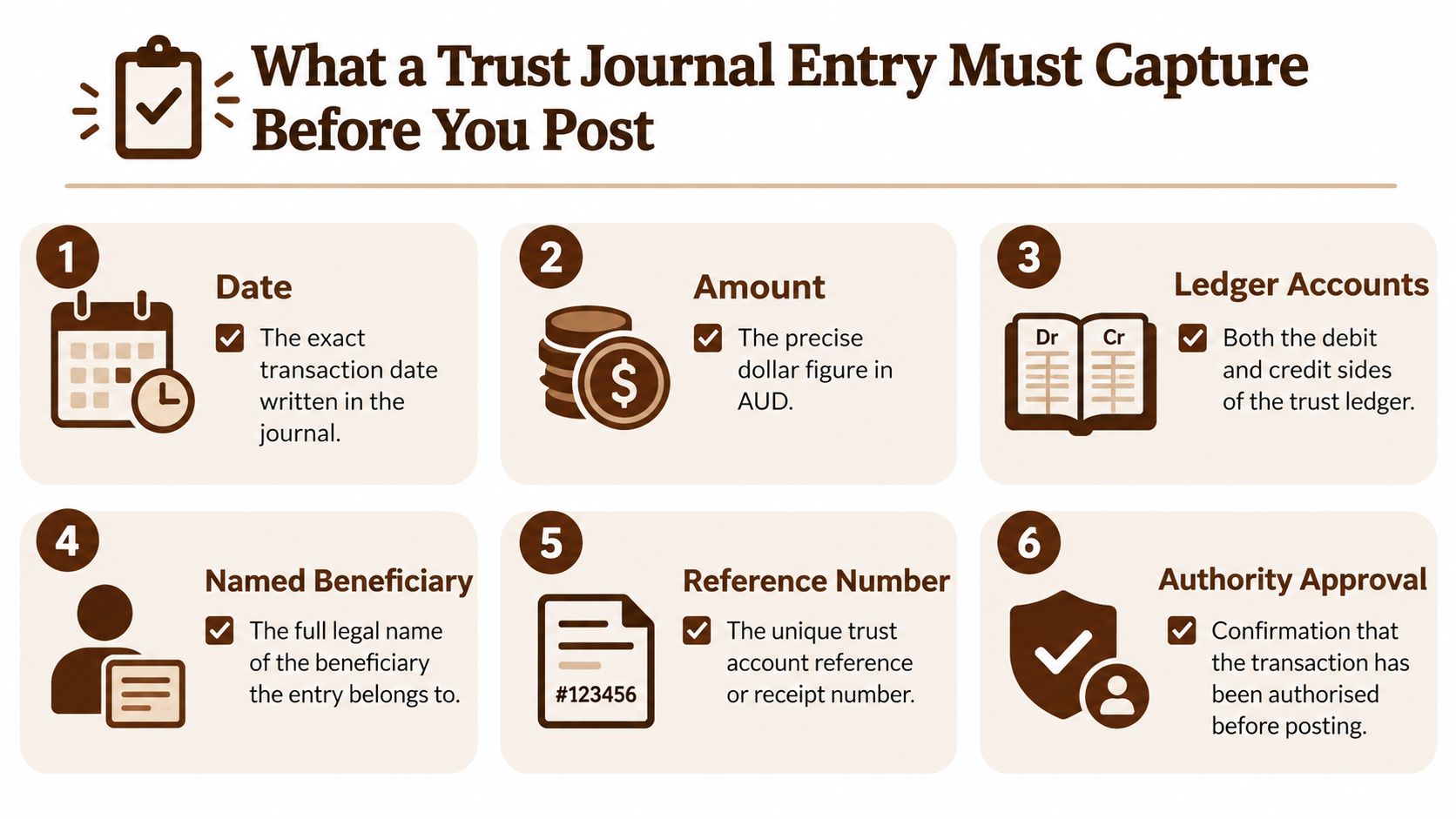
A journal line is only worth receipting when the support is already in front of you. Date, amount, ledger accounts, beneficiary, reference, and authority trail all need to match the property file, invoice, or receipt. If one piece is missing, the entry may still balance on paper, but it will not survive audit review.
Small agencies feel the pressure here first. Three ledgers are active, two receipts still need allocation, and an owner payout is approved in principle but not yet receipted. If the transfer goes in before the reason and source document are fixed, reconciliation inherits the problem.
The pre-receipt check I'd want on every desk
A compliant entry should carry the exact transaction date, the precise AUD amount, both sides of the ledger movement, the full legal name of the beneficiary or account holder, and a unique receipt or reference number.. That is the standard auditors look for because the record has to show the true position of trust money, not just the bank balance. Consumer Affairs Victoria's trust money accounting requirements
Practical rule: if you cannot explain an entry in one sentence without opening three other files, it is not ready to receipt.
For agencies that want a cleaner document trail, this documentation resource fits neatly beside the journal because the journal line and the support file should tell the same story.
What goes wrong when the fields are thin
The usual failure is not dramatic fraud. It is a thin narration such as “transfer”, “adjustment”, or “payment” with no property, payee, or authority reference. That entry might still let the bank reconciliation clear for the month, but it leaves the auditor guessing which beneficiary the money belongs to and why it moved.
The fix is simple. Write the entry only after the support is in hand, and treat the narration as part of the evidence, not a comment box.
Recording Receipts from Rent and Other Trust Sources
Rent receipts are easy to get sloppy with because they are frequent and familiar. In the ledger, they are neither. A receipt has to tell the trust bank what arrived and tell the beneficiary ledger who owns that balance.
A standard rent receipt from a managed property follows the same structure each time. Credit the tenant or owner ledger because the agency now owes that money to the correct party. The narration should name the receipt type, the property file, and the period covered, so the transaction can be matched later without guesswork.
Rent receipt example that actually helps at month-end
If a tenant pays weekly rent for a managed property, the journal should identify it as a rent receipt against that property file and rent period. The funds sits in the trust bank account, the credit sits in the relevant ledger, and the description ties the receipt to the tenancy record. That way, the cash journal, ledger, and bank deposit all describe the same event.
The point of classifying the receipt at receipting time is simple. If the receipt is mis-tagged, the monthly reconciliation has to untangle it later.
For agencies handling rent-heavy portfolios, the same logic applies when the receipt lands through a trust workflow integrated with the property file. Rental trust accounting support only works when the source, property, and receipt type are coded cleanly at the start.
Other trust receipts still need the same skeleton
A bond top-up, vendor contribution, or other non-rent receipt still needs the same core fields. The label changes, but the mechanics do not. The correct trust ledger is credited, and the narration names the source and purpose clearly enough for an auditor to follow the trail.
The file that gets closed fastest is usually the one where the receipt narration already answers the next question.
If the money is in but the narration does not tell you whether it was rent, a top-up, or a pass-through contribution, you have not saved time. You have pushed the problem into reconciliation.
Posting Owner Disbursements and Creditor Payments
Disbursements are where trust files often crack because the pressure comes from outside the ledger. Owners want funds released, creditors want invoices cleared, and the office wants the batch finished. None of that changes the control sequence.
Check the authority first, not after
Before a payment entry is prepared, verify the payee, the amount, the client or property allocation, the supporting invoice or statement, and the legal or contractual authority. Victoria requires written authority before withdrawal, and the agency must record the full particulars and amount withdrawn. Consumer Affairs Victoria's trust account auditing guidance
A sales payout should read like a file note, not a guess. For example, debit Owner Ledger, Lot 12 Smith St settlement proceeds, credit Trust Bank, EFT 88412 to vendor solicitor per Section 32 authority dated 12 May. That entry tells the auditor what left trust, why it left, and which authority supports it. If the authority is missing or the support document does not match the payment, the entry stays unreceipted.
The same control applies to a creditor invoice paid from a management trust. The payee changes, but the discipline does not. The invoice has to be on file, the amount has to match, and the allocation has to point to the correct owner or property before the payment is prepared. If the invoice is split across files, the split needs to be obvious in the narration and ledger references.
Separation of duties still matters
The person preparing the entry should not be the same person giving final approval. That separation catches the mistakes auditors look for, especially where disbursements move quickly and the support file is thin. In practice, one person assembles the batch and another checks the authority trail before release.
A good payment file shows the invoice, authority, allocation, and completed entry side by side. A weak one shows a bank line and a hope.
If the approval step is informal, the audit file will look informal too.
Recording Transfers Between Trust Ledger Accounts
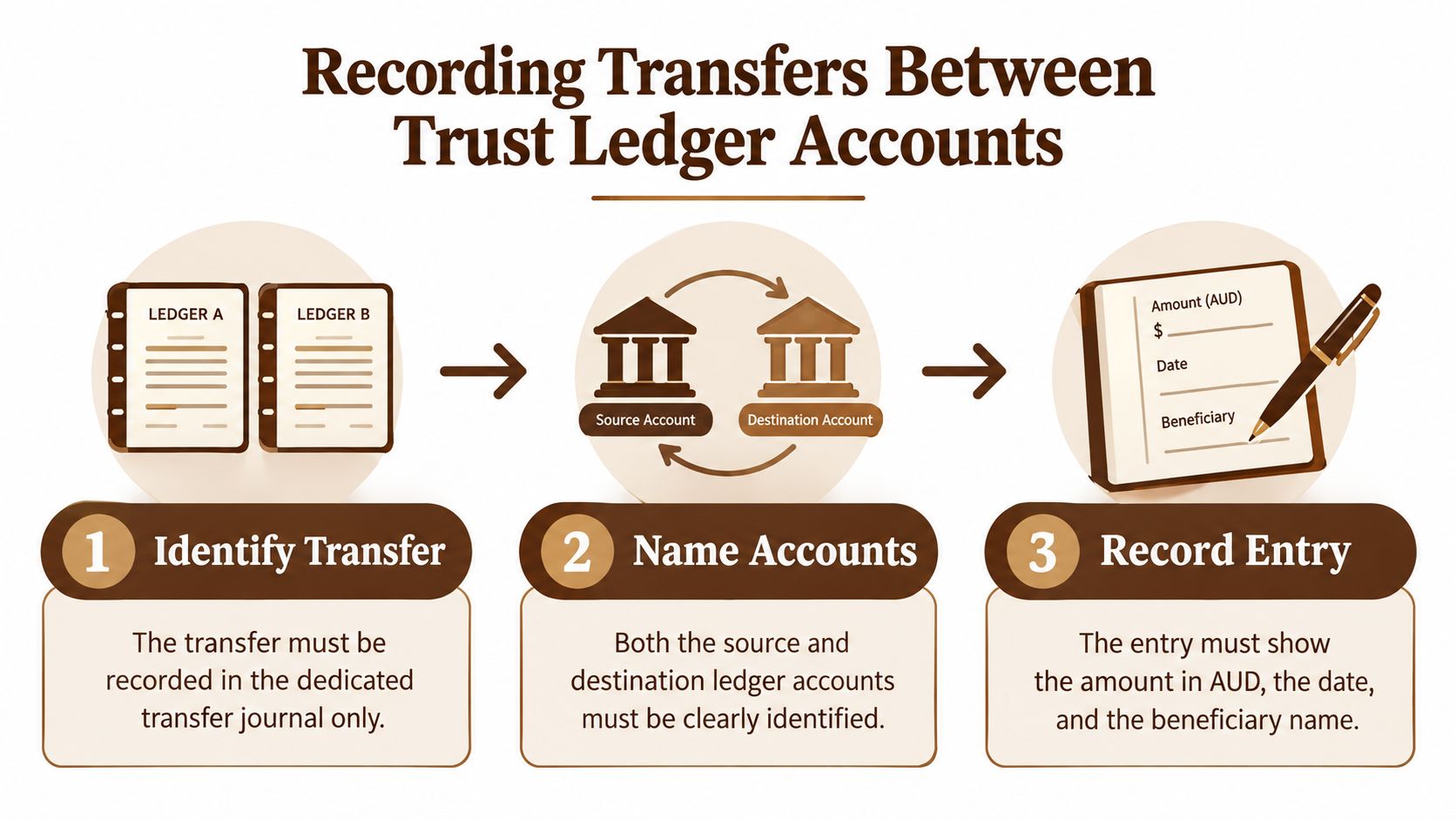
A trust ledger transfer is not a receipt and not a payment. It is a journal entry that moves money between ledger accounts inside trust, and in Victoria it has to be recorded in the transfer journal with the date, amount, source and destination ledgers, and enough identifying detail to show why the movement happened. Estate Agents (General, Accounts and Audit) Regulations require that level of detail because auditors need to follow the reallocation from the journal to the ledger and then to the supporting file.
The transfer journal is a record, not a comment
When rent collected for a managed property needs to be reallocated between a holding ledger and a fees-earned ledger, the bank balance does not change. The journal does. The transfer reclassifies trust money between ledgers, for example: Debit Holding Ledger, 14 Jones St rent, Credit Fees-Earned Ledger, 14 Jones St, with reference TR-2026-041.
A proper transfer entry names the source ledger, destination ledger, date, amount, and the reference that explains why the move occurred. If a receipt was receipted to the wrong ledger and you correct it later, move the amount to the correct ledger and keep the trail clear. Do not bury it in a generic suspense account and expect the monthly close to explain it.
Month-end is where people try to use suspense as a shortcut. That usually makes the audit file harder to read, not easier. A suspense line without a named ledger, date, and reason does not solve the allocation error, it only delays it.
Why the transfer file needs to stay separate
Transfers are checked differently from receipts and disbursements because they change the ledger picture without changing the cash position. The support needs to stand on its own, with the journal, ledger references, and reason for the reallocation aligned. If that support is thin, the bank reconciliation may still balance, but the audit trail will not.
Keep the rule simple. If the money stayed inside trust and only the allocation changed, use the transfer journal and document the reason properly.
Handling Fees, Commissions and Recoverable Costs
Fees and commissions need tighter handling than ordinary disbursements. The money is leaving trust as earned or recoverable value, so the file has to show authority, calculation, and the ledger movement clearly. In Victoria, the withdrawal record must carry full and accurate particulars, and the authority needs to be written before the money leaves trust.
Fee withdrawals need clean support, not loose assumptions
A management fee deducted from rent before the owner payout should show the owner ledger debit, the management-fees income ledger credit, and the trust bank credit for the net amount released. The fee calculation should tie back to the management agreement and the support file should show the basis for the amount taken. If the agreement does not authorise it, the entry should not be receipted.
Recoverable costs need the same discipline. The narration should point to the owner instruction or contract term that allows recovery. A repair invoice passed through to an owner is not just a payment, it is a recovery event, and the source document has to be in the file. If that document is missing, the transaction has no clean support.
Common failure modes auditors notice quickly
The mistakes are usually plain to see:
-
Fee calculation does not match the agreement, so the file cannot justify the amount taken.
-
Fee taken before authority exists, which leaves the withdrawal unsupported.
-
Recoverable cost receipted without an owner instruction, which breaks the evidence chain.
-
Preparation and approval collapsed into one step, which removes the check that catches coding errors.
A fee file should also show the arithmetic, not just the result. For example, a calculation sheet that matches Clause 5.2 of Management Agreement PM-118 and shows 7.7% inc GST on $620 rent = $47.74 gives the auditor something concrete to follow from agreement to journal to bank movement.
Once those gaps appear, the balance can still look tidy, but the file stops showing who approved what and why. That is what matters in the audit room because the approval trail protects both the agency and the beneficiary.
Connecting Entries to Monthly Reconciliation and the Audit
A journal entry is not finished when it receipts. It has to survive the monthly reconciliation and the audit trail that follows. In Victoria, the trust reconciliation statement must be completed at the end of every month, and it has to reconcile the trust journals, the trust cash journals against the authorised financial-institution account, and the individual trust-ledger balances against the trust cash-journal balance. The principal agent or officer in effective control must verify that statement within 14 days after month-end. Victoria's trust account reference guide
What a miscoded entry does to the three-balance check
One wrong code can show up in any of the three comparisons. A receipt receipted to the wrong ledger can leave the ledger-to-cash check off. A transfer that was not written into the dedicated transfer journal can leave the supporting file weak even if the numbers reconcile. A disbursement without clean authority can sit numerically correct and still fail audit review.
Queensland pushes the same logic through a shorter monthly window. Under the Agents Financial Administration Regulation 2014, the principal agent must complete the required monthly reconciliations within five business days after month-end and retain each completed reconciliation in the principal agent's records. Queensland's regulation text
What auditors actually do with the journal file
They trace from the bank statement to the cash journal, then from the cash journal to the trust ledger, and finally from the trust ledger back to the support. If the journal entry does not name the beneficiary, explain the reason, or link back to the invoice or receipt, that trail breaks. The annual audit in Victoria then turns the same file into a year-end review of whether the monthly controls were followed.
For agencies that want a tighter reconciliation workflow, trust account reconciliation support makes sense only if the journal entries are already strong enough to feed it. A reconciliation process cannot rescue a poorly written entry file.
Three Real Reconciliation Breakages and the Fix
A rent receipt lands in the wrong trust ledger, and the bank reconciliation still looks fine. The ledger-to-cash balance will not clear because the money sits under the wrong beneficiary. The fix is a transfer journal correction with the correct property file and a pre-receipt checklist so the receipt cannot be coded without the beneficiary name.
A disbursement goes out before written authority is filed. The numbers reconcile, but the auditor marks it as a procedural breach because the approval trail is missing. The fix is an authority-on-file step before payment preparation, with final approval held separately from the person assembling the batch.
A stale reconciling item stays parked as a generic suspense adjustment. That does not solve the allocation problem, it hides it. The fix is a named coding rule for suspense items so every reconciling line carries a date, reason, and the correct beneficiary or ledger reference.
Reliance Property Accounts supports Australian real estate agencies with daily trust account management, reconciliations, payment preparation, and audit-ready records that fit state-based trust rules. If you want a cleaner journal file and a tighter monthly close, visit Reliance Property Accounts and see how outsourced trust accounting support can slot into your current workflow.