

Monday morning in a property office usually starts before anyone has time to think about risk. The phone rings, a landlord wants to know where last week's rent is, a tenant has paid late, a sales settlement has come in, and someone in the team is already asking whether a payment batch can go out before lunch. That's the moment real estate trust accounting stops being a compliance topic and becomes a live operating system.
The agencies that stay calm in that moment usually aren't the ones with the fanciest software. They're the ones that treat every receipt, allocation, reconciliation, and approval as part of a control chain that has to hold together under pressure. When that chain weakens, the problem rarely shows up as a dramatic failure on day one. It shows up as a mismatch, a stale item, a delayed payment, or an audit question that should've been answered months earlier.
Table of Contents
- The Quiet Risk Sitting in Your Trust Account
- What Trust Money Actually Is and Why It Is Ring-Fenced
- The Daily Trust Accounting Workflow in Practice
- Monthly Reconciliations as the Control Loop
- Software Integration and Where It Quietly Breaks
- Payment Governance and the Speed versus Safety Trade-off
- Building an Audit-Ready Operating System
How healthy is your trust account?
Book a complimentary 30-minute Trust Account Health Check and see where your processes could be improved.
Book a Free Health Check →The Quiet Risk Sitting in Your Trust Account
By the time the office opens, trust money may already have landed overnight. Rent comes in, a deposit gets transferred, a settlement amount arrives, and each of those amounts has to be identified, posted, and protected before the day starts moving at full speed. That's why real estate trust accounting is never just bookkeeping, it's a daily custody function with consequences.
A lot of agencies only feel the risk when something jolts the system. A missed reconciliation leaves a balance unexplained. A payment bounces because the ledger wasn't current. An auditor asks for evidence the office thought it had filed somewhere, and the search starts to consume the afternoon. Those are not software issues first, they're workflow issues.
What changes when trust money enters the building
The money in a trust account doesn't belong to the agency. It belongs to the landlord, tenant, vendor, vendor's buyer, or seller depending on the transaction, and that means the agency is handling other people's funds under fiduciary obligations. Consumer Affairs Victoria's guidance and reporting make the scale of that responsibility obvious, with thousands of statutory trust accounts under supervision and recurring audit obligations across the sector Consumer Affairs Victoria annual report.
That changes the standard. The question isn't whether the office has "done the accounts" at month end. The core question is whether every payment, receipt, and adjustment has enough evidence attached to survive scrutiny later.
Practical rule: if a transaction can't be explained quickly from the records, it isn't really controlled yet.
The daily rhythm matters because trust money moves fast while audit evidence moves slowly. One sloppy shortcut in the morning can sit hidden until month end, then reappear as a reconciliation gap or an approval problem. That's why experienced operators treat the trust ledger like a live control environment, not a filing cabinet that gets cleaned once a year.
Could outsourcing save your agency time and money?
Book a complimentary 30-minute Trust Account Health Check and see where your processes could be improved.
Book a Free Health Check →What Trust Money Actually Is and Why It Is Ring-Fenced
Trust money is client money held on behalf of someone else, not the agency's trading cash. In property management, that usually means rent, holding deposits, and pre-settlement funds. In sales, it can also include money received while a contract is moving toward settlement.
The ring-fence matters because the agency never gets ownership of those funds. They're held for a specific purpose, then released, refunded, or disbursed according to the relevant authority and legislation. If those funds land in the business account, they're no longer separated from operating money in a way that protects the client or the principal.

Why the protected account structure matters
The whole point of a statutory trust account is separation. A trust account sits apart from the agency's operating account, and that separation is what keeps client money from being used for office rent, payroll, or any other business expense. The moment an office starts treating trust money like available cash, it's stepped outside the control framework.
The three records matter together. The trust cash journal shows what moved. The individual trust ledger shows who it belongs to. The bank statement shows what the account holds. No single record tells the whole story on its own.
Trust accounting works only when the agency respects the difference between holding money and owning money.
The practical consequence is simple. If a landlord payment is due, the agency needs the underlying receipts, the correct ledger allocation, and an available balance that matches the records. If any one of those pieces is weak, the payment process slows down for a good reason, because speed without proof is just risk moving faster.
The Daily Trust Accounting Workflow in Practice
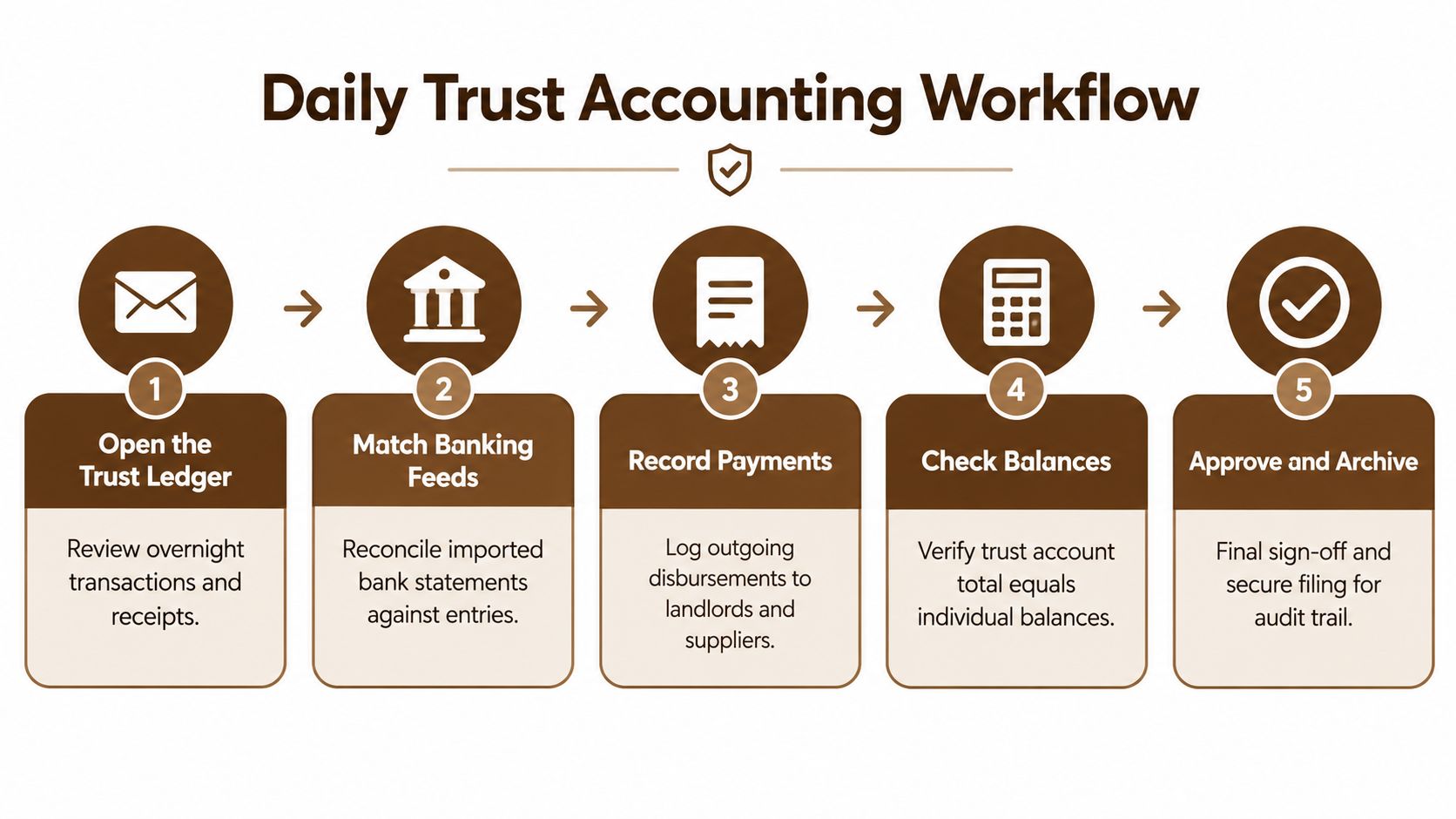
A good trust day starts with the ledger, not with the inbox. The first task is to open the software, check overnight receipts, and compare them against bank imports or deposit advice so every amount lands against the right matter. That sounds basic, but it's where a surprising number of errors enter the system, especially when one deposit covers more than one property or when a payment reference is vague.
From receipt to allocation
The daily process should move in a strict order. First, review receipts and postings. Then match them to the bank feed or statement. After that, allocate each amount to the correct tenant, landlord, vendor, or sales matter. Only once that's clean should payment batches be prepared.
A lot of offices get tempted to reverse the order when the phone is busy. They prepare a batch first, then look for supporting evidence later. That might feel efficient, but it's the fastest way to create a payment with weak backing and a messy audit trail.
What gets missed when the office is rushing
The small things usually create the biggest headaches. Receipt numbers get left off deposit slips. A tenancy schedule isn't attached to the batch. A part-payment is applied to one ledger even though it should've been split across two matters. Those are the kinds of errors that don't look serious in the moment, but they weaken the file the auditor will later rely on.
A workable daily checklist often includes:
- Open the trust ledger early: Review overnight receipts before disbursements start.
- Match each incoming amount: Tie deposits to invoice, remittance, or settlement support.
- Allocate with care: Split payments only when the paperwork justifies it.
- Prepare the batch with evidence: Keep authorisation, receipts, and support together.
- File the day cleanly: Archive the records so the trail is easy to follow later.
The best offices don't rely on memory for any of this. They build a repeatable routine so the same records appear in the same order every day. That's what keeps the trust account usable when the office is busy and the manager who usually handles payments is off sick.
Monthly Reconciliations as the Control Loop
A reconciliation is where the daily transactions become evidence. In Victoria, the trust cash journal, the individual trust-ledger balances, and the authorised financial-institution balance all have to agree, and the reconciliation statement must be completed at month end and verified as true and accurate within 14 days by the principal agent or officer in effective control Victorian trust account reconciliation guidance. That verification step matters just as much as the matching itself.
The three-way check that actually controls the account
The journal says what the office recorded. The ledgers show what each client or matter is owed. The bank statement shows what the institution says is there. If those three views don't line up, the account isn't reconciled, it's merely partially explained.
That's why the reconciliation isn't a clerical task. It's the principal detective control in the system. It catches timing issues, posting mistakes, misallocations, and unauthorised movements before they become entrenched.
How to handle differences without creating noise
When a mismatch appears, the response needs structure. A variance register should note whether the difference comes from timing, unreconciled banking, incorrect ledger allocation, or an unauthorised transaction. Each item should carry evidence of the correction and the sign-off that closed it out.
Consumer Affairs Victoria also treats repeated late reconciliations, unexplained items, and unexplained adjustments as warning signs of poor record keeping that may indicate a trust-money deficiency Victorian trust money accounting guidance. That's the practical reason a month-end file should never just show a final number, it should show the path taken to get there.
A reconciliation that can't explain its own differences hasn't finished the job.
For agencies operating across states, the exact lodgement windows differ, but the control logic doesn't. The reconciliation has to be timely, evidenced, and signed off by the person with real accountability.
Software Integration and Where It Quietly Breaks
An agency can have live bank feeds, tidy mapping, and fewer manual entries, yet still miss a control failure. PropertyMe and PropertyTree can reduce repetitive work when they are configured properly, but they can also hide weak workflow design when the team starts trusting the feed more than the controls. Fast imports are useful. They are not a control.
When mapping breaks down, review real estate trust accounting software configuration guidance before relying on manual journals, then check whether the bank feed, ledger rules, and approval steps still match the way the office operates. Trust reconciliation support for agencies often begins there, at the point where software and process stop agreeing.
Where integration goes off track
The failures are usually predictable. A bank feed duplicates an imported transaction. A landlord changes account details and the payee mapping no longer fits. A software update resets a rule that used to post cleanly. Someone patches the gap with a manual journal, and then the patch becomes routine.
That last step is where offices get into trouble. Manual journals can be valid, but repeated use often means the workflow is broken and the team has learned to work around it. The issue has not been fixed, it has been hidden.
What good configuration looks like
Good configuration keeps the source of truth clear. The bank feed should match the actual trust account. The ledger mapping should point to the correct matter. The payment path should preserve the approval chain instead of folding it into one person's inbox.
Practical rule: automation speeds up a process, it does not replace a control.
That matters most where software gives one user too much power. If one person can create, alter, and release a payment, the system may be efficient, but the control setup is weak. A safer arrangement separates preparation from verification and final approval, so speed still has friction where it counts.
Payment Governance and the Speed versus Safety Trade-off
Payment batches are where a lot of offices feel pressure to move quickly. A landlord is waiting, a supplier wants funds, and someone is asking why the file can't be approved already. The temptation is to treat speed as service quality, but in trust accounting that assumption can backfire quickly.
Why the quickest path isn't always the safest one
The problem is not whether a payment goes out today or tomorrow. The issue is whether the agency can prove the payment was prepared correctly, checked independently, and approved by someone with authority. That means segregation of duties has to sit at the centre of the workflow.
Changed bank details are a classic risk point. So are new payees, duplicate invoices, urgent requests, and staff leave. Each one creates a small opening for error or fraud if the office doesn't slow down at the right step.
Controls that keep payments moving
A practical payment model usually includes:
- Independent verification: The person checking payee details shouldn't be the same person preparing the batch.
- Callback checks: Changed account details should be confirmed through a separate contact method.
- Dual approval where needed: Bigger or unusual disbursements should pass through a second set of eyes.
- Authority limits: Multi-branch teams need clear limits on who can release what.
- Leave coverage: Payment continuity shouldn't depend on one overworked staff member.
The same logic applies to outsourced support. A preparer can work inside client-approved systems, gather the support, and prepare the batch without holding final authority. That gives the agency continuity without handing over the last control step.
Building an Audit-Ready Operating System
An annual audit gives reasonable assurance, not absolute assurance, and that distinction matters. Audit-ready day to day means the evidence is already there when the auditor asks, instead of being recreated under pressure after a letter arrives. The stronger systems keep their records live, indexed, and easy to trace.
Audit checklist support for trust accounts is most useful when it reflects how the office works, not how a checklist wishes it worked.
The pieces that hold the system together
The operating model isn't complicated, but it does need discipline. Reconciled journals and ledger-to-bank agreement come first. Documented approvals and payee verification come next. Exception escalation needs a named owner, not a vague team inbox.
An indexed evidence pack is just as important. It should hold statements, receipts, disbursement support, verification records, and any notes needed to explain an exception. When staff leave or the office grows, the file structure has to survive the handover.
What different agencies can change this quarter
Solo principals need a simpler file structure and a tighter cadence, because there's less room for slippage. Growing agencies need authority limits and clearer batch review steps, because the risk is usually spread across more hands. Multi-branch businesses need consistent procedures across locations, because inconsistency creates its own audit headache.
Consumer Affairs Victoria's timing expectations make that discipline more than a housekeeping preference. The Victorian cycle, audit by an approved auditor within three months after 30 June and lodgement within 10 business days of receiving the report, forces internal deadlines that can't be left to the last week Victorian audit guidance. The offices that handle that well don't scramble at year end, they operate as if the audit is already watching.
Reliance Property Accounts supports Australian agencies with outsourced trust accounting, including daily management, reconciliations, payment preparation, bill entry, and audit-ready clean-up. If your trust file feels harder to control than it should, visit Reliance Property Accounts to see how their team works within your systems and supports the day-to-day discipline this article has covered.