

Audit-ready trust accounts are built in the daily routine, not in the week before an auditor arrives. In Australia, the timing rules already show why. Victoria's audit period runs from 1 July to 30 June, with the audit completed within three months after 30 June. New South Wales requires the audit report to be submitted within three months after the end of the audit period, generally no later than 30 September. In Western Australia, real estate agents are generally audited for the calendar year from 1 January to 31 December, with the audit report due within three months of year-end, by 31 March.
That means every effective trust account audit checklist comes back to three questions: does the balance reconcile, can the agency prove why each transaction happened, and is there a documented response when something doesn't match?
Keep the checklist practical. Verify daily transaction controls first, then trace balances and documentation, then close legislative and lodgement gaps with clear remediation actions. Requirements vary across states and territories, so the final review has to match the agency's jurisdiction, not a generic template. For agencies that need structured reconciliations, payment preparation, compliance checks, or backlog clean-up, Reliance Property Accounts is a relevant outsourced option to consider.
How healthy is your trust account?
Book a complimentary 30-minute Trust Account Health Check and see where your processes could be improved.
Book a Free Health Check →Table of Contents
- 1. Bank Reconciliation Accuracy and Timeliness
- 2. Trust Account Receipting and Ledger Accuracy
- 3. Disbursement Authorisation and Segregation of Duties
- 4. Client Ledger Reconciliation and Clearing of Old Balances
- 5. Month-End Balancing, Trial Balance, and General Ledger Reconciliation
- 6. Compliance with State-Specific Trust Account Legislation and Reporting
- 7. Supporting Documentation Retention and Audit Trail
- 8. Preparation and Timely Lodgement of Trust Account Certificates and Auditor Reports
- 8-Point Trust Account Audit Checklist Comparison
- Turn Findings Into a Controlled Remediation Plan
1. Bank Reconciliation Accuracy and Timeliness
The first control is simple, and it's the one that prevents most later headaches, the trust bank balance has to match the agency's records quickly and consistently. If a payment, deposit, or refund sits unreconciled for too long, the team loses the thread of what happened and the audit trail gets messy.

Make the daily routine non-negotiable
Daily reconciliation works because it catches errors while the people involved still remember the transaction. A sales office that receives many trust movements across several listings can clear items before they become month-end bottlenecks, and a multi-branch business can keep one standard across locations by centralising the process through external support like trust account reconciliation services.
Practical rule: if a reconciling item is old enough that staff have to “go back and check who did that”, the process is already behind.
A useful register should show the date, preparer, reviewer, and every exception. That register matters because an auditor is looking not only for the final balance, but for evidence that someone checked the balance, reviewed the difference, and followed up properly.
Could outsourcing save your agency time and money?
Book a complimentary 30-minute Trust Account Health Check and see where your processes could be improved.
Book a Free Health Check →Reconcile every business day: Daily matching is easier to defend than a weekly catch-up, because the trail stays fresh.
Document both roles: Record who prepared the reconciliation and who reviewed it, so the control isn't just implied.
Chase ageing items promptly: Anything that remains unexplained for more than a few business days needs escalation and a written note of the follow-up.
Use bank feeds where available: Automated feeds reduce manual entry, but they still need human review.
For agencies under pressure, daily routines also make staff handovers cleaner. The next person can see exactly what was left open, which prevents small mismatches from spreading into the rest of the ledger.
Keep Your Trust Accounts Audit Ready
Reliance Property Accounts provides experienced outsourced trust accounting support for Australian real estate agencies, helping keep accounts accurate, organised and compliant.
Explore Trust Account Support →2. Trust Account Receipting and Ledger Accuracy
Accurate receipting is one of the foundations of a well-managed trust account. Every amount received should be clearly allocated so the agency can identify who the money belongs to, what it relates to, and how much is being held on that client or property ledger.
Trust money should be receipted promptly and allocated to the correct tenant, owner, property, sale, supplier or other relevant ledger.
Where the purpose of a payment is not immediately clear, the funds should not be guessed or allocated simply to make the bank reconciliation balance. The payment should remain unidentified or unallocated while the agency confirms where it belongs.
Supporting information should also be easy to locate where required. Depending on the transaction, this may include emails, invoices, settlement instructions, owner directions, tenancy information or other records explaining why the funds were received and how they were allocated.
Useful daily and ongoing checks include:
Receipt funds promptly: Record trust money as soon as practicable after it is identified.
Allocate to the correct ledger: Make sure the receipt is applied to the correct property, owner, tenant, sale or other trust ledger.
Do not guess unidentified deposits: Investigate unknown payments before allocating them.
Review unusual balances: Check unexpected credits, deposits held for long periods, unapplied funds and other balances that do not match what the agency expects to be holding.
Keep supporting records: Retain bank statements, relevant emails, invoices, instructions and other documents that explain the transaction.
A reviewer should be able to take a deposit from the trust bank account and trace it through to the corresponding receipt and ledger allocation.
If a receipt has been allocated incorrectly, it should be corrected using the appropriate trust accounting process, with a clear audit trail showing what was changed and why. Entries should not simply be deleted or overwritten in a way that removes the transaction history.
Strong receipting controls also make day-to-day trust accounting easier. When a property manager, owner, tenant or auditor asks about a payment, the agency should be able to quickly explain where the money came from, how it was allocated and what balance remains.
3. Disbursement Authorisation and Segregation of Duties
Trust payments deserve a tighter check than ordinary office spend. Once money leaves the account, the file has to show who approved it, what it was for, and why the payment was valid at that point in time.

Keep preparation, review, and release separate
The practical control is simple. One staff member prepares the batch, another checks the payee and amount, and the principal or nominated signatory gives the final release. That split matters because it reduces the chance of duplicate payments, wrong account details, or money leaving without proper authority.
Practical rule: if the same person can prepare, approve, and release a trust payment, the agency has a control gap.
Use a payment checklist: Confirm amount, payee, and authority before release.
Keep written approval: Email or signed instruction is stronger than verbal sign-off.
Reconcile the batch to the payout: Check that what was approved is what was paid.
Log each disbursement: Record date, payee, amount, approver, and document reference.
These checks also help under pressure. A busy team can still move payments quickly if the approval trail is clear and the evidence is already attached, but final approval should stay inside the business even when batch preparation is outsourced. That keeps speed without giving up accountability.
4. Client Ledger Reconciliation and Clearing of Old Balances
A client ledger should read cleanly, money in, money out, and a balance that matches the work done. Once a matter is settled or a job is complete, any leftover amount needs a clear explanation. Otherwise the ledger looks unfinished, and auditors will ask why it was never cleared.
Old balances create work on several fronts. They slow client queries, make reporting harder to trust, and can hide missed instructions, unapplied receipts, or a posting error that has not been traced.
Start with the ledger, then move to the cause
Review aged balances on a set cycle, then work the list from oldest to newest. For each item, confirm whether the money is waiting on instruction, held for a refund or further payment, or only sitting there because a posting step was missed. The goal is not to leave the balance in place. The goal is to prove why it exists and what will clear it.
If the matter is finished, close the ledger. If funds are still on hold, record who is holding them and what action is outstanding. If the item belongs elsewhere, correct the posting and keep the supporting note with the file. State-specific trust account rules may set different timing or reporting expectations, so follow the local requirement for your jurisdiction rather than assuming one process fits every office.
Run aged balance reports routinely: Make old items visible before they become a long-running cleanup job.
Trace each balance to source records: Match the ledger entry to the receipt, disbursement, instruction, or settlement file.
Record the reason for any delay: A short note such as “awaiting instruction” is better than an unexplained remainder.
Assign one person to clear the item: Name who will contact the client, correct the posting, or process the refund.
Keep evidence of follow-up: Save emails, notes, and updated ledger entries so the audit trail stays intact.
This work is easiest to manage when it is treated as part of routine control, not as a year-end scramble. Clear old balances early, and the trust account stays easier to read, easier to reconcile, and easier to defend during audit review.
Need Help Clearing Backlogs and Tightening Process?
Reliance Property Accounts supports agencies with trust account optimisation, reconciliations, payment preparation and clean-up work, giving your team a clearer path to audit readiness.
Explore Trust Account Optimisation →5. Month-End Balancing, Trial Balance, and General Ledger Reconciliation
Month-end close should confirm the trust account still holds together after the daily work is done. Start with the bank balance, the control account, and the client ledger total. If they do not agree, stop and trace the difference before the file is signed off.
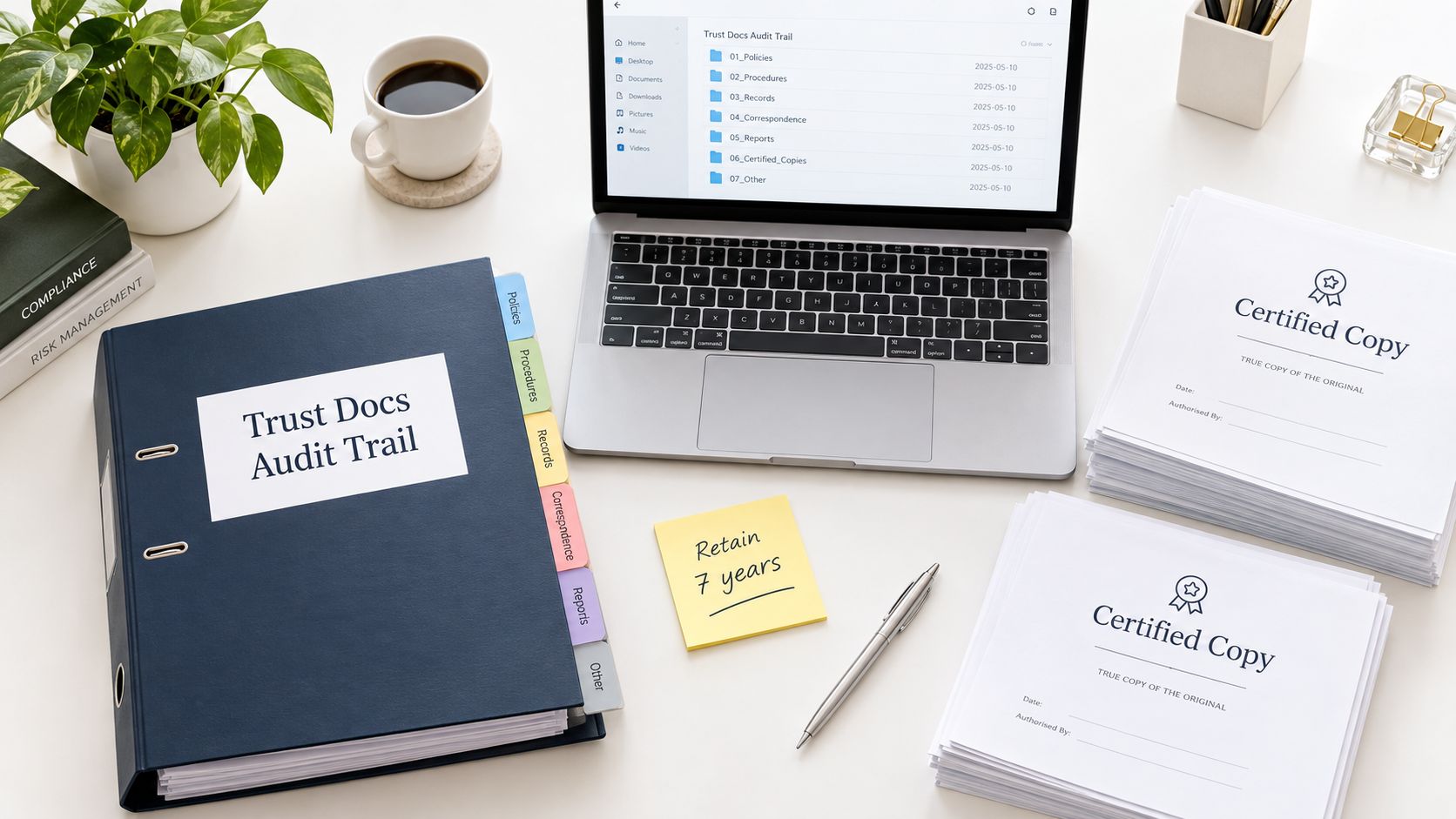
A repeatable close process helps when the month is already busy. A working trial balance, clear support schedules, and a clean general ledger give you a path back to the source if an auditor asks why a figure moved. They also make it easier to spot posting gaps before they turn into a longer cleanup.
Compare the current close with the prior month and focus on movement, not just totals. A sharp change in a ledger, a reconciling item that stays open, or a balance that looks out of place should all have a plain explanation in the file. If the issue is timing, say so. If the posting is wrong, correct it and keep the amended entry with the support.
Month-end processing support can help agencies that are spending too much time on manual close steps or trying to steady a messy process.
Every unexplained variance needs an answer, even if the answer turns out to be a timing difference.
Close within the next business cycle: Fresh entries are easier to trace before paperwork builds up.
Use one close template each time: Consistent layout makes review faster and exposes errors sooner.
Keep support beside the final numbers: Trial balances, reconciliations, and notes should sit together.
Review the prior month for movement: Unexpected shifts need a short explanation.
Name the owner of any deferred item: Show who will clear it, who will follow up, and what action remains.
This stage carries pressure because the month is already moving. The practical fix is a disciplined close, not more guesswork.
6. Compliance with State-Specific Trust Account Legislation and Reporting
Trust accounting in Australia does not run on one national rulebook. The safe starting point is the jurisdiction where the agency holds the trust account, then the legislation and reporting duties that apply there.
A Victorian agency, for example, has to work to that state's audit timeline and local trust account rules. A business that expands into another state cannot copy the old workflow and assume the same filing dates, certificate requirements, or record checks still fit.
Build the checklist around the local rule set
Recent Australian compliance material notes that real estate professionals are expected to come under AUSTRAC regulation from 1 July 2026, adding customer due diligence and suspicious matter reporting to existing trust obligations Australian real estate trust account regulations overview. The same material also notes that trust-account rules are largely state and territory based, so agencies need to confirm local requirements before they standardise anything across branches.
A practical checklist should separate daily controls from jurisdiction-specific reporting. First, confirm the trust account is being run to the local legislation. Then check whether the office has the right audit cycle, filing trigger, and certificate or return requirement. If the agency operates in more than one state, keep the requirements side by side so staff do not mix procedures.
A state-by-state compliance matrix works well because it keeps the rule set visible. It should record the governing legislation, the audit cycle, the reporting obligation, and any recurring lodgement or certificate task that applies to that office.
Document the local legislation: Keep the current rule set in one place and review it regularly.
Track annual changes: Compliance rules change, and a stale checklist is a weak checklist.
Keep regulatory correspondence together: Approvals, notices, and filings should be easy to find.
Match the audit scope to the state: Do not assume one jurisdiction's process applies everywhere.
Use specialist support where needed: A provider familiar with the jurisdiction can help keep procedures aligned.
The strongest agencies do not try to memorise every rule. They keep the rule set visible, assign ownership, and make sure the records match the jurisdiction they are in.
7. Supporting Documentation Retention and Audit Trail
Auditors do not just check the numbers. They trace each trust entry back to the source record, and they expect the person who processed it to be clear from the file or the system history.
That is why this audit area works best as a practical sequence, not a loose archive review. Start with daily transaction evidence, then confirm the supporting paperwork still matches the ledger, then close any gaps in how records are stored and recovered. If paperwork is scattered across inboxes, desktops, and shared folders with vague names, staff lose time proving what should already be easy to show. That is a records issue, and it becomes a control issue as soon as the audit starts.
Build the trail from the transaction backwards
Every trust entry should point to something concrete, such as a contract page, an email date, a settlement statement, or an instruction note. Standard naming and filing rules make that chain visible without forcing the auditor to chase explanations.
This matters even more during system clean-up or migration, including moves through platforms such as PropertyMe or PropertyTree. Older transactions still need a clear path back to support. If they sit in a half-finished archive, the file becomes harder to defend and harder to repair.
A trust record is only as strong as the evidence attached to it.
Use one file naming convention: Keep the order of date, transaction type, client name, and reference consistent.
Keep source documents centralised: The auditor should not have to search several systems to reconstruct one payment.
Use narrative fields properly: Routine entries can stay brief, but non-routine items need a clear explanation in the transaction record.
Review document completeness regularly: Missing files are easier to recover before audit season.
Separate regulatory files: Keep approvals and compliance correspondence together so they are easy to produce.
A tidy audit trail saves time under pressure. It also gives staff a cleaner way to answer questions, because the evidence is already organised and the remediation step, if something is missing, is clear.
8. Preparation and Timely Lodgement of Trust Account Certificates and Auditor Reports
The filing stage should be treated as the final control, not admin after the fact. If the certificate or auditor report is late, incomplete, or does not match the reconciliation file, the agency creates a preventable compliance problem.
Work backwards from the deadline
Start by identifying the statutory lodgement deadline that applies in your state or territory, then set an internal cutoff earlier than that date. That gives time to confirm the closing balances, reconciling items, and supporting schedules the auditor will expect, instead of trying to assemble them under pressure.
A written handoff plan helps here. It should set out the documents to provide, the person who signs off, the review point for the draft, and how lodgement confirmation will be recorded.
Use a simple checklist for the final pack, such as the one in this audit preparation checklist.
Set an internal completion target: Leave room for review and corrections.
Confirm the auditor's evidence list: Ask which balances, reconciliations, and outstanding items need to be shown.
Keep signed copies: Store the certificate and report in the compliance file.
Assign one owner: One person should track lodgement through to confirmation.
File the submission proof: Keep written evidence that the report was lodged.
If this stage feels rushed, the pressure usually started earlier. Daily reconciliations, clean ledgers, and complete support make lodgement a controlled close-out, not a rescue job.
8-Point Trust Account Audit Checklist Comparison
| Item | Process Complexity 🔄 | Resources & Efficiency ⚡ | Expected Outcomes ⭐ | Ideal Use Cases 💡 | Key Advantages 📊 |
|---|---|---|---|---|---|
| Bank Reconciliation Accuracy and Timeliness | 🔄 Daily, high-frequency matching; requires integration and separation of prep/review | ⚡ Time‑intensive if manual; efficient with automated bank feeds and PropertyMe/PropertyTree integration | ⭐ Immediate discrepancy detection; audit-ready reconciliations; maintained trust integrity | 💡 High-volume agencies; multi-branch networks; firms needing daily compliance | 📊 Reduces audit queries; real-time fund visibility; prevents month‑end backlogs |
| Trust Account Receipting and Ledger Accuracy | 🔄 Immediate entry and coding per receipt; moderate complexity for allocation | ⚡ Labor-heavy in peak periods; improved by consistent coding and same-day receipting | ⭐ Accurate client balances with traceable receipt history | 💡 Sales/settlement-heavy agencies; multiple payment sources (EFT, cheque, cash) | 📊 Prevents misallocation; supports auditor verification; improves billing accuracy |
| Disbursement Authorisation and Segregation of Duties | 🔄 High control process; preparer ≠ approver; verification steps required | ⚡ Requires multiple staff roles, can slow processing but essential for control | ⭐ Strong fraud prevention; clear accountability and audit trail | 💡 High‑value payments; agencies needing robust internal controls | 📊 Prevents unauthorized payments; reduces payee/amount errors; audit visibility |
| Client Ledger Reconciliation and Clearing of Old Balances | 🔄 Ongoing reconciliations with aging analysis and investigations | ⚡ Resource‑intensive for aged/legacy balances; needs client contact and documentation | ⭐ Clean client ledgers; reduced unclaimed funds and audit queries | 💡 Agencies with legacy backlogs or many settlements per client | 📊 Identifies misplaced funds; reduces disputes; simplifies audits |
| Month-End Balancing, Trial Balance, and General Ledger Reconciliation | 🔄 Complex consolidation and variance analysis each month | ⚡ Significant monthly time and reviewer attention; delayed by outstanding items | ⭐ Independent verification of control; audit‑ready month-end position | 💡 Agencies requiring formal monthly reporting or multi-branch consolidation | 📊 Catches cumulative errors; supports financial reporting; provides audit evidence |
| Compliance with State-Specific Trust Account Legislation and Reporting | 🔄 Complex, varies by jurisdiction; requires ongoing legislative monitoring | ⚡ Needs specialist knowledge and documented procedures; multi-jurisdiction adds burden | ⭐ Regulatory compliance; reduced legal and licensing risk | 💡 Multi-state agencies; firms expanding interstate or facing regulatory change | 📊 Prevents breaches/penalties; supports licence renewal; tailored compliance |
| Supporting Documentation Retention and Audit Trail | 🔄 Process discipline for filing, linking and retention policies | ⚡ Significant storage and organization effort; digital systems require governance | ⭐ Clear audit trail; faster dispute resolution; substantiated transactions | 💡 Agencies with legacy records, audits, or system migrations | 📊 Provides evidentiary support; simplifies audits; defends against claims |
| Preparation and Timely Lodgement of Trust Account Certificates and Auditor Reports | 🔄 Periodic but deadline-driven process; consolidation and attestations required | ⚡ Coordination with external auditors; strict timelines and documentation needs | ⭐ Statutory compliance; independent attestation of trust account position | 💡 Agencies required to lodge annual certificates; multi-trust consolidations | 📊 Avoids penalties; demonstrates compliance; dated regulator evidence |
Turn Findings Into a Controlled Remediation Plan
A strong trust account audit checklist doesn't end with a list of issues. It ends with a remediation register that turns exceptions into actions the team can track. For each item, record the issue, the affected ledger or transaction, the evidence gap, the responsible person, the priority, the corrective action, and the review date.
Separate urgent fund or authorisation issues from record-keeping improvements. A missing approval, an unexplained balance, or a payment that went out without proper support needs immediate attention, while a file naming problem or a missing attachment can often be fixed in the same cycle but with less urgency. Every correction should be documented, and an authorised reviewer should confirm the resolution before the item is closed.
That approach matters because trust account risk rarely sits in one place. It shows up as a late reconciliation, an uncleared client balance, a payment batch waiting for approval, a missing support document, or a lodgement file that doesn't match the records behind it. Once those items are pulled into one register, the agency can see what's urgent, what's blocked, and what just needs tidy-up work.
Keep the jurisdictional rules in view while you work through the register. State and territory requirements change, and agencies should confirm any rule interpretation with the relevant regulator or a qualified adviser before relying on it operationally. That is especially important where audit timing, reporting, and new compliance obligations intersect with day-to-day processing.
For agencies dealing with daily reconciliation pressure, payment bottlenecks, legacy backlogs, or staff gaps, outsourced trust accounting support can stabilise the workflow and give the internal team cleaner records to review. Reliance Property Accounts provides daily trust account management, reconciliation support, payment preparation, end-of-month processing, and cleanup for agencies that want a more structured path back to audit readiness.
Looking for Reliable Ongoing Support?
Reliance Property Accounts helps agencies stay on top of daily trust accounting, sales trust processing, leave cover and audit preparation with calm, experienced support.
Explore Full Trust Accounting Support →Reliance Property Accounts helps Australian real estate agencies keep trust accounting organised, compliant, and audit-ready through outsourced reconciliations, payment preparation, month-end support, and legacy clean-up. If your team is dealing with audit pressure or a growing backlog, visit Reliance Property Accounts to review support that fits your trust accounting workflow.