
Every trust account needs five core records: consecutively numbered receipts, a cash book, client ledgers, bank reconciliation statements and trust transfer journals. The single biggest audit risk is late posting or reconciliation, so transactions should be recorded within a few business days and reconciled monthly. Most states require records kept for five to seven years, with NSW mandating permanent, unalterable form.
Key Takeaways
Maintaining detailed, accurate, and well-organized trust recordkeeping is essential for audit compliance in Australian real estate and legal trust accounts.
How healthy is your trust account?
Book a complimentary 30-minute Trust Account Health Check and see where your processes could be improved.
Book a Free Health Check →| Point | Details |
|---|---|
| Timely posting and reconciliation | Transactions should be recorded within a few business days, and reconciliations completed monthly with full supporting documentation. |
| Complete and consistent documentation | Trust receipts, ledgers, bank statements, and correspondence must include metadata like reference numbers, dates, and purposes. |
| State-specific rules matter | Different states require precise timelines and retention periods, making it crucial to follow local guidelines for recordkeeping. |
| Perform thorough monthly reconciliations | Reconciliations should show their full process, include adjustments with explanations, and be signed off by control personnel. |
| Reliance Property Accounts’ approach | We build workflows around existing systems, ensuring daily receipting, prompt posting, and comprehensive audit packs for clients. |
Table of Contents
- Which source documents and secondary records to capture for every trust transaction
- Posting timelines and retention requirements across NSW, VIC, QLD and WA
- How to perform and document monthly reconciliations so auditors can follow the trail
- Audit and lodgement essentials: what to provide your auditor and statutory lodgement steps
- Using computerised accounting systems and outsourcing: what compliance looks like in practice
- How agencies put documentation into daily practice: Reliance Property Accounts’ operational approach
- Guidelines for verifying the authenticity and accuracy of trust accounting documents during daily management
- Procedures for correcting errors or discrepancies found in trust accounting documentation
- Examples of compliant trust accounting documentation formats/templates specific to Australian real estate agencies
- Detailed explanation of best practices for organizing and indexing trust accounting documents to facilitate easy retrieval
- Author perspective: the single habit that prevents the majority of trust-account failures
- How Reliance Property Accounts helps keep trust-account documentation audit-ready
- FAQ
- Sources
Which source documents and secondary records to capture for every trust transaction
Every trust transaction starts with a source document, and the quality of that first capture determines whether the whole audit trail holds up later. Trust receipts need consecutive numbering, deposit slips must match banked amounts exactly, and cheque butts, EFT authorities and trust transfer journals all need to be retained alongside the invoices and correspondence that explain why the money moved.
Beyond the transaction itself, agencies and practices need to maintain secondary records that turn individual entries into an auditable system. The Law Society’s 2024 Legal Accounting Handbook sets out the full set expected of legal practices, and the same structure applies closely to real estate trust accounts.
- Trust receipts and payments cash books, updated promptly as transactions occur
- Trust ledger accounts kept per beneficiary or matter, showing a running balance
- Monthly trial balances that total every ledger against the cash book, as part of regular monthly processes, prepared regularly
- Reconciliation statements and a register of reconciling items
- Transaction files and correspondence supporting each entry
Every record also needs consistent metadata: a matter or client reference, a unique receipt or transaction number, the name of the party entitled to the funds, the date and a plain description of the purpose. Missing or inconsistent metadata is one of the most common reasons an otherwise accurate ledger fails an audit test, because the auditor cannot trace the entry back to its authority. Capturing this detail at the point of receipt, rather than reconstructing it later, is what separates a documentation system that survives scrutiny from one that only looks tidy.
Posting timelines and retention requirements across NSW, VIC, QLD and WA
Timing and retention rules differ by state, so checking the local handbook before setting internal deadlines matters more than following a generic rule of thumb.
In NSW, the Legal Accounting Handbook sets a five-working-day posting expectation for particulars, a reconciliation statement and trial balance due within 15 working days after month-end, records must be retained for several years and, in NSW, kept in permanent form.
Victoria requires accounting records to be updated promptly after a trust transaction and retained for several years, with electronic records backed up monthly and a complete copy stored separately, per Consumer Affairs Victoria.
Queensland’s Agents Financial Administration Regulation 2014 requires reconciliations within five business days after each month-end, with records generally retained for several years.
Could outsourcing save your agency time and money?
Book a complimentary 30-minute Trust Account Health Check and see where your processes could be improved.
Book a Free Health Check →Western Australia’s trust account handbook requires monthly reconciliations signed by the person in bona fide control, with records retained for at least six years.
How to perform and document monthly reconciliations so auditors can follow the trail
A reconciliation is only useful as evidence when it shows its working, not just a final balance that happens to match. Auditors expect to see the full comparison and every adjustment behind it.
- Total the trust receipts and payments cash book for the month.
- Total every client ledger account and compare it to the cash book total.
- Compare both totals against the trust bank account’s closing balance per the bank statement.
- List and date every reconciling item, such as outstanding deposits or uncleared cheques, with a source reference.
- Record any journal adjustments with an explanation and the document that supports them.
- Have the person in bona fide control of the account sign and date the completed reconciliation.
Western Australia’s handbook expects this sign-off from the person in bona fide control, and the Law Society’s handbook treats a reconciliation without a documented explanation for every reconciling item as incomplete. A simple verification line works well: “Reconciled [date], cash book total $EX matches bank statement closing balance $EX, reconciling items listed and explained below, signed [name].” Keeping this format consistent every month makes a run of 12 reconciliations easy for an auditor to follow in sequence.
Audit and lodgement essentials: what to provide your auditor and statutory lodgement steps
Auditors work from a defined pack, not a general look through the books, so assembling the right documents in advance saves time and reduces the risk of a qualified report. Typical deliverables include the trial balance, every signed monthly reconciliation for the audit period, a statement of trust money, trust bank statements and the underlying source documents for a sample of transactions.
In NSW, auditors lodge the completed report through the Auditor’s Report Online portal, with many licensees working to an annual deadline late in the third quarter each year. The portal itself is for lodgement only; it does not store or replace the licensee’s own retained records.
Audit readiness comes down to one habit: an exportable audit pack that opens and prints on the first try, according to NSW Government guidance, which notes the portal does not replace a licensee’s own exportable evidence. Auditors also perform selective testing of transactions and are required to report any breaches they find, so the original signed report needs to match what was lodged.
Using computerised accounting systems and outsourcing: what compliance looks like in practice
Software does not reduce what regulators expect to see, it just changes where the evidence lives. A compliant system needs an immutable change log, the ability to print or export records in permanent form, sequential numbering of receipts and payments, and a chronological record of any changes made after the original entry.
Backups matter as much as the live data. Victoria’s guidance expects electronic trust records to be backed up regularly with a complete copy stored separately from the working system, and the same principle holds wherever software is used.
Outsourcing day-to-day processing to a bookkeeper or external provider does not transfer legal accountability away from the licensee or practice. Agencies still need their own retained records, evidence of who approved each payment, and a contract that sets out exactly what the provider will deliver and when.
Pro Tip: Test that your exported trust reports actually open and print correctly well before an audit deadline, not on the day you need them.
How agencies put documentation into daily practice: Reliance Property Accounts’ operational approach
Daily discipline is what turns a compliance checklist into something an agency actually lives by. Our team builds workflows around each agency’s existing systems, capturing the matter reference, entitlement and purpose for every receipt at the moment it comes in, rather than reconstructing that detail weeks later.
In practice that means daily receipting, posting as close to same-day as the agency’s systems allow, and a monthly reconciliation pack that includes signed reconciliations and export files ready for an auditor. An audit-ready pack kept on file should always include the trial balance, every signed reconciliation for the period, bank statements and the source documents behind any sampled transactions.
Guidelines for verifying the authenticity and accuracy of trust accounting documents during daily management
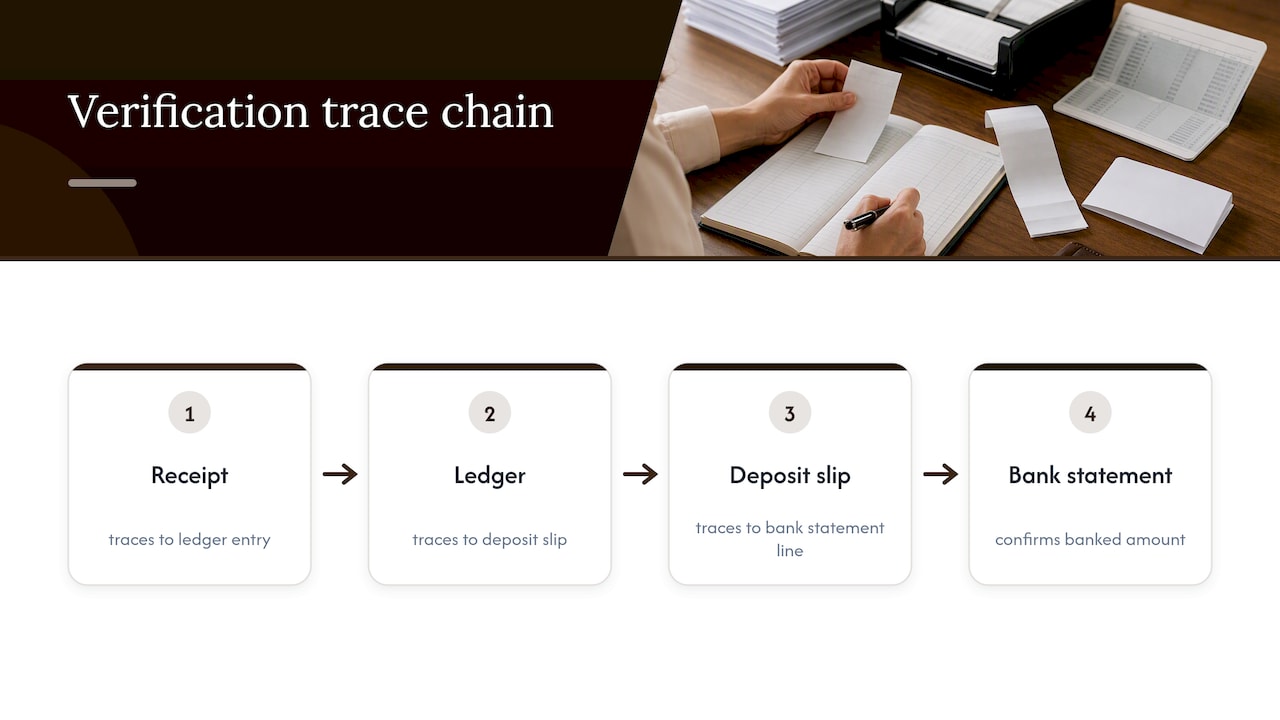
Verification needs to happen as part of daily processing, not as a once-a-month scramble before reconciliation. Every receipt should be checked against the deposit slip and the bank statement to confirm the amount banked matches the amount recorded, and any discrepancy should be flagged the same day rather than carried forward.
Cross-referencing is the core technique. A receipt number should trace to a ledger entry, the ledger entry should trace to a deposit slip, and the deposit slip should trace to a line on the bank statement. Where any one of those links is missing, the transaction is not yet verified, regardless of how confident the figures look.
For payments, the authority behind each disbursement needs checking before funds leave the account: a signed instruction, a settlement statement or an invoice that matches the amount and payee recorded. Supplier and owner bank details should be verified independently of the invoice itself, since invoice details can be altered or spoofed.
Running totals also act as a verification tool on their own. A client ledger balance that drops below what the matter file shows it should hold is a signal to investigate before the monthly reconciliation, not after. Building this check into daily processing, rather than leaving it to month-end, is what keeps small errors from compounding into a reconciling item nobody can explain by the time the auditor asks.
Procedures for correcting errors or discrepancies found in trust accounting documentation
An error in a trust account should never be corrected by simply overwriting the original entry. Every correction needs its own dated journal entry that references the original transaction, explains the mistake and shows the adjustment clearly, so the ledger keeps a full history rather than a silent edit.
The first step is identifying exactly where the discrepancy occurred: a misposting between client ledgers, a timing difference such as an uncleared cheque, or a genuine data entry mistake. Each of these has a different fix, and treating a timing difference as if it were an error can create a second problem where none existed.
Once the cause is confirmed, the correcting journal should be entered with a reference back to the original receipt or payment number, a brief explanation of what went wrong, and the name of the person making the correction. This reference trail is exactly what the Law Society’s handbook expects to see supporting any adjustment in a trust ledger.
Where the error has caused a client ledger to be short, funds need to be corrected from the agency’s own account, not covered by delaying other clients’ disbursements. Any correction affecting a reconciliation already signed off should be noted in the following month’s reconciliation with a clear explanation of what changed and why, so the sequence of monthly reconciliations stays internally consistent and explainable from one period to the next.
Examples of compliant trust accounting documentation formats/templates specific to Australian real estate agencies
A compliant trust receipt template records a sequential receipt number, the date, the payer’s name, the amount, the property or matter it relates to, the purpose of the payment and the name of the person issuing the receipt. Leaving any of these fields blank is one of the most common findings auditors raise against real estate trust accounts.
A trust ledger template for each property or matter should show the opening balance, every receipt and payment with its reference number, a running balance after each entry and the ledger holder’s name. This format makes it straightforward to reconcile each ledger against the cash book total, which is the core of the monthly reconciliation process described earlier.
The monthly reconciliation template itself typically sets out the cash book total, the sum of all client ledger balances, the bank statement closing balance, a list of reconciling items with explanations, and a signature line for the person in bona fide control of the account. Keeping this exact structure every month, rather than varying the layout, is what allows an auditor to move through 12 months of reconciliations quickly and with confidence.
For disbursement authorities, a simple template recording the property address, the amount, the payee, the bank details, the approving person’s signature and the date gives both the agency and an auditor a clear record of who approved each payment out of the trust account.

Detailed explanation of best practices for organizing and indexing trust accounting documents to facilitate easy retrieval
Documents that are accurate but hard to find create almost as much audit risk as documents that are missing altogether. Organising trust records around the matter or property reference, rather than by document type alone, means an auditor or internal reviewer can pull every receipt, ledger entry and correspondence item for a single transaction in one search.
A consistent folder or file structure, whether physical or digital, should mirror the information architecture of the ledger itself: one folder per matter or property, with clearly labelled subfolders for receipts, payments, correspondence and reconciliation evidence. Naming conventions matter here. A file named with the date, the matter reference and a short description retrieves far faster than one named only with a receipt number.
Indexing by date within each matter folder, alongside a master register that lists every open and closed matter with its reference number, gives a second way into the records when someone needs to find something quickly but doesn’t remember the exact file name. For digital systems, this register can be a simple spreadsheet or a report generated directly from the accounting software, provided it is kept current.
Retrieval speed matters most under audit pressure, when an auditor asks for a specific transaction from several months earlier and expects a prompt answer rather than a lengthy search. Agencies that review their filing structure periodically, rather than only when a problem arises, tend to find the structure holds up well under that kind of pressure.
Author perspective: the single habit that prevents the majority of trust-account failures
The habit that matters more than any other is capturing detail right at the source: the reference, the entitlement, the purpose, written down the moment money moves. Most failures I see trace back to a gap at that first step, not a flaw in the reconciliation. Build evidence forward, not backward.
— Kasie
How Reliance Property Accounts helps keep trust-account documentation audit-ready
Keeping trust documentation audit-ready day to day is easier with a team whose entire focus is that one job. At Reliance Property Accounts, we manage daily reconciliations, receipting, bill entry and owner disbursements for Australian real estate agencies, building exportable audit packs as part of the regular workflow rather than assembling them under deadline pressure.

We adapt to each agency’s existing systems rather than imposing a fixed process, so agency staff keep approval control and visibility over every transaction while the detailed recordkeeping runs in the background. Our work covers daily reconciliations, receipting with full source-document capture, owner and supplier payment processing with recorded approvals, monthly reconciliation packs with sign-offs, and trust account clean-up and process review where records need tidying.
If your agency’s trust documentation needs a second set of eyes or a steadier daily process, visit our outsourced trust accounting page to see how we work, or get in touch for a compliance review.
This article is general information, not a substitute for advice from a qualified financial advisor. Consult a qualified financial professional about your own circumstances before acting on anything here.
FAQ
What information must a trust account statement contain?
A trust account statement needs the date, amount and purpose of each transaction, the running balance, and the name of the client or matter it relates to. For legal practices, the Law Society’s handbook sets out the specific format and the posting timelines that apply in NSW.
What are the new rules for trusts in Australia?
Trust account rules are set and updated at state level rather than nationally, so the current requirements depend on where the agency or practice operates. Checking the relevant state handbook, such as Consumer Affairs Victoria’s guidance or the WA trust account handbook, is the reliable way to confirm current obligations.
How to do bookkeeping for a trust?
Trust bookkeeping centres on recording every receipt and payment in a cash book, posting each transaction to the correct client ledger, and reconciling the cash book, ledgers and bank statement against each other every month. Outsourced providers handle this daily processing and monthly reconciliation for real estate agencies that prefer a dedicated specialist to manage it.
What are the regulations regarding trust accounts?
Trust account regulations vary by state and profession, covering how quickly transactions must be posted, how often reconciliations are required and how long records must be kept. Queensland’s Agents Financial Administration Regulation 2014 and the NSW Legal Accounting Handbook are two examples of the primary rules that apply to real estate and legal trust accounts respectively.
Sources
- 2024 Legal Accounting Handbook – Trust money and trust records (Law Society)
- Accounting for trust money – estate agents (Consumer Affairs Victoria)
- Agents Financial Administration Regulation 2014 (Queensland legislation)
- Trust account handbook – For real estate agents and real estate business agents (WA Consumer Protection)
- Guide to the Auditor’s Report Online portal (NSW Government)