

By Monday morning, the trust account has already started moving. A settlement receipt arrived late on Friday, two EFTPOS deposits are waiting to be verified, the property ledger needs checking before disbursements can proceed, and a sales agent is asking at reception when a deposit can be released. The agency still has inspections, maintenance calls, listings and settlement appointments to manage, but the money held for clients can't be treated as another item in the general inbox.
That pressure is why trust account management is a daily operating discipline, not a month-end chore. Australian agencies need routines that show who received money, where it was allocated, who approved its movement and what evidence supports each decision. The practical test of audit-readiness is whether the business can prove those answers while staff are busy, absent or changing roles.
Table of Contents
- A Monday Morning in the Trust Account
- What Trust Account Management Actually Involves
- The Daily and Weekly Reconciliation Routine
- Segregation of Duties in Real Estate Trust Accounting
- Common Pitfalls and Quiet Assumptions
- In-House, Hybrid, or Outsourced Trust Account Management
- Building a Trust Account Workflow That Survives Audits
- Frequently Asked Questions About Trust Account Management
How healthy is your trust account?
Book a complimentary 30-minute Trust Account Health Check and see where your processes could be improved.
Book a Free Health Check →A Monday Morning in the Trust Account
The trust account administrator starts with the bank feed rather than the email inbox. The late Friday settlement receipt has to be matched to the right sale, the payer and the supporting contract documents. The two EFTPOS deposits may have landed as one bank amount or under a description that doesn't immediately identify the property, so the administrator checks the merchant report before allocating anything.
At the same time, the sales agent wants a held deposit released. That request might be valid, but a verbal instruction at the front desk isn't enough. The administrator needs the relevant authority, confirmation that the transaction has reached the required stage and an approval from the person authorised to release the funds.
Practical rule: A payment request isn't ready because someone is asking loudly. It's ready when the authority, ledger allocation and approval evidence agree.
The administrator then checks the trust ledger before preparing disbursements. A balance can appear correct at bank level while the property-level allocation is wrong. If a receipt was posted to the wrong property, the agency may be holding the right total but attributing the money to the wrong client or transaction. That distinction matters because trust money must remain identifiable, not merely present somewhere in the account.
Western Australian guidance makes the regulated nature of this work clear. Agents and settlement agents who hold or receive money for others must maintain trust accounts, those accounts must be audited, and trust money must be deposited as soon as practicable. The guide links those obligations to section 70 of the Real Estate and Business Agents Act 1978 and section 51 of the Settlement Agents Act 1981, and says the auditor must be registered under Part 9.2 of the Corporations Act 2001 (Western Australian trust account auditing guide).
The rest of the week should not depend on one person remembering what happened on Monday. A workable operation has four visible habits:
- Daily reconciliation: Receipts, allocations, transfers and exceptions are reviewed while the supporting documents are still easy to find.
- Separated responsibilities: Preparation, checking and approval don't sit with one unchecked user.
- Exception handling: Unmatched deposits, uncleared payments and unusual adjustments are recorded instead of being buried.
- Continuity planning: Another trained person can operate the workflow when the trust officer is on leave or leaves the business.
Annual audits test the records, but daily routines create them. Agencies that wait for the audit notice usually discover that the problem isn't one dramatic error. It's a trail of small assumptions, undocumented approvals and unresolved items that nobody owns.
Could outsourcing save your agency time and money?
Book a complimentary 30-minute Trust Account Health Check and see where your processes could be improved.
Book a Free Health Check →What Trust Account Management Actually Involves
A real estate trust account is a separate bank account for money the agency holds on behalf of others. Depending on the agency's work, that can include sales deposits, pre-settlement funds, rental receipts and other client money. The bank account is only one part of the system. Each amount also needs a property, tenancy, sale or client ledger that explains who the money belongs to and why it moved.
The operating account pays the agency's own expenses. The trust account doesn't fund wages, supplier bills or temporary cash-flow gaps. Keeping those purposes separate protects the client money and makes the records intelligible to the reviewer who needs to trace a transaction from receipt to final disbursement.
The continuous work
Daily trust account management includes more than entering transactions into software:
- Receipt the money. Record the date, source, amount and relevant transaction reference, then retain the bank or payment evidence.
- Allocate it correctly. Post the amount to the right property or sales ledger. A pooled bank account still requires accurate individual records.
- Check authority before disbursing. Match payments and transfers to invoices, statements, settlement directions, owner instructions or other approved documents.
- Record adjustments clearly. Don't overwrite an unexplained difference. Note what changed, who approved it and what source document supports the entry.
- Review the resulting balance. The ledger should show enough detail to explain both the total trust balance and each individual holding.
The software can automate matching, recurring entries and reports, but it can't decide whether a receipt belongs to the right sale or whether an authority is valid. Modern trust platforms shift the administrator's role from repetitive data entry towards verification, exception handling and evidence management. That can make the process faster, but only when staff understand what the system has matched automatically and what still needs human review.
What changes at month-end
Month-end reconciliation is a control point, not a substitute for daily discipline. The administrator compares the bank balance with the trust ledger, investigates outstanding items and prepares the statements or reports required by the agency's process. The audit file may also need bank statements, deposit records, payment evidence, approval records, ledgers and explanations for discrepancies.
The timing is jurisdiction-specific. Australian trust accounting generally works around recurring annual audits and fixed reporting windows. Queensland requires annual audits, appointment of an auditor within one month of opening a trust account and lodgement of the audit report within four months after the audit period. NSW audits are annual, with the audit period ending on 30 June and the report due within three months, no later than 30 September. Tasmania requires trust account records to be audited within three months after the audit year ends (Queensland trust account guidance).
Those requirements mean the month-end pack should be assembled as the work happens. Retrospective reconstruction is slower, less reliable and harder to defend.
The Daily and Weekly Reconciliation Routine
A useful routine starts before payments are prepared. The administrator first reviews new bank activity, payment platform reports and the previous day's exceptions. That opening check establishes what arrived, what remains unmatched and whether any item needs escalation before the agency promises a transfer.
The daily rhythm
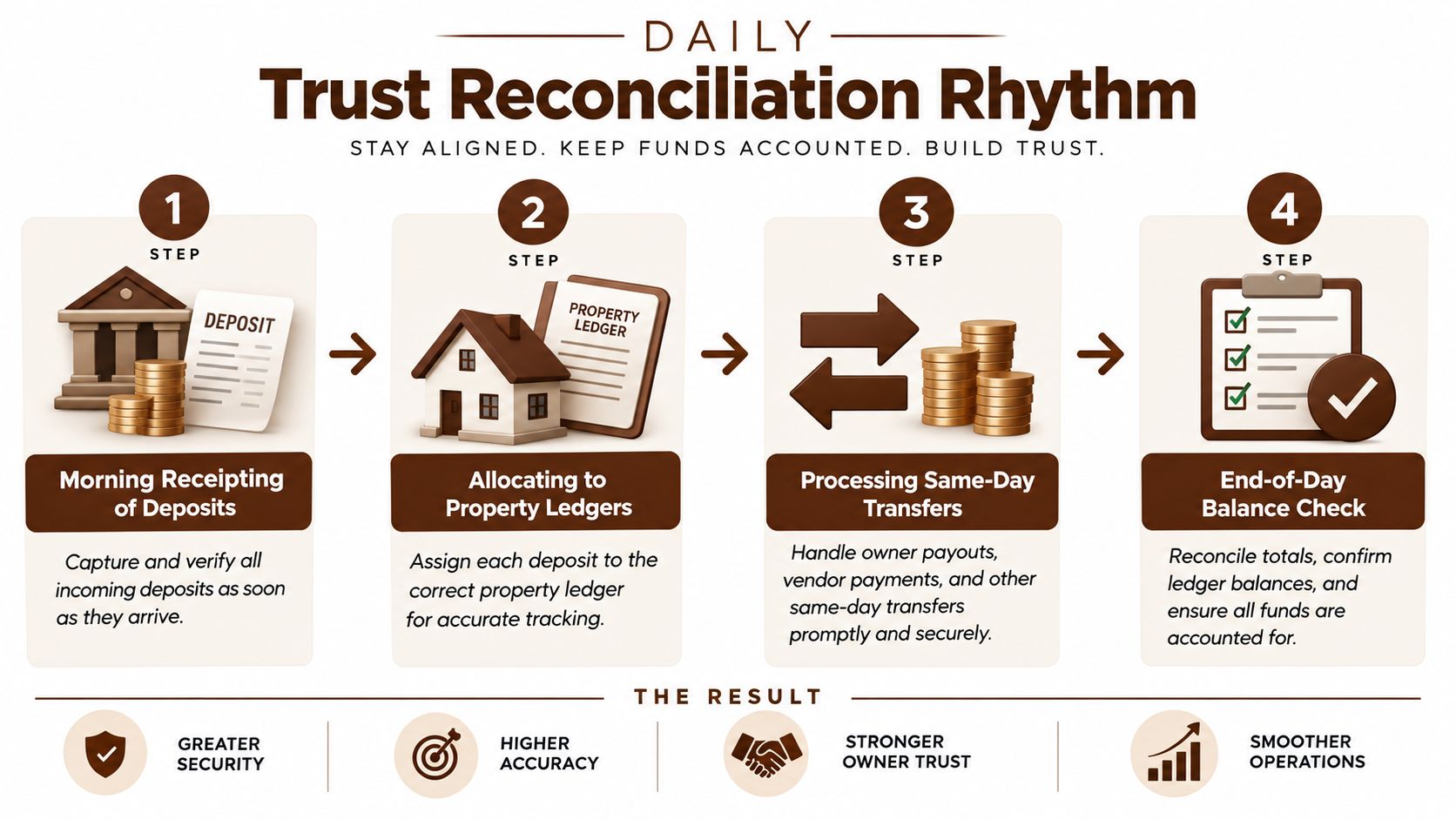
Morning receipting comes first. Record deposits and rental payments against the source evidence, then save the relevant receipt, remittance or settlement document in the transaction file. If the bank description doesn't identify the payer or property, leave the item in an exception queue rather than guessing.
Ledger allocation follows. Confirm that the property, tenancy, sale and payer details agree with the supporting document. A daily receipting summary should show the amounts received, how they were allocated and any items awaiting clarification.
Same-day transfers and disbursements should be prepared only after authority is visible. Payment batches need payee details, amount, purpose and supporting documentation. Preparation isn't approval. The person checking the batch should be able to challenge a missing invoice, unusual bank detail or inconsistent ledger entry.
End-of-day balance checking catches problems while the day's activity is still familiar. Compare the bank activity with the system entries, confirm that the total ledger position makes sense and list every unresolved item in an exception report. The report is useful evidence because it shows that the agency identified a problem, assigned it and followed it through.
A daily cash sheet, receipt register and exception report don't need to be elaborate. They need to be dated, retained and clear enough for another person to understand what happened without relying on memory.
The weekly review
The weekly review is broader than the daily check. Run the trust bank reconciliation, examine uncleared deposits and payments, investigate unmatched amounts and scan for allocations that look unusual. A second person should review the reconciliation worksheet and sign or electronically record their approval.
The trust account reconciliation process should produce a repeatable evidence trail. That trail normally includes the bank statement or transaction export, reconciliation worksheet, trust ledger balance, list of outstanding items and reviewer sign-off. Where a difference remains open, record the explanation and next action rather than forcing the figures to balance.
The right staffing level depends on transaction complexity and the quality of the software feed. A small daily receipting run may take a short focused session, while a weekly review can require a longer uninterrupted block when there are sales settlements, multiple payment platforms or legacy exceptions. Owners should observe the actual workload across ordinary and busy periods, then roster enough capacity for review instead of allocating the work to whatever time is left.

Segregation of Duties in Real Estate Trust Accounting
Segregation of duties means one person shouldn't be able to prepare, verify and approve a trust transaction without oversight. In a property agency, the control doesn't require a large finance department. It requires clear role boundaries and a documented fallback when the usual person isn't available.
Three roles with different responsibilities
The preparer records receipts, allocates funds, enters bills and builds the payment batch. For example, a trust clerk can collate owner statements, enter supplier bills and prepare a transfer list, but shouldn't release the batch independently.
The reviewer checks the bank activity against the ledger, tests the supporting documents and investigates exceptions. A senior accountant or office manager might review the reconciliation and confirm that the batch agrees with approved instructions.
The approver authorises the disbursement or release. In many agencies, that responsibility sits with the principal, licensee or another person with documented authority. A director signing off a held deposit after settlement is performing a different control from the administrator who entered the receipt.
The same person may perform more than one role in a very small office, but the exception should be recognised and compensated for. The principal can review the bank reconciliation personally, require a second approval for EFT batches or arrange an external review. The dangerous arrangement is not merely a small team. It's an undocumented process where nobody knows who is meant to challenge the work.
Where control breaks quietly
Owner-operators often approve their own entries because they know the transaction. Single-admin offices can let one person handle receipting, reconciliation and payments for years without a meaningful independent check. Temporary staff may cover leave with access to systems but little understanding of state-specific procedures. Another common weakness is allowing the same user to create and authorise an EFT batch because the bank portal makes it convenient.
A written segregation matrix should name the task, preparer, reviewer, approver and backup. It should also define what happens when the usual approver is absent. That turns segregation from an intention into an operating instruction.
Separation isn't about distrusting the trust officer. It protects the agency when a transaction is misunderstood, a bank detail changes or a key person becomes unavailable.
The need is procedural as well as financial. Australian guidance emphasises separate trust money, regular reconciliation and independent audit, while state portals and reporting windows create deadlines that leave little room for an unowned backlog (Property Agents Board information for auditors).
Common Pitfalls and Quiet Assumptions
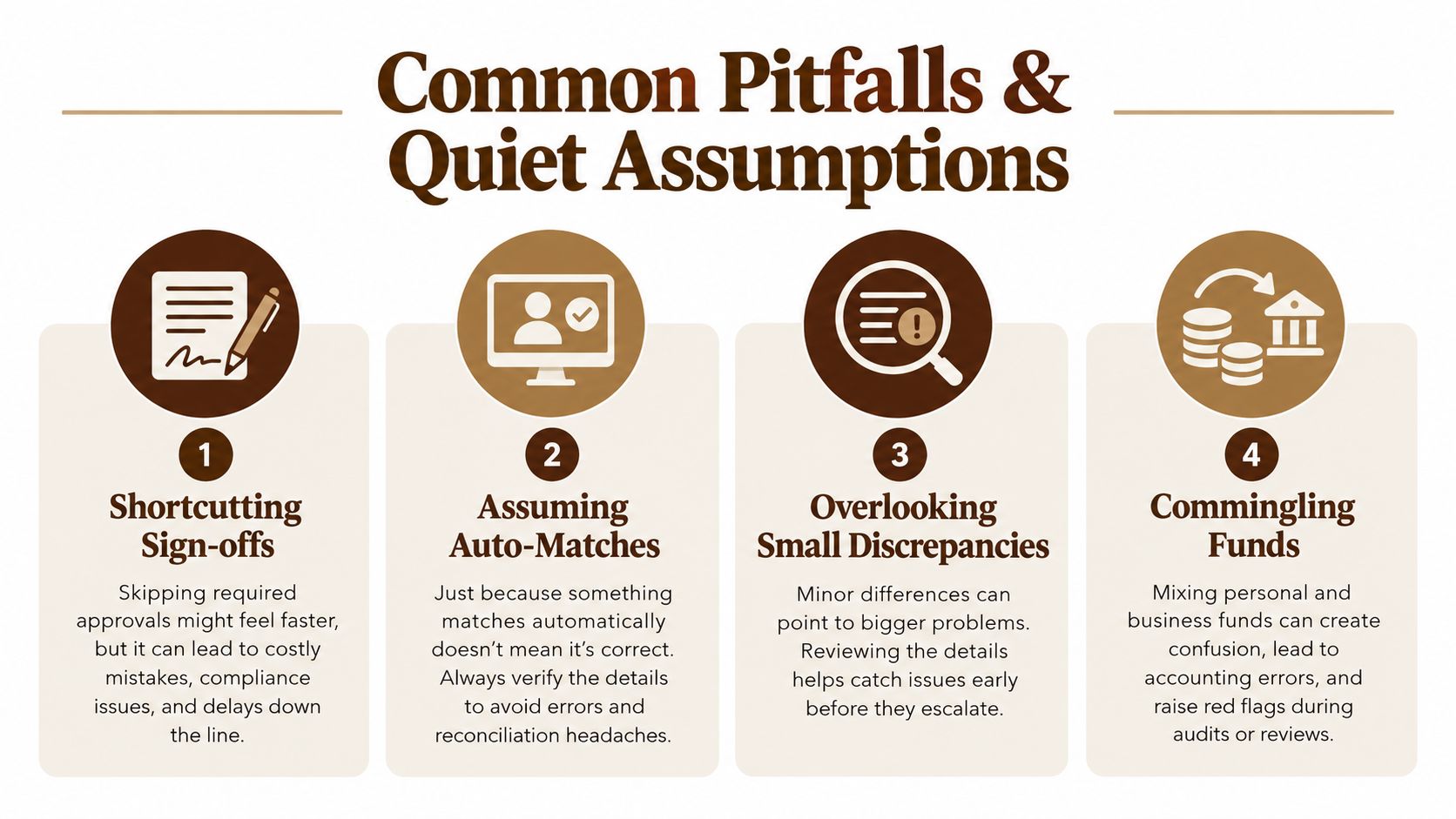
Most problems begin with a reasonable shortcut. Staff trust the software match, postpone an unexplained item until month-end or approve a payment because the request came from someone they know. The trouble starts when that shortcut becomes the normal control.
The system isn't the control
Trust accounting software can restrict permissions, create audit trails and match bank transactions. It can't validate a document that was never uploaded, recognise that a receipt was allocated to the wrong property or question an approval entered by an unauthorised user. A green status in the system means the configured rule passed. It doesn't prove the underlying decision was correct.
Use software to enforce the process, then require people to review exceptions. Configure user permissions, use consistent property and payer naming, and make the supporting document mandatory before a payment can enter the approval queue.
Monthly isn't enough for operational visibility
An agency may satisfy its scheduled reconciliation routine and still lack day-to-day control. If staff leave deposits, transfers or unmatched receipts untouched until the next formal review, the evidence becomes harder to assemble and the person who created the entry may no longer remember it.
The replacement is simple: run a short daily balance and exception check, then reserve the formal reconciliation for the weekly or monthly control point required by the agency's procedure and jurisdiction. The shorter cycle doesn't remove the formal review. It makes that review less dependent on detective work.
A temporary float is still the wrong money
Using trust funds to cover an operating shortfall, supplier payment or personal expense is not made safe by intending to replace the amount later. Client money has a defined purpose and must remain separate from operating funds. The practical control is to block informal transfers, require documented authority for every movement and escalate a funding problem through the operating account.
Other recurring weaknesses include single signatory arrangements, relief staff working without training and reconciliations approved by the person who prepared them. Replace each with a named backup, access limited to the required task and a reviewer who has enough independence to question the result.

In-House, Hybrid, or Outsourced Trust Account Management
The right operating model depends on volume, headcount, systems and the principal's tolerance for dependency on one person. Cost matters, but it shouldn't be the only test. An inexpensive arrangement that collapses during leave or produces incomplete audit records is expensive in management time and risk.
| Criterion | In-House | Hybrid | Fully Outsourced |
|---|---|---|---|
| Daily control | Internal staff perform receipting, reconciliation and payment preparation | Internal team retains ownership while a specialist handles defined processing | Specialist manages the agreed daily workflow |
| Approval authority | Usually remains with the principal or designated internal approver | Remains internal, with external preparation or review | Should remain with the authorised agency approver unless the scope expressly provides otherwise |
| Continuity | Depends on trained backups and documented procedures | Shared continuity between agency and provider | Provider supplies operational cover, subject to clear access and communication rules |
| Audit defensibility | Strong when records and reviews are maintained consistently | Can improve when the specialist maintains organised evidence | Depends on the provider's records, reporting and state-specific process |
| Principal time | Highest internal management load | Reduced, but internal oversight remains active | Lowest day-to-day processing load, with oversight still required |
| Where it breaks down | One-person dependency or untrained relief staff | Unclear hand-offs between the agency and provider | Outsourcing without retained approval, visibility or a clear scope |
When each model makes sense
In-house suits an agency with enough recurring work to support dedicated trust capability. It gives the principal close access to the process and can work well when training, backup coverage and review independence are real rather than assumed. It breaks down when the trust officer is also the only person who understands the system.
Hybrid works when the agency wants to keep client relationships, approvals and policy decisions internally but needs help with daily reconciliation, payment preparation, backlog clean-up or audit packs. The hand-off must be precise. Both sides should know who owns the ledger, who resolves exceptions and who signs the final approval.
Fully outsourced can suit a small or growing agency that doesn't want to build an internal trust function. It still needs an engaged principal, controlled system access, regular status reporting and a documented approval matrix. Outsourcing transfers processing work, not the agency's responsibility to maintain appropriate oversight.
Agencies considering the third model can review whether to outsource real estate trust accounting against their actual transaction pattern, backup capacity and audit requirements. The warning signs for a change are consistent: reconciliations are late, the owner is the only reviewer, staff turnover repeatedly creates backlogs, or nobody can take over the workflow without a long handover.
Building a Trust Account Workflow That Survives Audits
A Monday audit request should not trigger a search through inboxes, shared drives and someone's memory. Audit-readiness comes from treating routine processing as evidence production, with clear owners, deadlines and completion records.
Four habits to lock in
- Reconcile close to the transaction. Compare bank activity with the ledger promptly. Investigate exceptions while invoices, approvals and correspondence are still available, rather than allowing unexplained items to become normal.
- Document segregation of duties. Name the preparer, reviewer, approver and backup for receipts, reconciliations, payment batches and held-deposit releases. The matrix should show who can act when the usual officer is absent.
- Retain the complete file. Store bank records, ledgers, receipts, approvals, payment evidence, reconciliation worksheets and explanations for exceptions for the period required by relevant legislation and regulators.
- Test continuity. Before leave or turnover, have the backup person complete the workflow under supervision. Give that person only the system access and permissions required for the role.
A reviewer needs to trace cash movement from the bank statement to the ledger and then to the supporting document. Organise daily cash sheets, the trust ledger trial balance, source-document folders and approval registers so the file explains itself without a verbal reconstruction.
State requirements still vary. Victoria requires lodgement within 10 business days after receiving the signed audit report. NSW requires submission through the Auditor's Report Online portal within three months of the audit period ending on 30 June. Western Australia specifies an independent audit by a registered company auditor unless otherwise approved, as set out in the Victorian trust account auditing requirements.
Build the workflow into the agency's practice management system. A one-page procedure should show the daily opening check, receipting, allocation, approval, payment release, end-of-day review, weekly reconciliation, exception escalation, leave cover and record storage. Pair it with an audit preparation checklist so staff assemble evidence consistently instead of collecting attachments under deadline pressure.
Frequently Asked Questions About Trust Account Management
Who can approve a trust transaction?
The principal, licensee or another person with documented authority should approve each transaction under the agency's procedure and state requirements. The person preparing a payment should not approve it without an independent review or a documented compensating control. Keep approval evidence with the transaction record.
How often should reconciliations happen?
Daily bank and ledger checks catch errors while the supporting information is still fresh. A weekly reconciliation provides the formal control point, with exceptions assigned and resolved rather than carried forward. The annual audit then tests the records produced by those routines. As covered earlier, Queensland, NSW and Tasmania impose recurring audit obligations with different appointment and lodgement timing. Refer to the Queensland property trust account requirements for the state's requirements.
What happens when the trust officer takes unexpected leave?
A backup person needs documented procedures, suitable system access and a clear escalation path before leave occurs. Test that arrangement during normal operations. If receipting, payments, reconciliations and evidence collection stop when one employee is absent, the agency has a continuity gap.
Does staff turnover affect record retention?
Yes. Departing staff often hold process knowledge that is missing from the ledger and document folders. Transfer the workflow, approval register and open exceptions before access is removed. Store the underlying records in the agency's controlled system.
Can a small agency outsource the function?
Yes, provided the agency retains approval responsibility and receives visibility over transactions, reconciliations and exceptions. The arrangement should match the principal's ability to review work and include secure access, state-specific procedures and leave cover.
Reliance Property Accounts provides outsourced trust accounting support for Australian real estate agencies, including reconciliations, payment preparation, end-of-month processing, sales trust support and audit-ready records. Visit Reliance Property Accounts to discuss a workflow that keeps preparation organised while approval authority remains clear.
Refined using Outrank