

Keeping trust money compliant means separating client funds from business funds, posting every transaction by the end of the next business day, reconciling the trust account monthly with principal verification, backing up records off-site, and submitting to an annual audit. The principal or officer in effective control carries ultimate responsibility for these trust accounting procedures, and most regulators expect records to be kept for around seven years.
Key Takeaways
Effective trust account compliance relies on meticulous record-keeping, timely reconciliation, and maintaining audit-ready records, all overseen by the principal.
How healthy is your trust account?
Book a complimentary 30-minute Trust Account Health Check and see where your processes could be improved.
Book a Free Health Check →| Point | Details |
|---|---|
| Daily transaction recording | Record every trust transaction by the end of the next business day with complete details for accountability. |
| Reconciliation schedule | Perform monthly reconciliations of all trust records and have the principal verify the results within the set timeframe. |
| Record storage and backups | Keep all records for around seven years and maintain off-site monthly backups to ensure data safety and audit readiness. |
| Responding to issues | Identify, investigate, and notify regulators immediately of any trust shortfalls or discrepancies to prevent further breaches. |
| Outsourced trust accounting | Reliance Property Accounts offers ongoing trust compliance services that keep records organized, audit-ready, and integrated with existing systems. |
Table of Contents
- 1. Trust accounting checklist for daily compliance
- 2. Recording transactions daily: mandatory fields and timing
- 3. Receipts and deposits: form requirements and banking rules
- 4. Payments from trust: cheque butts, EFT reports and payment records
- 5. Ledgers and journals: separate accounts and posting rules
- 6. Monthly reconciliations and principal verification
- 7. Audits and external examiners: timing and readiness
- 8. Record storage and backups: retention and system requirements
- 9. Responding to deficiencies and shortfalls
- 10. How outsourced trust accounting puts these procedures into practice
- Prioritising oversight and verification for licensees
- How Reliance Property Accounts can help with trust compliance
- FAQ
- Sources
1. Trust accounting checklist for daily compliance
A reliable trust accounting checklist gives staff a fixed order of operations rather than a vague sense of “staying on top of things.” The sequence below reflects what regulators expect to see when they review a file or conduct an audit.
- Record every receipt and payment on the day it happens, or by the end of the next business day at the latest.
- Issue a receipt or deposit form with full transaction particulars before banking any trust money.
- Post cash journal entries to the correct client or matter ledger without delay.
- Reconcile the trust account monthly and have the principal verify the reconciliation.
- Retain all records, including backups, for the statutory retention period.
- Report any deficiency or suspected shortfall immediately, rather than waiting for the next audit.
Each step feeds the next: a late entry delays reconciliation, and a skipped reconciliation delays audit sign-off.
2. Recording transactions daily: mandatory fields and timing
Every trust transaction needs to hit the books by the end of the next business day following the deposit, withdrawal or transfer, a timeframe set out by Consumer Affairs Victoria. Each entry in the cash receipts or cash payments journal needs enough detail to stand alone if questioned later.
- Date of the transaction and the date it was recorded.
- A unique reference or receipt number.
- Payer or payee name.
- Client or matter reference.
- Purpose of the transaction and the amount.
- Form of payment (cheque, EFT, cash).
Pro Tip: Enter transactions chronologically as they occur rather than batching them at the end of the week; batching is where missed entries and transposition errors creep in.
3. Receipts and deposits: form requirements and banking rules
A trust receipt needs a clear heading identifying it as a trust account document, plus the particulars listed above, so it can be matched to the ledger entry and the bank deposit without guesswork. Deposit forms carry the same information, and both documents should be numbered sequentially with no gaps.
- Use a dedicated, sequentially numbered receipt book or system for trust money.
- Record the date, amount, payer, purpose and client/matter reference on every receipt.
- Bank trust money promptly and keep the deposit slip or bank confirmation on file.
- Match every receipt to its corresponding bank deposit as part of the monthly check.
Keeping deposit evidence alongside the receipt closes the loop auditors look for first.
4. Payments from trust: cheque butts, EFT reports and payment records
Payments out of trust need the same level of detail as money coming in. Consumer Affairs Victoria specifies that cheque butts and EFT transaction reports must carry the date, reference, payee, client or matter reference, purpose and amount, and that these records form part of the trust account file.
Could outsourcing save your agency time and money?
Book a complimentary 30-minute Trust Account Health Check and see where your processes could be improved.
Book a Free Health Check →- Retain cheque butts with full particulars, not just the amount and payee.
- Obtain an EFT transaction report from the financial institution for every electronic payment.
- Enter each payment in the cash payments journal before posting it to the ledger.
- Post to the correct client ledger within the timeframe your jurisdiction sets, typically within a few business days.
A payment that cannot be traced from bank statement to journal to ledger is the first thing an auditor flags.
5. Ledgers and journals: separate accounts and posting rules
Each client or matter needs its own ledger account showing a continuous running balance, never pooled with another client’s funds. Queensland’s trust account legislation sets out posting timeframes and record-keeping detail that most jurisdictions mirror in substance.
- Maintain a separate ledger account for every client or matter, with its own running balance.
- Post cash book entries to the ledger within two business days of the transaction.
- Record journal transfers between ledgers with the date, amount, reason and authorising officer.
- Never delete or overwrite a ledger entry; corrections are made by a reversing entry, not a deletion.
Posting promptly keeps the ledger balance a true reflection of what the client is actually owed at any point in time.
6. Monthly reconciliations and principal verification
Reconciliation is where daily record-keeping either proves itself sound or reveals a problem. Each month, the cash journal totals, the ledger totals and the bank or ADI balance need to agree exactly.
- Total the cash receipts and payments journals for the month.
- Total all client ledger balances and confirm they match the journal totals.
- Obtain the bank statement balance and reconcile it against both totals.
- Prepare a written reconciliation statement identifying any discrepancy.
- Have the principal or officer in effective control verify and sign the reconciliation within the statutory deadline.
Monthly reconciliation timelines range from 5 business days in Queensland to 14 days in other jurisdictions for principal verification, a window that leaves little room for delay once the month closes. Treat the reconciliation as a diagnostic tool rather than a formality: running it even in a quiet month catches a data-entry slip before it compounds into something reportable.
7. Audits and external examiners: timing and readiness
Trust accounts are subject to an annual audit, and the records need to be, in the regulator’s own words, “properly and conveniently auditable” according to Consumer Affairs Victoria’s audit guidance. An approved auditor must meet independence criteria, meaning they cannot have a financial or personal interest in the agency they are auditing.
- Confirm the auditor is independent and meets the regulator’s approved auditor criteria.
- Lodge the annual audit report within the timeframe your regulator sets.
- Index records by client, month and transaction type so an auditor can trace any item quickly.
- Keep all records in a printable format, not locked inside a format only one staff member can read.
Audit-ready records are simply well-organised records; the structure that makes a reconciliation fast also makes an audit fast.
8. Record storage and backups: retention and system requirements
Most regulators expect trust records to be kept for around seven years, with monthly backups stored at a location separate from the live system. Queensland’s trust accounts guide requires computerised systems to log every change chronologically and prevent improper deletion of ledger entries.
- Retain all trust records, including receipts, journals and reconciliations, for the required statutory period.
- Back up records monthly and store a complete copy off-site or in a separate secure environment.
- Confirm the accounting system logs changes and can produce a full printout within five business days.
Pro Tip: Test your backup restoration process once a year; a backup nobody has ever restored is a theory, not a safeguard.
9. Responding to deficiencies and shortfalls
A suspected shortfall needs containment before it needs explanation. The sequence matters because evidence degrades quickly once staff start “fixing” entries without a record of what changed.
- Isolate the affected ledger and freeze related transactions pending review.
- Investigate the discrepancy and preserve all original records, including bank confirmations.
- Notify the regulator, agency director and auditor within the statutory period, often a matter of a few business days.
- Document every remediation step taken, in case an external examination follows.
Acting within the notification window, rather than waiting for certainty about the cause, is what separates a managed incident from a compounded breach.
10. How outsourced trust accounting puts these procedures into practice
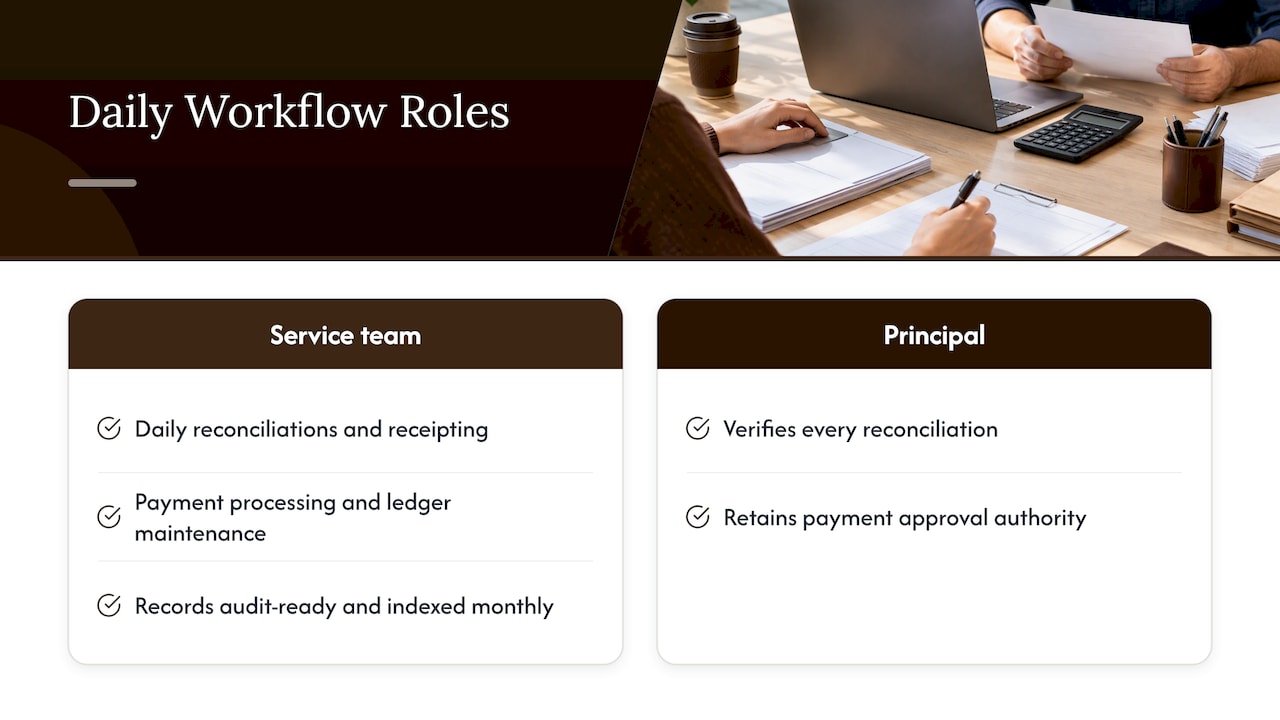
Our daily reconciliations, receipting, payment processing and ledger maintenance can be adapted around each agency’s existing systems rather than imposing a new workflow on staff who already have one that works. Handling the daily mechanics does not change who signs off: the principal still verifies every reconciliation and retains approval authority over payments, while we keep the underlying records audit-ready and indexed month to month.
Prioritising oversight and verification for licensees
Oversight of a trust account cannot be outsourced, no matter how much of the daily entry work is. A principal’s real job is routine verification: open the reconciliation, check it against the bank statement, and sign only once the numbers agree. Set a fixed day each month for sign-off, and escalate any unexplained variance the same week it appears, not at audit time.
— Kasie
How Reliance Property Accounts can help with trust compliance
We manage the procedures covered above as an ongoing service for agencies that would rather hand over the daily mechanics without handing over control: daily reconciliations, receipting, bill entry, payment processing and audit preparation, all built around the systems an agency already uses. 
Every approval stays with the agency; we fit into existing sign-off chains rather than replacing them. If trust accounting procedures have been eating into time that should go toward managing properties, our outsourced trust accounting service is a direct route to records that stay organised and audit-ready without adding to anyone’s workload.
FAQ
What are the accounting standards for trusts?
Trust accounting is governed by state-based legislation and regulator guidance rather than a single national accounting standard, with rules covering record-keeping, reconciliation timing and audit requirements. In Queensland, for example, the trust accounts legislation sets out specific obligations for computerised systems and ledger posting.
How do trust accounts operate?
A trust account holds client money separately from business funds, with every receipt and payment recorded in a journal and posted to an individual client ledger. Transactions must be entered by the end of the next business day, and the account is reconciled monthly against bank records, as outlined by Consumer Affairs Victoria.
What are some examples of trust accounting?
Common examples include receipting a tenant’s bond into a dedicated ledger, recording a property settlement payment with full payer and matter details, and processing an owner disbursement through an EFT with a matching transaction report. Each example requires the same core particulars: date, reference, parties, purpose and amount.
What accounting software is best for trust accounting?
The right software depends on the agency’s existing systems, but any platform used for trust money needs to meet statutory requirements: a chronological audit trail, protection against deleting ledger entries, and the ability to produce a full printout within five business days, as required under Queensland’s legislation. We work within whichever system an agency already has rather than requiring a change of software.