

A trust account is a legally controlled bank account where a real estate agency holds money, such as rent or deposits, on behalf of clients, not money the agency owns. It comes with strict duties around recording, reconciling and paying out those funds.
Your bank feed might show rent arriving while a supplier is chasing payment and an owner is waiting for their distribution. The important question isn't whether there's enough money in the bank. It's whether you can explain who each amount belongs to, what you're authorised to do with it and which records support the transaction.
Table of Contents
- What Is a Trust Account
- Why Real Estate Agencies Need Trust Accounts
- What Money Goes Into a Real Estate Trust Account
- How a Real Estate Trust Account Works Day to Day
- Trust Account Compliance Requirements Across Australia
- Common Trust Accounting Mistakes and Warning Signs
- Outsourcing Trust Accounting and Next Steps
How healthy is your trust account?
Book a complimentary 30-minute Trust Account Health Check and see where your processes could be improved.
Book a Free Health Check →What Is a Trust Account
A real estate trust account is a dedicated, legally controlled bank account used to hold money received on behalf of someone else. Think of it as a holding account with an accompanying recordkeeping system, rather than another agency bank account.
Western Australia's trust account handbook explains that agents receiving money for another party in connection with a real estate transaction must maintain trust accounts and formal records showing the account's position.

Rent received isn't agency revenue
When a tenant pays rent, the agency receives that payment on behalf of the owner. The agency may subsequently deduct authorised management fees, pay approved property expenses and distribute the remaining funds.
Receiving the payment doesn't make the entire amount available for the agency's use. Each deduction needs an appropriate basis, and the records must explain what happened to the balance.
Practical rule: Before handling a payment, establish whose money it is and what authority permits its next movement.
Could outsourcing save your agency time and money?
Book a complimentary 30-minute Trust Account Health Check and see where your processes could be improved.
Book a Free Health Check →
This is why ordinary business banking habits aren't enough. A bank statement shows money entering and leaving an account, but it doesn't, by itself, explain the amount attributable to each client or property.
Why Real Estate Agencies Need Trust Accounts
The purpose is protection through separation and accountability. An agency needs to distinguish money it manages for clients from money available to run its own business.
That distinction matters when an owner asks about an expense, a purchaser queries a deposit or an auditor requests supporting records. The agency should be able to connect the original receipt with the relevant ledger, authority and eventual payment.
A separate account is only the starting point
The Victorian trust account reference guide describes records that show the true position of trust money and permit a proper audit. In practical terms, this means the agency needs more than a bank balance that looks reasonable.
Useful controls let the principal answer:
-
Ownership: Which client or transaction does this money relate to?
-
Authority: Why was the payment or deduction permitted?
-
Evidence: Can someone other than the person who processed it follow the records?
-
Accountability: Who prepared, checked and approved the transaction?
A pooled bank balance can look correct while individual client allocations are wrong. For example, a receipt allocated to the wrong property may leave the overall total unchanged but give the property management team misleading information.
A balanced account is important. An explainable account is the stronger operating standard.
Trust accounting for real estate agents therefore involves both financial accuracy and a defensible workflow. Software can help organise the records, but staff still need clear instructions about identification, checking, approval and follow-up.
What Money Goes Into a Real Estate Trust Account
Start with the purpose of the payment, not the description someone typed into the bank reference. Money received for a client needs to be classified before anyone decides how to handle it.
Consumer Affairs Victoria's accounting guidance identifies client money such as rent, sales deposits and advance funds for property-related purposes.
Common categories to identify
-
Tenant rent: Money received for the relevant tenancy and owner.
-
Sales deposits: Funds associated with a property sale, held subject to the applicable requirements.
-
Owner contributions: Amounts provided for approved maintenance or other property expenses.
-
Advance client funds: Advertising money, maintenance funds and other amounts held for a specified client purpose.
For an owner contribution, record why the owner supplied the money and which property it relates to. A vague description such as “extra funds” makes later checking harder, particularly if another staff member takes over the portfolio.
Treat bonds as a separate handling question
Don't assume a rental bond follows the same process as ordinary rent. Check the relevant state or territory requirements, including the applicable lodgement process, and maintain a clear follow-up record.
A documented rental bond handling procedure helps staff distinguish money awaiting action from money already dealt with. The same discipline applies to unusual receipts: identify the beneficiary and purpose before choosing the accounting treatment.
The useful habit is simple: classify first, then receipt and allocate according to the applicable rules. Don't let an unclear bank reference become an unsupported assumption.
How a Real Estate Trust Account Works Day to Day
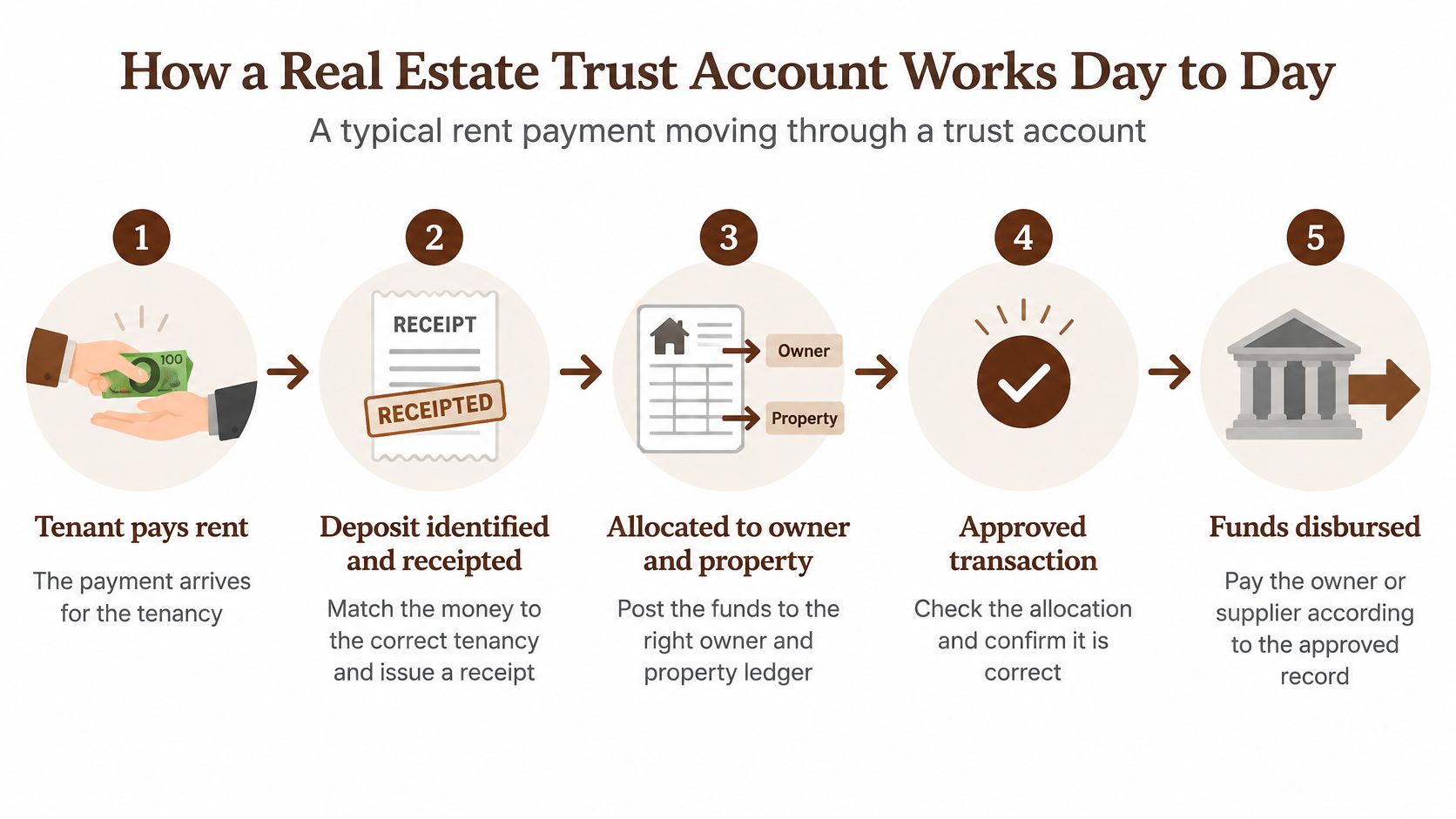
A typical rental transaction starts when the tenant's payment appears in the trust bank account. Staff match it to the correct tenancy, confirm the relevant details and receipt it accurately.
The accounting records then associate that receipt with the correct owner and property. Before preparing any outgoing payment, staff check the available funds, supporting documents and authority.
When the deposit can't be identified
An unidentified deposit interrupts that routine. Don't assign it to a tenant just because the amount resembles their rent.
The practical investigation is to:
-
Check the reference: Compare the bank information with tenancy and payment records.
-
Seek confirmation: Ask the relevant team for supporting payment information.
-
Escalate uncertainty: Request a bank trace where necessary.
-
Document the outcome: Retain the evidence supporting the final identification and allocation.
Unresolved money needs an assigned person and a follow-up action, not merely a note that someone will investigate later.
Routine trust account reconciliation supports this work by comparing banking activity with accounting records and highlighting exceptions. It's an active daily process, not just a tidy-up before owner disbursements.
Trust Account Compliance Requirements Across Australia
Daily monitoring and formal monthly reconciliation serve different purposes. Daily bank matching helps staff identify missing receipts, unexpected payments and allocation problems promptly.
A formal month-end trust account reconciliation tests the accounting records against the bank position at the reporting date. In Victoria, this involves agreement between the trust cash journal, individual trust-ledger balances and financial-institution balance, with verification by the principal agent or officer in effective control.
Build a jurisdiction-specific calendar
Record the relevant deadlines, responsible person and evidence required for completion.
Include receipt requirements, payment authorities, reconciliation review, audit arrangements and document retention. A daily reconciliation routine doesn't replace formal monthly obligations, and an annual audit doesn't replace ongoing supervision.
Common Trust Accounting Mistakes and Warning Signs
Established agencies can have weak procedures even when staff are experienced and annual audits have been completed. A completed audit shouldn't be treated as confirmation that every current workflow is sound.
Consumer Affairs Victoria's auditor guidance identifies repeatedly late reconciliations, unexplained adjustments and unresolved items as indicators of poor recordkeeping and possible trust-money deficiency.
Look beyond the final balance
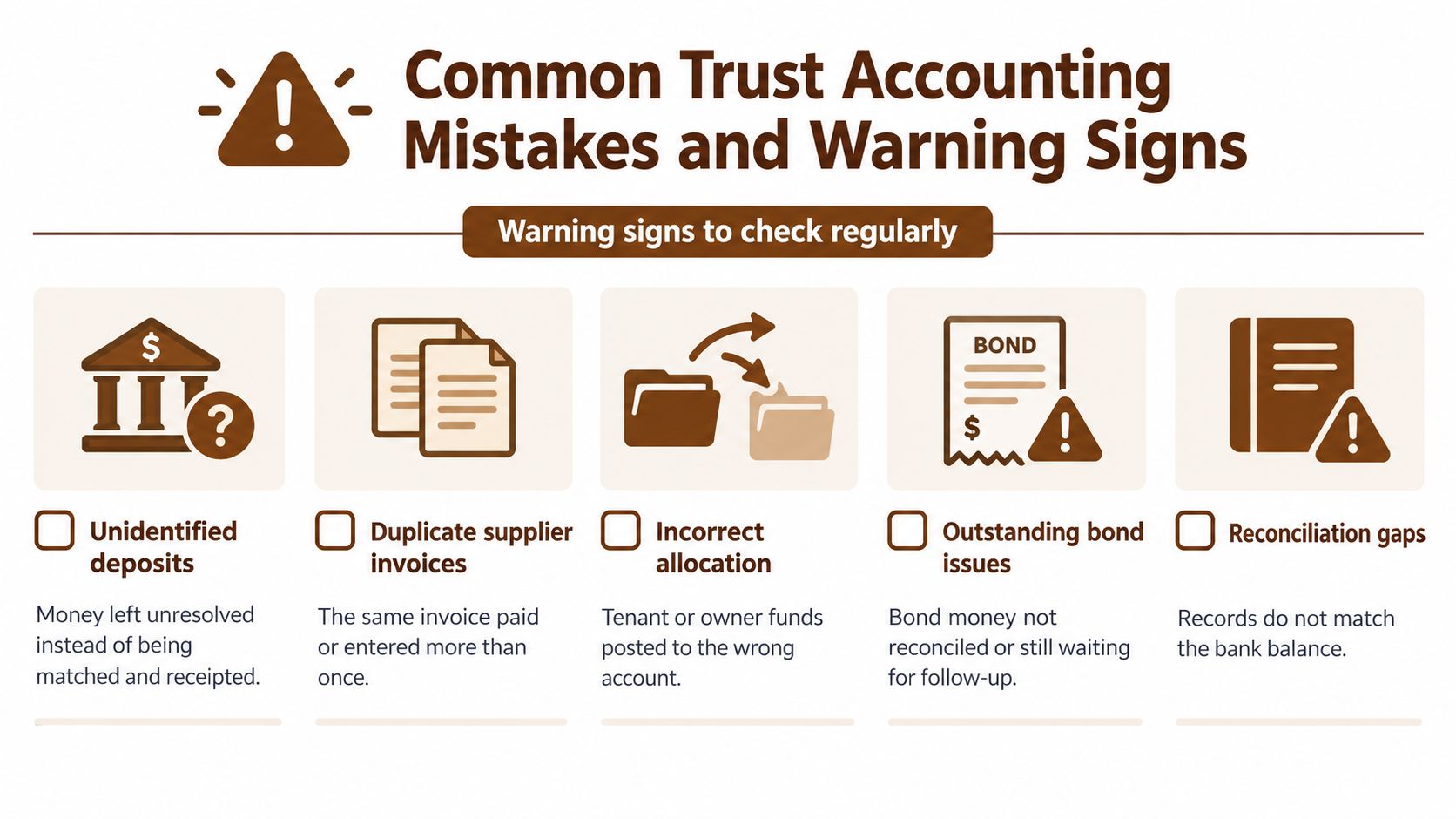
Common warning signs include:
-
Unidentified deposits: Money remains unresolved without documented investigation.
-
Duplicate supplier invoices: Staff enter or pay an invoice again because duplicate checks are inconsistent.
-
Incorrect allocations: Tenant or owner funds are assigned to the wrong ledger.
-
Outstanding bond lodgements: Required action remains incomplete or lacks confirmation.
-
Weak payment approvals: The approver can't readily see the invoice, authority or verified payee details.
-
Missing documents: Staff record transactions without enough evidence to explain them later.
These are process failures to investigate, not automatic evidence of dishonesty. The right response is to establish what happened, correct the records where necessary and change the procedure that allowed the issue.
Don't clear an exception merely to make a report look tidy. Resolve its cause and retain the explanation.
Daily follow-up works best when each exception has an owner, supporting notes and a clear next action. A principal should be able to distinguish a genuine timing difference from an unexplained item that staff have repeatedly carried forward.
Outsourcing Trust Accounting and Next Steps
Outsourced trust accounting changes who performs the agreed work, not the agency's need for legal responsibility and oversight. An internal trust accountant, external specialist or combined arrangement can work, provided responsibilities and approval boundaries are clear.
Onboarding should begin with a review of software, bank accounts, reconciliations, ledgers and outstanding issues. It should also establish banking permissions, authority limits, payment verification and communication arrangements before routine processing begins.
What ongoing support involves
The agreed scope may include receipting, bill entry, payment preparation, owner disbursements, daily reconciliation, month-end reporting and audit preparation. Work can take place within client-approved systems such as PropertyMe, PropertyTree and the agency's banking portals.
The trade-off is that external support still needs timely information from the property management team. Unclear instructions and delayed approvals remain problems unless the agency and provider agree how to handle them.
These questions to consider before outsourcing real estate trust accounting can help define a workable scope.
Frequently asked questions
Is a real estate trust account different from a normal business bank account?
Yes. It holds client money and requires the supporting controls described above.
Can an agency use trust money to pay business expenses?
No. Client funds aren't working capital for agency expenses.
How often should trust accounts be reconciled?
Use daily checking as an operating control and meet your jurisdiction's formal reconciliation requirements.
Who is responsible for compliance?
The agency and its responsible licence holder must retain the required oversight, including when tasks are outsourced.
Do all Australian states have the same rules?
No. Check the requirements applying to your agency's jurisdiction.
Can an agency outsource its trust accounting?
Yes. Define the scope, access permissions, reporting and approval responsibilities clearly.
Trust accounting is about protecting client funds through accurate records and reliable procedures, not just balancing numbers.
Reliance Property Accounts provides outsourced trust accounting support for Australian real estate agencies, including daily operations, reconciliations and payment preparation. If you're unsure whether your procedures are working as they should, visit Reliance Property Accounts to arrange a complimentary 30-minute Trust Account Health Check to discuss your current processes and identify areas worth reviewing.
