
In Australia, a rental bond is your money, held in trust by a state authority, never by the landlord directly. Confirm it has actually been lodged with the relevant authority, and keep the entry condition report with dated photos. Those two steps protect you whether you are claiming a full refund or defending against an unfair deduction.
Key Takeaways
Lodging and managing rental bonds through official state authorities ensures legal protection, clarity, and smooth dispute resolution for tenants and landlords in Australia.
How healthy is your trust account?
Book a complimentary 30-minute Trust Account Health Check and see where your processes could be improved.
Book a Free Health Check →| Point | Details |
|---|---|
| Always lodge bonds officially | Ensure bonds are lodged with the relevant state authority within legislative timeframes to avoid legal complications. |
| Keep detailed records | Save lodgement receipts, take timestamped photos, and document all communications to support your position if disputes arise. |
| Use the entry condition report | A thorough, signed, and photo-supported entry report helps prevent unjust claims about property condition at move-out. |
| Follow proper refund procedures | Initiate refund requests promptly, use fast-track options when possible, and gather itemized evidence for any disputes. |
| Reliance Property Accounts supports agencies | We help agencies keep their trust accounts reconciled daily, supporting legislative compliance and reducing disputes. |
Table of Contents
- What a rental bond is and the legal basics in Australia
- How to lodge a bond: step-by-step for tenants, landlords and agents
- How to get your bond back: refund request process and timelines
- What landlords can reasonably claim from a bond and how tenants should prepare evidence
- If the bond is disputed: notice of claim, dispute resolution and tribunal steps
- State differences and the main online portals you’ll actually use
- Practical checklist: 10 steps tenants and landlords should follow to avoid bond disputes
- How bonds are handled when a lease transfers or tenants change
- Penalties for landlords and agents who mishandle bonds
- What tenants should do if a bond hasn’t been lodged on time
- Why accurate trust account processes reduce disputes
- Where Reliance Property Accounts fits for agencies
- FAQ
- Sources
What a rental bond is and the legal basics in Australia
A rental bond is a security amount a tenant pays at the start of a lease, held by a state tenancy authority rather than sitting in the landlord’s own account. In Victoria that’s the RTBA, in New South Wales it’s Rental Bonds Online, and in Queensland it’s the Residential Tenancies Authority. South Australia runs its bond scheme through Consumer and Business Services. The bond sits untouched until the tenancy ends, and even then it can only cover actual financial loss.
That’s the core rule worth remembering: a bond is a security a government authority holds in trust, and it can be used only for genuine loss such as unpaid rent, damage beyond fair wear and tear, or cleaning needed to return the property to its entry condition. It cannot be used to leave the property better than it started, a principle usually called “no betterment.”
A few quick examples make this concrete:
- A landlord can claim for a carpet stain caused by a spilt drink, but not for the carpet’s general age-related wear.
- A landlord can claim for unpaid rent owing at the end of the tenancy, not for rent they wish they’d charged.
- A tenant cannot claim a retrospective refund for repairs made during the tenancy without the landlord’s agreement.
- A cleaning fee is valid only if the property was cleaner at move-in than at move-out.
The entry condition report is the single most useful document either party has. Without it, claims about pre-existing damage or cleanliness become a case of one word against another, which is exactly the scenario dispute resolution bodies are built to avoid.
How to lodge a bond: step-by-step for tenants, landlords and agents
Lodgement isn’t optional, and it isn’t something either party can skip in favour of a private arrangement. Agents and landlords who take a bond must pass it on to the relevant state authority within the legislative timeframe for their jurisdiction, and in Victoria, licensed agents must lodge bonds electronically through the RTBA rather than by paper form.
- Collect the bond payment from the tenant and issue a receipt immediately.
- Register for the relevant state’s electronic lodgement system if you haven’t already (agents in Victoria must use RTBA Web Services; similar registration applies in other states).
- Enter tenant details, property address and bond amount accurately, since a typo in an email address or name can delay the whole process.
- Submit the lodgement and wait for the acknowledgement or receipt number.
- Check the receipt matches the amount paid, the correct property address and the tenant’s correct contact details.
- Give the tenant a copy of the lodgement confirmation for their own records.
Pro Tip: Save the lodgement receipt and bond number somewhere you can find it years later: it’s the single reference number everyone, from the authority to the tribunal, will ask for if a dispute arises.
The most common pitfalls are mundane but costly: an unregistered email bouncing an important notice, a payment that bounces because of incorrect account details, or an agent who never finished registering for the state’s Web Services portal. Landlords managing their own properties should check the registration requirements for their state before the first tenant moves in, not after.
Could outsourcing save your agency time and money?
Book a complimentary 30-minute Trust Account Health Check and see where your processes could be improved.
Book a Free Health Check →How to get your bond back: refund request process and timelines
Getting a bond back starts with a refund request, usually submitted online once both tenant and landlord agree on the amount. Where there’s no disagreement, most state systems offer a fast-track option that skips the formal paperwork entirely.
- One party, usually the tenant or the agent, initiates the refund request through the relevant state portal.
- Both parties confirm the amount: if they agree, the fast-track process releases funds quickly without need for a formal claim.
- If there’s disagreement, the authority issues a formal Notice of claim, giving both sides 14 days to respond.
- Undisputed amounts can be released immediately, while disputed amounts are held pending resolution.
- Once approved, funds are typically paid by bank transfer, which can take several business days depending on the authority and the banks involved.
A few practical notes worth keeping in mind:
- Fast-track or an agreed refund avoids the Notice of claim process altogether, which is the quickest path to your money.
- If you don’t receive funds within the expected window, check your lodgement receipt first for the correct account details.
- Contact the relevant state authority directly if a payment seems delayed beyond their stated processing times, rather than assuming it’s lost.
What landlords can reasonably claim from a bond and how tenants should prepare evidence
The law draws a reasonably clear line between what’s claimable and what isn’t, even if the day-to-day arguments can get heated. Landlords can claim for unpaid rent, damage that goes beyond fair wear and tear, and cleaning required to return the property to its original entry-report condition. They cannot claim for routine maintenance, items that were already worn when the tenant moved in, or “betterment”, meaning replacing something old with something new at the tenant’s expense.
- Permitted: unpaid rent at the end of the tenancy, a carpet burn from a cigarette, a broken window caused by the tenant.
- Permitted: cleaning costs if the property was left visibly dirtier than the entry report recorded.
- Not permitted: general carpet fading from sunlight, a worn hinge from years of normal use, or a full repaint when a simple patch would do.
- Not permitted: claiming the full replacement cost of an item that was already near the end of its useful life.
Tenants should keep a straightforward evidence file: the signed entry condition report, time-stamped photos from move-in and move-out, receipts for any cleaning or repairs they paid for themselves, and meter readings taken on the day they left. Pro Tip: Photograph every room, including cupboards and under sinks, on the day you collect keys, before you’ve unpacked a single box.
Landlords calculating a claim should weigh the item’s age and remaining useful life rather than its replacement cost. A five-year-old carpet damaged beyond repair doesn’t justify billing for brand new carpet throughout the property, since that would hand the landlord a better asset than they had before the tenancy began.
If the bond is disputed: notice of claim, dispute resolution and tribunal steps
When tenant and landlord can’t agree on a refund split, the process moves into formal territory. The authority issues a Notice of claim, and the other party has 14 days to respond, either accepting the claim or disputing it. If no response arrives within that window, outcomes vary by state, so check the specific authority’s rules before assuming a default result.
- Lodge a dispute resolution request through the state authority if informal negotiation stalls.
- Gather your evidence pack: the entry condition report, photos, invoices, quotes and any written communication about the issue.
- Expect the authority or a conciliator to review both sides’ evidence before suggesting or ordering a resolution.
- If conciliation fails, either party can escalate to the relevant tribunal (such as VCAT in Victoria or QCAT in Queensland) for a binding decision.
- Prepare for a tribunal hearing by organising evidence chronologically and being specific about the dollar amount and orders you’re seeking.
Tribunal hearings are generally low-cost compared to other legal avenues, but they do require genuine preparation. Turning up with a vague complaint and no documentation is the fastest way to lose a claim that was otherwise reasonable.
State differences and the main online portals you’ll actually use
Each state runs its own bond authority, and the portal names differ even though the underlying principles are similar.
- Victoria: the RTBA handles lodgement, claims and transfers, and licensed agents must use it electronically.
- New South Wales: Rental Bonds Online lets landlords and tenants lodge and claim bonds, with landlords required to register first.
- Queensland: the RTA’s Web Services platform requires identity verification, such as Queensland Digital Identity, for online lodgements.
- South Australia: Consumer and Business Services operates the state’s bond scheme through its own RBO portal.
Registration requirements and identity checks differ slightly by state, so always use the official portal for your jurisdiction rather than a generic lodgement form found elsewhere online.
Practical checklist: 10 steps tenants and landlords should follow to avoid bond disputes
Most bond disputes trace back to a missing or vague condition report, not to actual disagreement about the law. A disciplined routine at both ends of the tenancy fixes that.
- Agree the entry condition report together, in writing, before keys change hands.
- Take time-stamped photos of every room, including minor pre-existing damage.
- Note any pre-existing issues directly on the condition report, not just in a side conversation.
- Document repairs and cleaning performed during the tenancy with dated receipts.
- Keep written records of any maintenance requests and the landlord’s responses.
- Complete a mirrored exit condition report at move-out, referencing the same categories as the entry report.
- Provide correct bank details for the refund early, so a fast-track payment isn’t delayed by a simple admin error.
- Use the fast-track refund option whenever both parties agree on the amount.
- If a claim is raised, ask for itemised quotes rather than accepting a lump-sum figure.
- Submit counter-evidence and request dispute resolution promptly if the claim still seems unfair.
Pro Tip: Send your exit condition report and photos to the landlord or agent by email the same day you vacate: a clear timestamp is worth more than any argument after the fact.
How bonds are handled when a lease transfers or tenants change
Bond handling gets more complicated when one tenant on a shared lease moves out and another moves in, or when the whole tenancy is formally transferred to a new leaseholder. The bond itself usually stays lodged with the authority under the original tenancy, but the paperwork around who contributed what needs to be sorted carefully to avoid confusion later.
When an outgoing tenant is replaced, the parties typically need to agree in writing on how much of the existing bond the outgoing tenant is entitled to have refunded, and how much the incoming tenant needs to top up to match the required bond amount. This agreement, along with a fresh condition report reflecting the property’s state at the changeover, should be kept on file by whoever manages the tenancy.
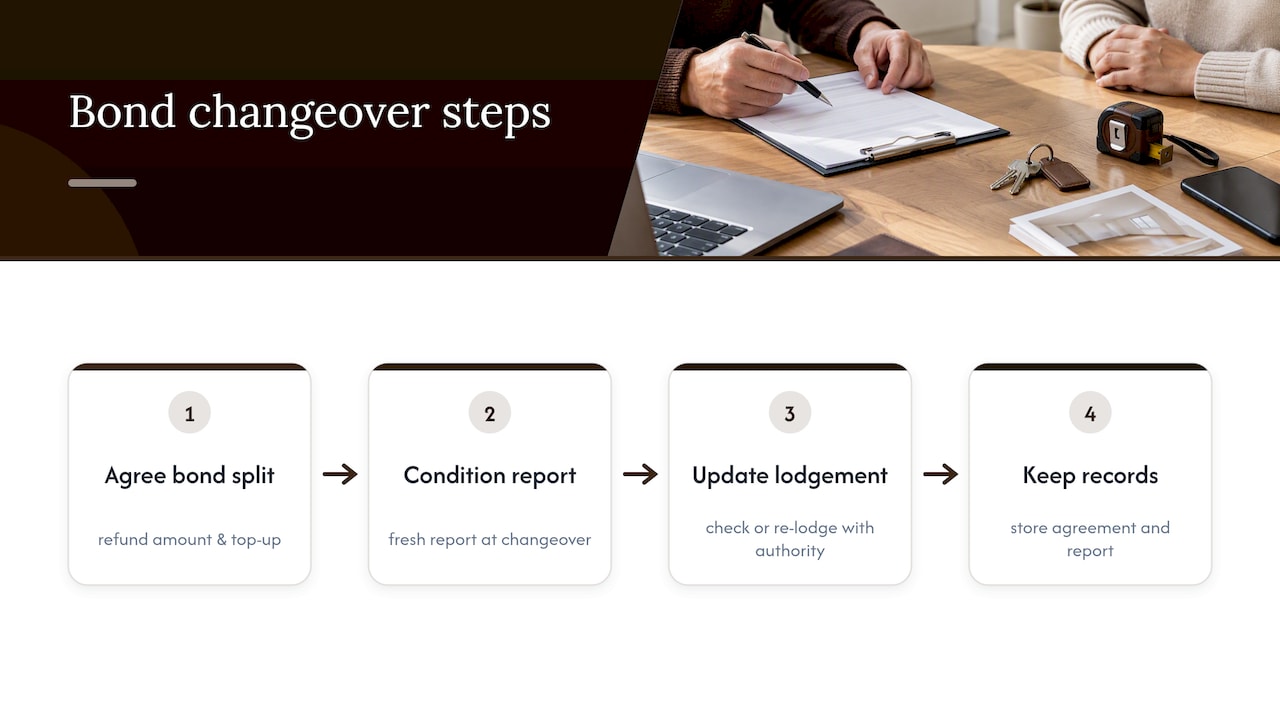
If the whole lease transfers to a new entity, such as when a company tenancy changes hands, the bond may need to be re-lodged under the new tenant’s details, depending on the state authority’s specific rules. Landlords and agents should check with the relevant portal, whether that’s the RTBA, Rental Bonds Online or the RTA, before assuming the existing lodgement simply carries over. Getting this wrong can leave an outgoing tenant’s name attached to a bond they no longer have any claim to, which complicates refunds months or years down the track.
Penalties for landlords and agents who mishandle bonds
Failing to lodge a bond, lodging it late, or holding bond money outside the proper trust arrangements isn’t a minor administrative slip. State tenancy laws treat bond handling as a compliance matter, and authorities can pursue landlords or agents who don’t lodge funds within the required timeframe.
Consequences can include financial penalties, formal compliance action from the state authority, and in serious or repeated cases, action against an agent’s licence. Beyond the formal penalties, a landlord or agent who mishandles a bond faces a much weaker position if a dispute ever reaches the tribunal, since they’ll struggle to produce lodgement records or clean trust account evidence to support their side.
This is exactly where sloppy trust account practices turn into real financial and reputational risk. An agency that doesn’t reconcile its trust account daily can lose track of which bonds have actually been lodged, which creates exposure that has nothing to do with the individual tenancy and everything to do with internal process. For agencies, keeping airtight, audit-ready trust records isn’t just good practice, it’s the difference between an administrative footnote and a compliance investigation.

What tenants should do if a bond hasn’t been lodged on time
If you’ve paid a bond and suspect it hasn’t been lodged, the first step is simple: ask directly for the lodgement receipt or confirmation number. A legitimate lodgement generates a reference you can check against the relevant state authority’s portal, whether that’s the RTBA in Victoria, Rental Bonds Online in NSW, or the RTA in Queensland.
If the landlord or agent can’t produce that confirmation, or clearly hasn’t lodged the bond within the legislative timeframe, contact the state tenancy authority directly. Most authorities have a complaints or compliance pathway specifically for unlodged bonds, separate from the standard refund or dispute process. You don’t need to wait until the tenancy ends to raise this: an unlodged bond is a problem worth fixing immediately, as it leaves your money sitting outside the legal protections the trust system is designed to give you.
Keep your own payment receipt as proof you paid the bond in the first place, regardless of what the landlord or agent does with it afterwards. That receipt, combined with a formal complaint to the authority, gives you a paper trail if the matter needs to go further.
Why accurate trust account processes reduce disputes
Most bond disputes we see traced back to administrative gaps, not genuine disagreement about the law. A missing receipt, a late lodgement, or a reconciliation that fell a week behind creates exactly the kind of ambiguity that turns a routine move-out into a formal claim.
Daily reconciliations, accurate receipting and timely lodgements close that gap before it opens. When records are audit-ready from day one, responding to a Notice of claim or preparing tribunal evidence becomes a matter of pulling a file, not reconstructing a timeline under pressure.
— Kasie
Where Reliance Property Accounts fits for agencies
Our service addresses a common problem agencies face: trust accounts that drift out of sync with daily reality. Instead of imposing a rigid workflow, it adapts to the systems agencies already use and works alongside their teams.

What that looks like day to day:
- Daily reconciliations and receipting to ensure every bond transaction is accounted for as it happens.
- Lodgement support to help agencies meet legislative timeframes.
- Compliance audits and trust account clean-up for agencies managing backlog.
- Ongoing owner disbursement and supplier payment processing, handled with consistent daily discipline.
Agencies that keep their trust accounts audit-ready day to day spend far less time firefighting disputes and chasing missing receipts. If that sounds like the kind of support your agency needs, take a look at our outsourced trust accounting service or visit our home page to get in touch.
FAQ
What is the 30% rent rule in Australia?
It’s commonly used by housing advocates and researchers to flag rental stress, not a rule tied to bond lodgement or refund law.
How long can a landlord hold your bond?
A landlord or agent cannot hold your bond privately at all: it must be lodged with the relevant state authority within the legislative timeframe for that state. Once lodged, the bond stays with the authority until the tenancy ends and any refund or claim is resolved.
How does a rental bond work in Australia?
A rental bond is a security deposit held in trust by a state authority and can only be used to cover actual financial loss, such as unpaid rent or damage beyond fair wear and tear. At the end of the tenancy, both parties request a refund, and if they agree on the amount, funds are released quickly through a fast-track process.
Who manages rental bonds in NSW?
In New South Wales, bonds are managed through Rental Bonds Online, the state government’s platform for lodging, tracking and claiming bond funds. Landlords must register on the platform, and tenants can view their bond details and request refunds through the same system.