

It's month-end, the trust bank statement doesn't match the cashbook, and the difference appears to be cheques your agency has issued but the payees haven't banked. You can explain the gap, but you still need to prove which payments remain outstanding, who they belong to and what happens next.
That's where bank reconciliation outstanding checks, usually called unpresented cheques in Australia, need more than a software report. For a real estate agency, they belong in a controlled reconciliation process with supporting records, follow-up and clear ownership.
Table of Contents
- Why Outstanding Checks Matter in Trust Account Reconciliations
- Identifying Outstanding Checks in Your Reconciliation
- Ageing Outstanding Checks and Knowing When to Investigate
- Resolving Old Checks and Communicating with Payees
- The Electronic Equivalent of an Outstanding Check
- Staying Audit-Ready and Deciding Who Should Own the Work
- Keeping Outstanding Checks Under Control Long Term
How healthy is your trust account?
Book a complimentary 30-minute Trust Account Health Check and see where your processes could be improved.
Book a Free Health Check →Why Outstanding Checks Matter in Trust Account Reconciliations
An outstanding cheque is a payment recorded in the trust cash records that hasn't yet cleared the bank. The agency has recognised the payment, but the bank statement hasn't caught up. That makes it a reconciling item, not automatically a bookkeeping error.
Consider a landlord disbursement paid by cheque just before month-end. If the landlord hasn't presented it, the money still appears in the bank account even though the agency's records already recognise the payment. Treating that bank balance as available for another disbursement would overlook an existing commitment.
A timing difference still needs evidence
Property agencies handle rent, bonds, sale deposits and payments to beneficiaries. In that environment, an unexplained difference shouldn't be dismissed because it resembles last month's outstanding-cheque total.
The useful distinction is between an explained timing difference and an unverified exception:
- Explained timing difference: The issued cheque has valid supporting records and hasn't appeared among cleared bank transactions.
- Unverified exception: The payment reference, beneficiary, amount or status can't be established from the records.
- Possible recording problem: The bank and agency records disagree for a reason other than presentation timing.
In Victoria, agencies must prepare and retain a reconciliation statement at the end of every month, with the principal agent or officer in effective control verifying its accuracy within 14 days after month-end, under the Consumer Affairs Victoria trust-account reference guide.
Practical rule: A cheque can be legitimately outstanding. Its identity and accounting treatment shouldn't be uncertain.
Could outsourcing save your agency time and money?
Book a complimentary 30-minute Trust Account Health Check and see where your processes could be improved.
Book a Free Health Check →
For the agency owner, the sign-off question isn't whether the figures balance. It's whether the preparer can explain the difference and produce the documents behind it.
Identifying Outstanding Checks in Your Reconciliation
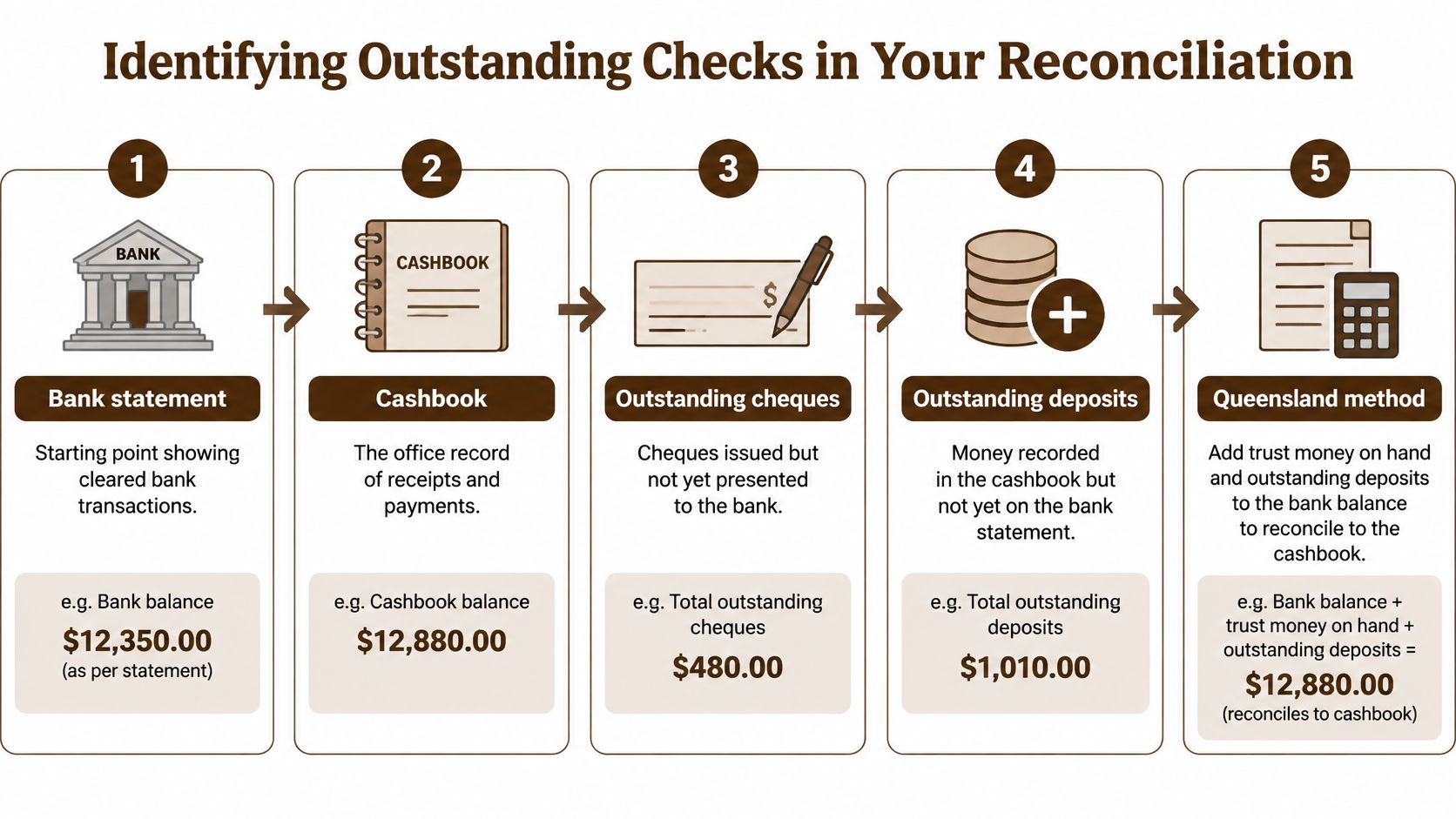
Start with the direction of the adjustment. An issued cheque has reduced the agency's cashbook balance, but it hasn't reduced the bank statement balance until it clears. You therefore deduct outstanding cheques from the bank side of the reconciliation.
Queensland's prescribed reconciliation method tests the cashbook balance by adding trust money on hand and outstanding deposits to the bank-statement balance, then deducting outstanding cheques; it also requires each outstanding cheque's number, amount and date, as set out in the Queensland trust-account reconciliation regulations.
Bank-statement balance + trust money on hand + outstanding deposits − outstanding cheques = cashbook balance
Keep those categories separate. An outstanding deposit explains money recorded as received but not yet reflected by the bank. An outstanding cheque explains a recorded payment the bank hasn't processed.
Build the listing from the reporting date
Run the unpresented-items report in your trust software, whether that's PropertyMe, PropertyTree or another system. Use the reconciliation date, not merely the date you happen to run the report. A cheque clearing after month-end may still have been outstanding at month-end.
Treat the report as a starting point rather than proof. Build a schedule that lets another person identify each payment without asking the preparer what it means.
- Payment identity: Record the cheque serial number, issue date, payee and amount.
- Trust allocation: Include the ledger beneficiary, ledger account and payment purpose.
- Supporting records: Trace the item to the cheque butt, cash-payments journal, relevant trust-ledger entry and cheque register.
- Bank comparison: Check whether the cheque appears among cleared transactions at the reporting date, noting subsequent clearance separately.
Match by reference and supporting detail, not amount alone. Similar payments can otherwise be matched incorrectly, leaving the wrong cheque on the outstanding list.
Prove the total without forcing the result
Add the verified outstanding items and apply the total to the bank-side reconciliation. Account separately for deposits and other identified differences, then check that the adjusted balance agrees with the cashbook.
If it doesn't, preserve the remaining variance for investigation. Don't alter a valid cheque amount just because a different amount would make the reconciliation work.
Where the underlying payment was recorded incorrectly, distinguish correcting that error from recognising an ordinary timing difference. The treatment of trust accounting journal entries matters because a genuine correction needs its own explanation and supporting authority.
Finally, compare the current schedule with the previous reconciliation. Each former item should be traceable to clearance, documented resolution or continued inclusion.
Ageing Outstanding Checks and Knowing When to Investigate
Age helps prioritise follow-up, but it doesn't establish what happened. A recently issued cheque may already be missing, while an older cheque may be sitting with a payee who confirms they haven't banked it.
Use ageing as an internal escalation policy, not a declaration that a cheque becomes invalid at a particular age. Review checkpoints at 30, 60 and 90 days provide a practical investigation rhythm alongside the cheque-level records required by Queensland's trust-account regulations. These are suggested operational checkpoints, not statutory cancellation deadlines.
Outstanding Check Ageing Guide
| Age bracket | Likely cause | Recommended action | Evidence to keep |
|---|---|---|---|
| Under 30 days | Recent issue or an ordinary presentation delay | Confirm the records are complete and monitor clearance | Cheque register entry, payment authority and issue evidence |
| 31 to 60 days | Payee may be holding the cheque or may not have received it | Contact the payee and confirm receipt and deposit status | Dated contact notes and the payee's response |
| Over 60 to 90 days | Possible loss, unresolved delivery issue or payment dispute | Assign a formal investigation and obtain bank-status evidence | Bank enquiry, supporting correspondence and investigation notes |
| Beyond 90 days | Prolonged unresolved payment requiring a decision | Escalate for an authorised resolution and assess applicable unclaimed-money requirements | Approval, original payment trail and documented next action |
A landlord who confirms they have the cheque but haven't banked it presents a different issue from a supplier who says nothing arrived. Record that distinction. Otherwise, an ageing report becomes a list of dates rather than a useful work queue.
Investigate the circumstances, not just the age
Bring unusual items forward regardless of their bracket. A missing serial number, altered payee or unexplained ledger allocation shouldn't wait for the next ageing checkpoint.
For ordinary follow-up, gather the cheque register entry, the payee's account of events and any relevant bank response. Assign someone to resolve conflicting information rather than accepting whichever explanation is easiest.
An old cheque disappearing from the report isn't evidence that the beneficiary received the money.
That's the weakness in “clearing out” an old list. An unsupported adjustment may make the reconciliation look tidier while removing the evidence needed to explain the payment.
The preferable outcome isn't an empty report at any cost. It's a report where each remaining item has a supported status, a named owner and an appropriate next action.
Resolving Old Checks and Communicating with Payees
Begin with a factual enquiry, not an immediate replacement. Establish whether the payee received the cheque, whether they deposited it and whether they can identify the relevant payment.
Keep dates and outcomes for every contact attempt. An unanswered email is useful evidence of attempted follow-up, but it isn't confirmation that the cheque was lost.
A payee follow-up you can adapt
Subject: Confirmation of outstanding cheque
Our trust records show cheque [reference], dated [date], payable to [payee] for [amount], remains unpresented. Could you please confirm whether you received it and whether you've deposited it?
If it hasn't arrived or has been misplaced, please let us know so we can investigate before arranging any replacement.
Use known contact details for follow-up. If the response includes a request to change payment instructions, handle that as a separate verification task rather than an incidental part of replacing the cheque.
Obtain authority before cancellation and reissue
Once the facts are established, send the internal approver a decision-ready summary. Include the original authority, payee response, bank-status evidence and proposed treatment.
Internal escalation
Cheque [reference] remains outstanding. The payee has confirmed [outcome], and the attached bank enquiry records [status].
Please approve the proposed stop-payment and replacement process, subject to bank confirmation and our documented authority limits. The original and replacement references will remain linked in the trust records.
Follow the bank's process and retain its confirmation before proceeding with the approved replacement. Record the cancellation reason and link the replacement to the original payment so another reviewer can follow the complete sequence.
The harder cases need different responses:
- Lost or potentially stale cheque: Establish its bank status and the beneficiary's entitlement before deciding how to replace it.
- Duplicated or missing serial number: Examine the register, cheque stock and payment records rather than treating it solely as a payee delay.
- Altered or suspicious payment: Preserve the evidence and escalate promptly as a possible trust-money problem.
- Uncontactable beneficiary: Assess the applicable unclaimed trust money requirements instead of assuming cancellation settles the obligation.
Victoria's guidance on accounting for trust money supports maintaining the cash-journal, ledger and bank reconciliation trail and warns against unexplained reconciliation adjustments. Apply that principle to every resolution: correcting the records must explain what happened, not hide uncertainty.
A suspected deficiency needs immediate internal escalation. Don't leave it in the ordinary payee-follow-up queue while waiting for a convenient answer.
The Electronic Equivalent of an Outstanding Check
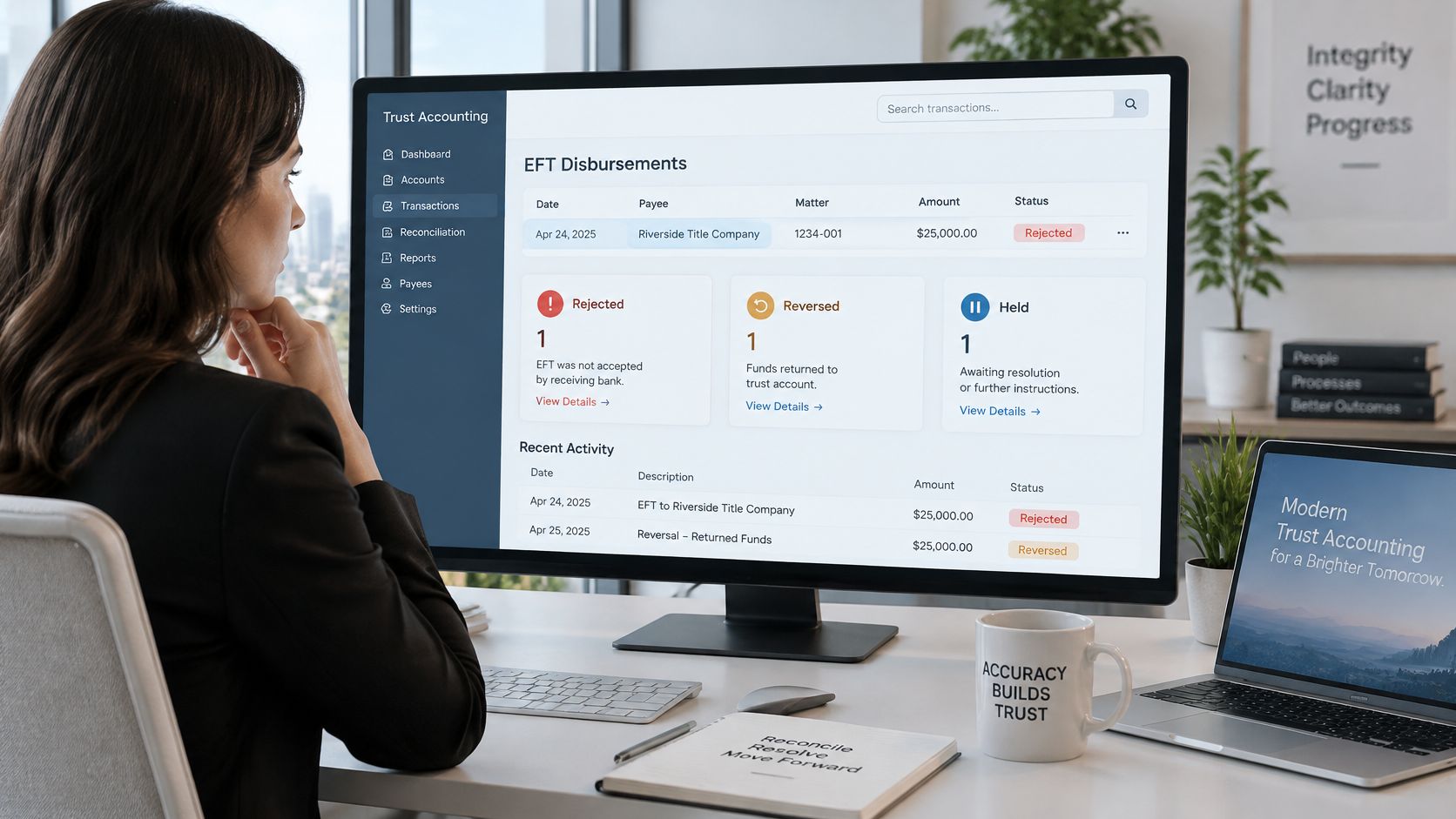
Agencies that disburse mainly by EFT still carry reconciling items at month-end. The cheque has been replaced by a payment instruction sitting in one of several states inside the banking portal: prepared but not released, accepted but unsettled, rejected, returned or duplicated.
Each status calls for a different response. A pending file may clear on its own timetable. A rejected payment never reached the beneficiary, so the obligation probably still stands against the trust ledger. A returned credit has to be traced back to the original debit before anyone touches the records.
Classify the bank status before choosing the treatment
| Electronic exception | What to establish |
|---|---|
| Pending or held payment | Whether the bank accepted the instruction and what remains outstanding |
| Rejected payment | Why it failed and whether the beneficiary still needs payment |
| Reversed or returned funds | Which original payment the return relates to and how the ledger should reflect it |
| Suspected duplicate | Whether both instructions settled and what recovery action is required |
| Changed beneficiary details | Whether the change was independently verified and authorised |
Record the actual payment type and bank status in the reconciliation rather than labelling every unmatched EFT an outstanding cheque. That distinction lets a reviewer separate a settlement delay from an error or an unauthorised instruction, which is exactly what an auditor wants to see when a trust ledger item stays open.
Make exception review part of the daily routine
Check unmatched bank-feed items against the banking portal and keep the status evidence where the software and the bank disagree. A batch marked prepared in the trust system does not prove settlement, and a feed description alone rarely explains why a payment failed.
- Before release: Verify payee details through the agency's approved process, independently of the invoice or email that requested the payment.
- At approval: Keep preparation separate from authorisation.
- After processing: Investigate rejected, returned and unmatched payments the same day rather than leaving them to month-end.
If a payment looks diverted, or beneficiary details changed without verified authorisation, treat it as a possible trust-money problem and escalate internally straight away. Notify the bank promptly and preserve the portal evidence before attempting any replacement payment.
Faster settlement changes the work without removing it. There are fewer paper items to chase, but the exceptions surface sooner and the window to stop a misdirected payment is shorter, so daily review carries more weight than the month-end clean-up.
Staying Audit-Ready and Deciding Who Should Own the Work
An audit-ready reconciliation lets a reviewer follow the payment without reconstructing it through conversations. The bank evidence, journal entry, beneficiary allocation and cheque records should tell a consistent story.
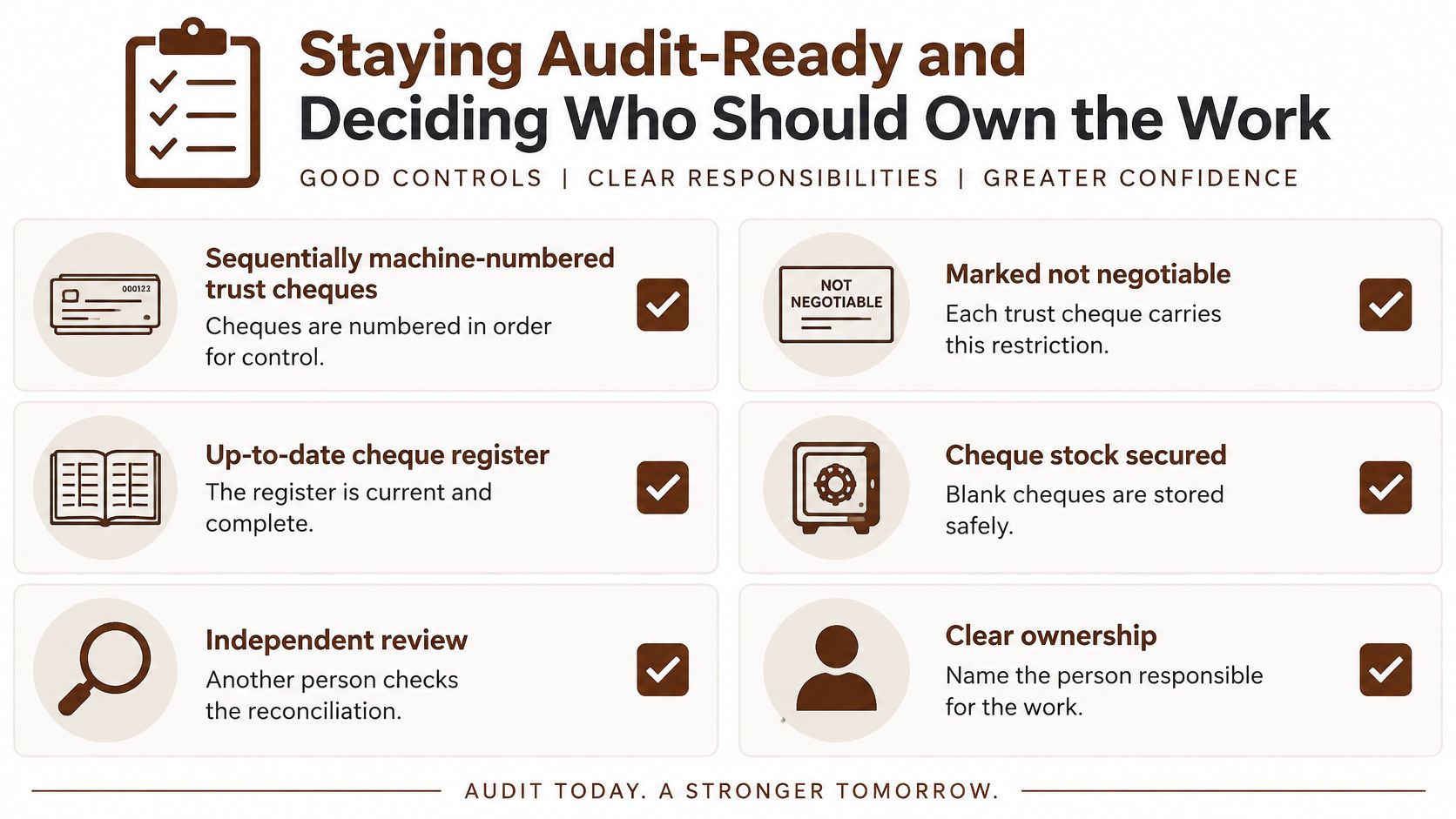
Victoria requires trust cheques to be machine-numbered sequentially, marked “not negotiable”, not payable to cash and signed by an authorised signatory; the required register includes serial numbers, batch receipt dates, cheque-book recipients, handover dates and return dates, under Consumer Affairs Victoria's payment requirements. The same guidance requires known deficiencies to be notified to the auditor and Director within three business days.
Test completeness, not just agreement
Use three-way completeness testing: bank transactions against the cash-payments journal, journal payments against individual trust-ledger debits, and issued cheque numbers against the cheque register. A matching total alone won't establish that every transaction is correctly allocated.
Support that testing with a short control set:
- Sequence exceptions: Investigate missing numbers and cheque statuses that contradict bank activity.
- Dated exception register: Record the issue, classification, evidence, owner and due date.
- Review evidence: Retain the reviewer's approval and any questions resolved before sign-off.
- Access and stock controls: Secure unused cheque stock and limit access according to documented responsibilities.
A working trust account audit checklist should direct staff to the evidence, not merely provide boxes to tick.
Compare the ownership models honestly
| Responsibility | In-house handling | Outsourced daily support |
|---|---|---|
| Routine reconciliation | Internal staff complete the work around agency demands | An external trust accountant performs the agreed daily routine |
| Exception follow-up | Depends on internal capacity and allocated responsibility | Can be maintained in a shared register with agreed escalation |
| Payment preparation | Staff prepare payments within agency controls | Provider prepares verified batches within approved scope |
| Final authority | Designated agency approvers retain control | Designated agency approvers still retain control |
| Continuity | Requires trained leave and absence cover | Requires documented provider access, scope and handover arrangements |
In-house handling works when capable staff have protected time and a genuine reviewer. Outsourcing can suit agencies needing dedicated daily bank reconciliations, state-aligned checks and organised audit records without allocating that workload to property managers.
Ownership test: If an unresolved payment needs action today, everyone involved should know who investigates, who approves and who receives the update.
Neither model fixes unclear authority. Agree the scope, evidence standards, reporting routine and escalation responsibilities before deciding who performs the work.
Keeping Outstanding Checks Under Control Long Term
Make outstanding-payment review part of the reconciliation routine, not an occasional clean-up. Carry unresolved items forward with their history intact, and record the evidence when their status changes.
Western Australian guidance requires reconciliation at least monthly, identifies cheques unpresented for significant periods as an audit-qualification issue, and describes completion within 10 days as accepted practice, while recognising that transaction volume or auditor recommendations may justify greater frequency. Those distinctions matter when setting your agency's timetable against the WA trust-account audit-qualification guidance.
Keep the routine workable
- Review the current list: Compare outstanding and unmatched payments with the bank evidence.
- Apply the ageing policy: Move delayed items into the appropriate follow-up queue.
- Record the outcome: Keep correspondence, approvals and resolution references together.
- Check ownership: Ensure unresolved work has an accountable person and a next action.
The useful management question is whether the current arrangement matches the workload. Can staff investigate exceptions while completing ordinary trust operations, or does the agency's transaction volume justify dedicated daily reconciliation support?
Pull today's unpresented-cheque or unmatched-payment list and apply the ageing workflow. Choose any item with an unclear status, locate its evidence and assign the next action before closing the file. Outstanding payments become routine when staff follow a disciplined process rather than repeatedly rediscovering the same uncertainty.
Reliance Property Accounts provides daily trust-account reconciliations, outstanding-payment follow-up and audit-ready records within your agency's approved systems and authority limits. Visit Reliance Property Accounts to discuss support for keeping unresolved trust payments visible, documented and under control.