Most advice about trust accounting software Australia starts with the wrong question. People ask which platform has the most automation, then treat that answer as a compliance plan. Automation helps. It does not decide whether a deposit belongs to the right tenancy, or whether two staff members typed the same invoice the same way.
Client money is not trading income. Rent, bonds, sales deposits, advertising and marketing funds, owner money and supplier payments have to be receipted, allocated, paid and reconciled so an auditor can follow the trail. A trust module speeds that work. It still needs a person checking the allocation.
At Reliance Property Accounts, our founder has worked in real estate since 2009 and specialised in trust accounting since 2018, across agencies of different sizes. The pattern is steady. Good software does not equal good trust accounting. The useful comparison is whether the platform fits the agency and is used with consistent Receipting, reconciliations and approval controls, including when support stays inside the system the agency already has.
How healthy is your trust account?
Book a complimentary 30-minute Trust Account Health Check and see where your processes could be improved.
Book a Free Health Check →Table of Contents
- What Trust Accounting Software Actually Does
- Popular Trust Accounting Software in Australia
- Key Features to Look for in Trust Accounting Software
- 1. Bank Feeds and Daily Reconciliations
- 2. Rent Receipting and Payment Allocation
- 3. Supplier Invoice Management and Duplicate Detection
- 4. Owner and Supplier Payments
- 5. Bond Management
- 6. Internal Ledger Reconciliation
- 7. End-of-Month Processing and Owner Statements
- 8. Reporting, Audit Trails and User Permissions
- Why Good Procedures Matter Just as Much as Good Software
- Lessons from Real Trust Accounts
- How Much Time Software Can Save
- Improve Processes or Change Software
- Questions Agencies Ask Before Choosing
What Trust Accounting Software Actually Does
Real estate trust accounting software exists to handle money the agency holds for other people. It raises a Receipt, allocates the amount, prepares payments and reconciles the bank. The record has to show the true position of trust money, not a tidy summary that hides a wrong ledger.
That is a different job from Xero or MYOB. Those platforms can record a business: sales, expenses, BAS and profit. They are not built around a real estate trust ledger, tenant and owner allocations, or the daily trust routines agencies rely on. This guide is about real estate trust accounting. It is not about family trusts, legal practices or ordinary business bookkeeping.
Popular Trust Accounting Software in Australia
Australian real estate agencies have several property management software options that offer trust accounting functionality. Some of the more commonly recognised platforms include PropertyMe, PropertyTree (MRI Software), Console Cloud, Re-Leased and Cirrus8.
Each platform offers different features and capabilities, and the right choice will depend on the agency's portfolio size, whether it manages residential or commercial properties, and its day-to-day operational requirements.
At Reliance Property Accounts, we work extensively with PropertyMe and PropertyTree, giving us firsthand experience with their trust accounting features, reconciliation processes and everyday functionality.
Could outsourcing save your agency time and money?
Book a complimentary 30-minute Trust Account Health Check and see where your processes could be improved.
Book a Free Health Check →Other platforms, such as Console Cloud, Re-Leased and Cirrus8, are also worth considering depending on an agency's requirements, particularly when managing commercial properties or more complex portfolios.
While software can make trust accounting significantly more efficient, it's important to remember that the software is only as effective as the people and procedures behind it. Consistent processes, accurate data entry and regular checks remain essential, regardless of which platform an agency uses.
Key Features to Look for in Trust Accounting Software
The right trust accounting software can make a significant difference to how efficiently a real estate agency operates. From processing rent payments and managing supplier invoices to completing reconciliations and preparing owner statements, modern software can automate many of the tasks that would otherwise take hours to complete manually.
However, not all software offers the same functionality, and even the most advanced systems still rely on accurate information and consistent procedures.
Here are some of the key features we believe agencies should look for when choosing trust accounting software.
1. Bank Feeds and Daily Reconciliations
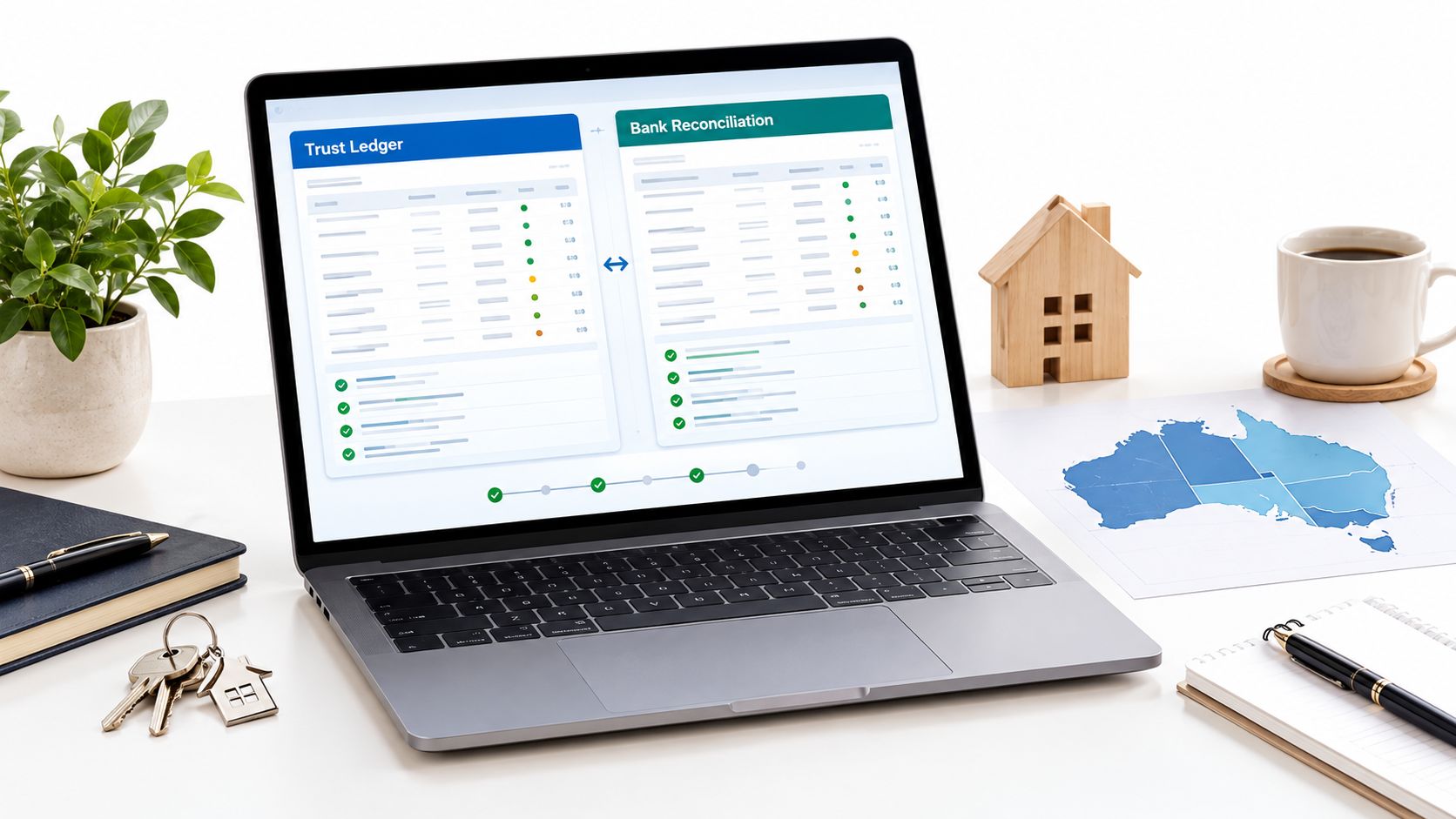
One of the most valuable features of modern trust accounting software is the ability to import bank transactions and match payments against the appropriate tenants, owners and properties.
Platforms such as PropertyMe and PropertyTree can significantly reduce the time spent manually entering and reconciling transactions.
However, automatic matching isn't always perfect. Payments can arrive with incorrect references, tenants may pay unexpected amounts, and deposits can sometimes be difficult to identify.
This is why daily reconciliation is so important. Reviewing transactions each day allows discrepancies to be investigated early, rather than leaving them unresolved until the end of the month.
Read more about the importance of trust account reconciliation.
2. Rent Receipting and Payment Allocation
Accurately recording rental payments is one of the most important everyday trust accounting tasks.
Good trust accounting software should make it easy to receipt rental payments, allocate funds to the correct tenancy and maintain accurate tenant ledgers.
It should also provide clear visibility over rental arrears, payments received in advance and any funds that haven't yet been allocated.
Errors in rent receipting can affect tenant paid-to dates, owner payments and financial reporting, so having a reliable process is essential.
3. Supplier Invoice Management and Duplicate Detection
Managing supplier invoices is another area where the right software can save agencies considerable time.
Trust accounting platforms generally allow invoices to be entered against individual properties, scheduled for payment and tracked through to completion.
Some systems, including PropertyMe, also have built-in checks designed to identify potential duplicate invoices.
However, these checks are only effective when information is entered consistently.
For example, if one staff member enters an invoice number as "INV-123" and another enters the same invoice as "123", the software may not recognise the duplication.
It's a simple example of why having good software doesn't automatically mean an agency has good procedures.
4. Owner and Supplier Payments
Trust accounting software should make it easy to manage payments to owners, suppliers and other authorised recipients.
Useful features include scheduled owner disbursements, payment batching, visibility over available funds and the ability to generate owner statements.
Agencies should also consider how the software integrates with their banking arrangements and payment approval processes.
At Reliance Property Accounts, we recommend having appropriate separation between the person preparing payments and the person authorising their release.
This provides an additional level of oversight and helps reduce the risk of payment errors or unauthorised transactions.
5. Bond Management
Rental bond management is another important consideration, particularly for agencies managing residential properties.
Depending on the software and the state or territory, agencies may have access to features that help track bonds received, outstanding lodgements and bond claims.
Having clear visibility over outstanding bond transactions is especially important, as bond handling and lodgement requirements vary across Australia.
A good system should help agencies identify matters requiring attention rather than relying on staff to remember to follow them up.
6. Internal Ledger Reconciliation
While most agencies focus on reconciling their bank account, reviewing internal ledgers is just as important.
Internal ledgers can contain unidentified deposits, clearing transactions, outstanding adjustments and other amounts requiring investigation.
Trust accounting software should provide clear reporting that makes it easy to identify these balances and review the transactions behind them.
Regularly reviewing internal ledgers helps prevent small issues from being overlooked or carried forward unnecessarily.
7. End-of-Month Processing and Owner Statements
End-of-month processing is a significant part of trust accounting for most property management agencies.
The right software can streamline owner payments, management fee calculations, statement generation and financial reporting.
However, a smooth end-of-month process starts well before the last business day.
When invoices are entered correctly, transactions are reconciled daily and outstanding issues are addressed throughout the month, end-of-month processing becomes much more manageable.
8. Reporting, Audit Trails and User Permissions
Reliable reporting is essential for both everyday management and trust account compliance.
Agencies should be able to easily access transaction histories, trust account reconciliations, owner and tenant ledgers, payment records and supporting documentation.
It's also important to consider user permissions.
Not every staff member needs access to every function. Restricting permissions according to individual responsibilities can help reduce errors and strengthen internal controls.
Detailed audit trails also make it easier to identify who entered, changed or processed a transaction, which is particularly valuable when investigating discrepancies or preparing for an audit.
Why Good Procedures Matter Just as Much as Good Software
One thing we've learned from working with different real estate agencies is that software alone doesn't guarantee accurate or compliant trust accounting.
Two agencies can use exactly the same platform and achieve very different results depending on how their teams use it.
Consistent invoice entry, accurate receipting, regular reconciliations, clear payment approval procedures and ongoing staff training all contribute to better trust account management.
The best trust accounting software is the one that suits your agency's needs, is used correctly and is supported by reliable everyday procedures.
At Reliance Property Accounts, we work with agencies to make the most of their existing systems, improve everyday processes and ensure trust accounting tasks are managed consistently and accurately.
Lessons from Real Trust Accounts

The same small failures show up in ordinary weeks. They are not dramatic case studies. They are the reason a trust account still needs a procedure.
What daily reporting is for
We use a daily summary for the agencies we support. It highlights unidentified tenancy payments, internal ledger balances, outstanding bond matters and other items that need a decision. Property managers can clear them as they appear, rather than meeting a pile at month-end. The same habit covers invoice entry, payment preparation and a check for insufficient funds before a payment run. The information is already in the software. The routine turns it into a short list.
Payment tools can prepare the batch. Someone still has to verify the invoice, the available funds and the authority to pay. Software does not hold the agency's licence.
Why the software cannot certify compliance
Accurate data, written procedures, separation between who prepares and who approves, reconciliation reviews, transaction records and agency oversight stay with the business. Rules differ by state and territory. Trust accounting compliance software can support those rules. It cannot guarantee them, and it does not prevent issues at audit time.
For a Victorian agency, speed of matching is the wrong benchmark. The Consumer Affairs Victoria trust accounts reference guide expects a computerised system to block amendment of a recorded transaction unless the correction is a separate transaction, to require the fields the Act and Regulations need, and to keep backups at least monthly, with complete backup sets stored separately. During setup, test a sample Receipt, a disbursement, a payee change, a reversal and a closed period. Keep that evidence where the agency and the auditor can open it. Bank-feed matching that still allows silent overwriting leaves a real control gap.
How Much Time Software Can Save
There isn't a fixed number of hours saved each month. Portfolio size, transaction volume, configuration and the workflow you already have all change the result. Anyone quoting a single percentage hasn't looked at your rent roll.
Used properly, PropertyMe and PropertyTree can cut repetitive administration around Receipting, bank reconciliations, owner disbursements and routine reporting. The experienced person then spends more time on exceptions: unknown deposits, wrong references, insufficient funds and items that should not wait for month-end. That shift delivers the saving. It isn't the software finishing the job alone.
When the hours don't move
We regularly see offices that aren't using the system they already pay for. Staff re-enter what a feed already brought in. Two people run the same check in a spreadsheet and in the platform. A report exists, and nobody opens it until the auditor asks.
A smaller rent roll with messy references can take longer than a larger roll with one way of Receipting. Even small daily changes add up across a month.
Improve Processes or Change Software
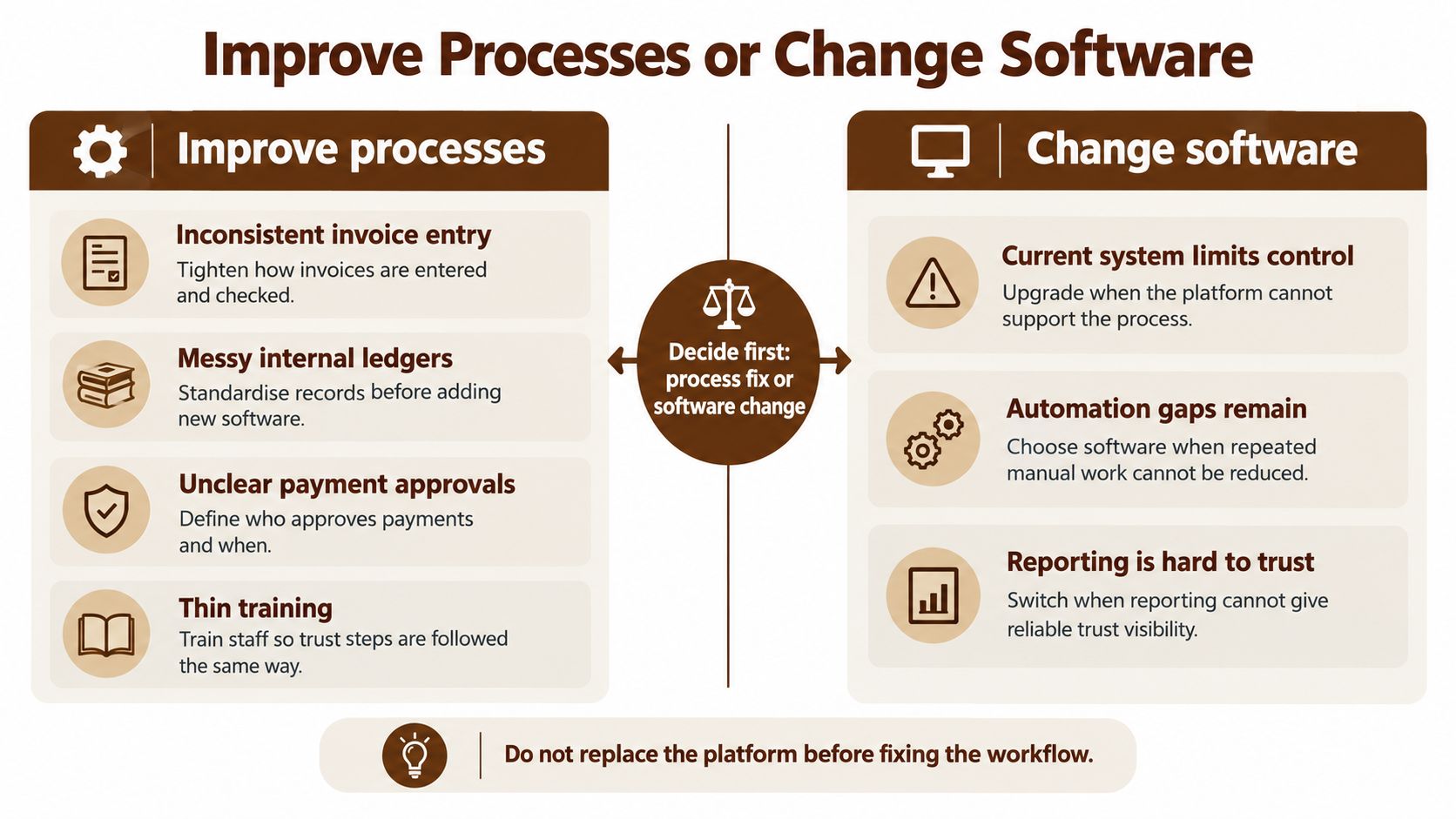
A trust problem does not automatically mean you need a new platform. Inconsistent invoice entry, messy internal ledgers, unclear payment approvals, thin training and missing procedures all look like software failure from the outside. Review how the current system is used before you price a migration.
Staying in the system you have
Outsourcing your trust accountings is one way to tighten the work without a migration. We work inside the agency's existing trust system and approved procedures, including PropertyMe, PropertyTree and the relevant banking portals. The support covers daily reconciliations, Receipting, bill entry, payment-batch preparation, end-of-month balancing, reporting, sales trust work where it is needed, backlog clean-up and records aligned to that agency's state.
Preparation stays separate from approval. Authorised people in the agency still release payments. The practical gains are experienced cover, daily attention, less dependence on one staff member, and continuity when someone is on leave or leaves the business.
Before you invest in new software, it is worth finding out whether you are getting the most from the system you already have. A complimentary Trust Account Health Check is a practical way to see the inefficient steps. The best software is the one that suits the agency, is set up properly and is used by people who understand it. Good software makes the work easier. Good processes and experienced people make it more reliable.
Questions Agencies Ask Before Choosing
What is the best trust accounting software for real estate agencies in Australia? There isn't one. Best trust accounting software Australia is a search, not a verdict. Match the platform to the portfolio, the staff, the payment authorities and the states you operate in.
Is PropertyMe better than PropertyTree? Neither is automatically better. Judge each on the work that office does, then confirm current functions with the vendor.
Can Xero be used for real estate trust accounting? Xero is general business accounting. It is not a substitute for a real estate trust ledger and the Receipting, allocation and reconciliation that go with client money.
Does trust accounting software guarantee compliance? No. It supports records and routines. Accurate entry, procedures and oversight remain the agency's.
Can an agency outsource trust accounting without changing software? Yes, when the provider works inside the current system and the agency keeps approval of payments.
What should an agency look for? Fit, correct setup, state-specific controls and people who know how to use the system. Outsourcing is an option, not a requirement.
Is trust accounting software suitable for small real estate agencies? Yes. A smaller rent roll still needs accurate records. Volume is lower. The standard is not.
What is the difference between residential and commercial trust accounting software? The transactions and portfolios differ. A platform built mainly for one should be checked against the other before a mixed agency commits.
Before you spend on a new platform, find out whether your current trust system is already doing the job. Reliance Property Accounts works inside agency software on daily reconciliations, Receipting, payment preparation and audit-ready records, and can help you tighten the process you already have. Book a complimentary Trust Account Health Check with Reliance Property Accounts.
