

It's Monday morning. Your property managers emailed tenants the new BSB last week, but several rent payments have still landed in the old trust account. Meanwhile, an owner payment batch is due and the new bank is waiting for a director to finish their identity check.
That's why learning how to change a real estate trust bank account starts with planning an overlap, not choosing a transfer date. Client money must remain identifiable, correctly receipted and available for authorised payments while both accounts are operating.
Table of Contents
- Why Agencies Change Trust Bank Accounts
- State and Territory Notice Rules Before Cutover
- How to Change a Real Estate Trust Bank Account
- Transfer Trust Funds With a Clear Audit Trail
- Software Setup and How Long the Change Takes
- Problems After Cutover and When to Close the Old Account
- Frequently Asked Questions About Changing a Trust Bank Account
How healthy is your trust account?
Book a complimentary 30-minute Trust Account Health Check and see where your processes could be improved.
Book a Free Health Check →Why Agencies Change Trust Bank Accounts
Agencies usually change banks because something in the daily workflow isn't working. Payment files need manual adjustment, support is hard to reach when a batch fails, or the bank's facilities don't suit the trust accounting software.
Lower fees can justify a review, but the cheapest account isn't necessarily the easiest to operate. A bank that makes payment approvals awkward can leave the principal dealing with avoidable interruptions every disbursement day.
Compare the workflow, not just the account
Before moving trust accounts to another bank, ask the proposed institution to demonstrate the functions your team uses.
- Payment processing: Check file formats, batch limits, approval arrangements and how rejected payments are reported.
- Receipting information: Confirm whether transaction references arrive clearly enough to identify tenant payments.
- Access and support: Establish who can prepare payments, who can approve them and how urgent banking issues are escalated.
- Software compatibility: Check the actual integration available, rather than accepting a general statement that the bank supports property management.
A household guide to how to change banks won't resolve these questions. Trust money belongs to clients, and changing the bank mustn't obscure which owner, tenant, purchaser or vendor each amount relates to.
Practical rule: Treat the change as a regulated parallel run, not a day when everyone stops using the old account.
At Reliance Property Accounts, we can plan and reconcile within an agency's own systems. We're not a bank and can't independently authorise a transfer. The licensee's legal notices and the team's sensible operating precautions are separate responsibilities.
Could outsourcing save your agency time and money?
Book a complimentary 30-minute Trust Account Health Check and see where your processes could be improved.
Book a Free Health Check →State and Territory Notice Rules Before Cutover
A rent cutover can be ready operationally while a notice deadline is still running. Check the state requirement before opening or changing the account, and assign someone to lodge the notice and retain proof.
Trust account bank-change notices by jurisdiction
| Jurisdiction | What is notified | Timing | Account point to get right |
|---|---|---|---|
| Western Australia | Opening, closing or amendment, including BSB or account number | As soon as practicable, or within five working days, as set out in the WA trust account handbook and notification form | Account name and number, authorised institution and date of change |
| New South Wales | Opening, change and closure | Closure notification is due within 14 days under NSW Fair Trading guidance. Check the required opening and change procedures before lodging | ADI in NSW, written trust designation, UID and bank-stamped duplicate |
| Queensland | Opening of the trust account | Within two months under Queensland Government trust account guidance | Queensland branch of an approved institution; general or special account; institution, BSB, name and number |
| Northern Territory | Each trust account opened | Within seven days under NT Government trust account guidance | Confirm the institution is approved before opening |
For Victoria, South Australia, the Australian Capital Territory and Tasmania, confirm notice requirements directly with the relevant state or territory regulator.
Before submitting the bank application, the licensee should identify the notice form, triggering event and person responsible. A notice period may start when the account opens, rather than when rent begins landing in it.
In Western Australia, amendments can include changes to the entity name, business name, certificate details or financial institution. Keep the completed notice, supporting account details and evidence of lodgement together.
For New South Wales, prepare the written trust designation, registration documentation and bank-stamped evidence as part of account establishment. The agency should retain these records in its own file.
The bank's onboarding checklist does not replace a regulator notice. Telling the auditor about the change is sensible practice, but it does not meet a separate notification obligation. See the overview of real estate trust account rules when planning the change.
How to Change a Real Estate Trust Bank Account
For a hypothetical 200-property rent roll, the working order should protect normal rent collection and owner payments while banking arrangements change.
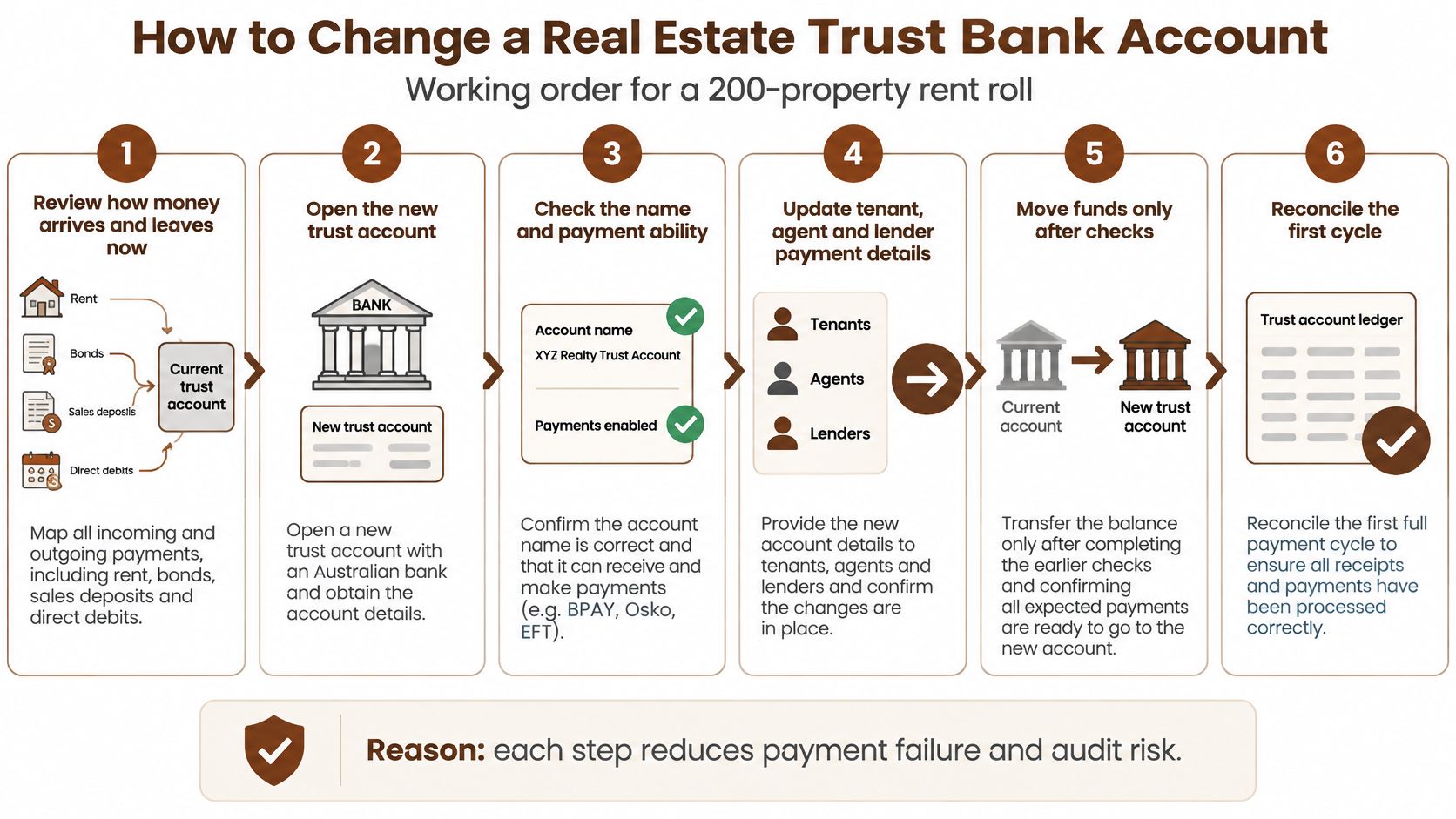
Follow the working order
Review existing money movements. List rent, bonds, sales deposits, DEFT, BPAY, direct debits and scheduled owner and supplier batches. This identifies arrangements that won't change merely because the software has a new BSB.
Confirm the jurisdiction requirements. Establish the account eligibility, naming and notice requirements before using the replacement account for receipting.
Open and configure the new account. Check the trust name, signatories, approval limits and access for staff who prepare payments. An account that exists but can't release an authorised batch isn't operationally ready.
Configure the software and test receipting. Use a controlled, properly authorised test transaction appropriate to the account. Confirm the reference, ledger allocation and reconciliation before redirecting tenants.
Update the people and providers. Send verified details to tenants, owners, suppliers and providers such as DEFT. Confirm whether the provider needs a new facility, authority or settlement configuration.
Build the outstanding-item list. Record pending deposits, unpresented payments, outstanding EFTs and scheduled transactions. Include the client ledger, amount, expected date and person investigating each item.
Choose the cutover date. Avoid end-of-month processing and the busiest rent days. Assign someone to identify payments that continue reaching the old account.
Reconcile and retain evidence. Keep separate bank reconciliations and records showing how each client balance is represented during the overlap.
Monitor both accounts. Investigate unexpected receipts and failed payments rather than assuming every tenant or provider has changed their instructions.
Close only after clearance. Obtain the licensee's approval once outstanding items are resolved, the final reconciliation is complete and applicable closure requirements are addressed.
Give every task an owner
Trust bank changeover checklist by owner
| Area | Ready when | Who owns it |
|---|---|---|
| Existing payments | Rent, bonds, sales deposits, DEFT, direct debits and scheduled batches are listed | Trust accountant |
| New account | Trust name, institution, signatories and payment access are live | Principal |
| Regulator | The applicable notice is identified and any lodgement receipt is filed | Licensee |
| Software | The new account is the receipting bank and a test receipt reconciles | Trust accountant |
| People | Tenants, owners, suppliers and payment providers have verified details in writing | Property manager |
| Cutover | The date avoids end-of-month and the old account stays open | Principal |
| Records | Both reconciliations, unpresented items and transfer authority are in the audit file | Trust accountant |
| Closure | No fresh receipts arrive, outstanding items are cleared and any closure notice is completed when due | Licensee |
Use the trust account banking overview alongside an agency-specific task register.
When we work within that register, the agency must provide complete, accurate and current information and access to its property management software and agreed platforms. Existing trust accounts must be balanced, or the agency must clearly identify that clean-up work is needed.
Transfer Trust Funds With a Clear Audit Trail
Sweeping the visible bank balance into the new account looks efficient. It's unsafe if that figure includes money committed to outstanding payments or amounts that haven't been matched to client ledgers.
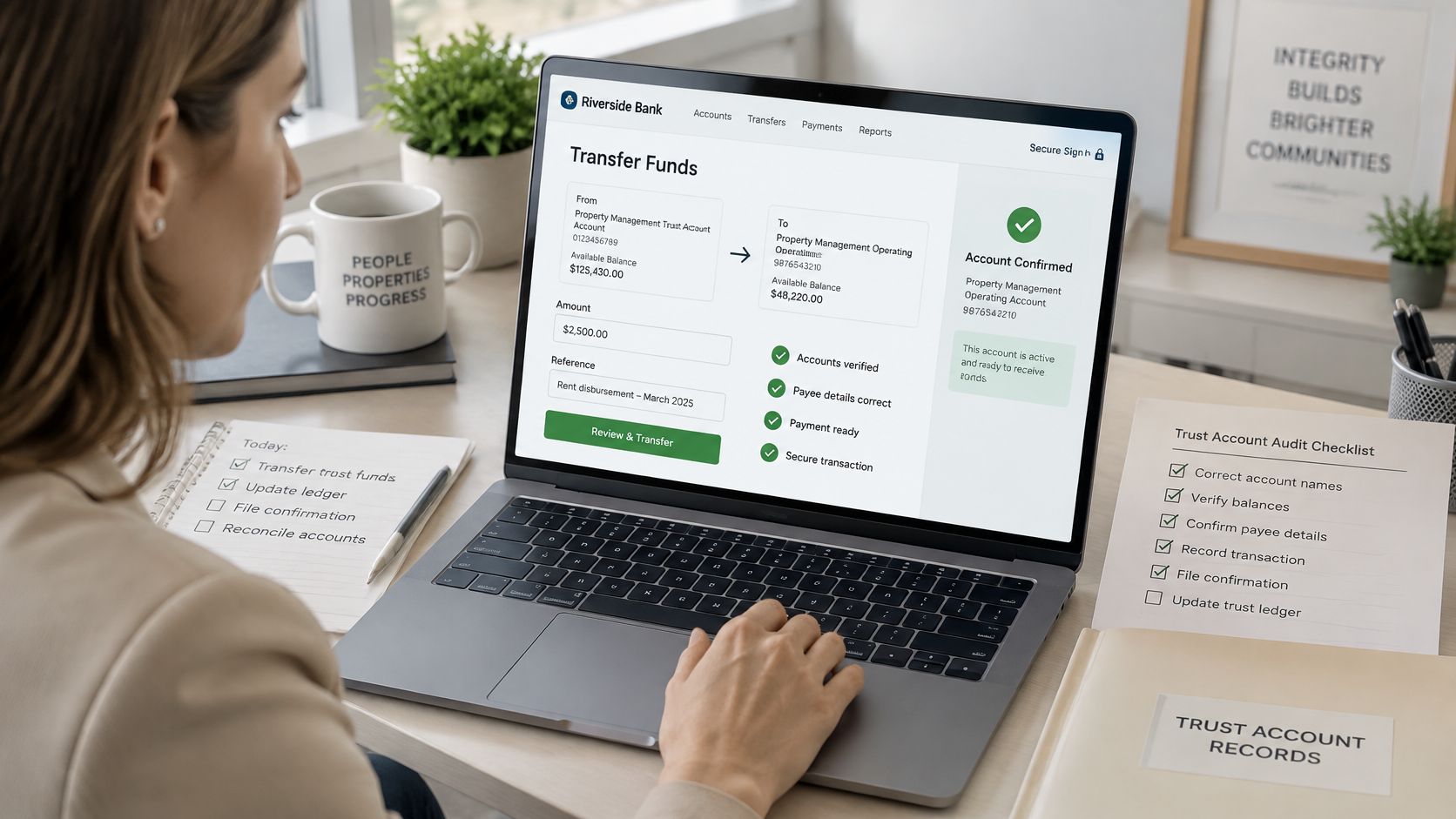
Establish the amount and authority first
Before preparing a transfer, confirm that the receiving account is correctly named and can make required payments. Then prepare a reconciled position showing client ledger balances, outstanding items and the amount available to move.
- Authority: Obtain written approval through the agency's permitted signatories and processes.
- Ledger mapping: Identify exactly which client balances the transfer represents.
- Transaction evidence: Retain the payment confirmation, receiving-bank entry and matching software records.
- Remaining obligations: Leave sufficient identified client funds to meet legitimate outstanding items, subject to local requirements.
A single transfer may be appropriate after those checks, but only where state rules and agency authorities permit it. Requirements differ across jurisdictions.
Say the migration includes a sales deposit and rental funds. The bank movement mustn't make the deposit disappear into a general balance that staff can't trace at settlement. Moving cash isn't new rent income and shouldn't create a duplicate rent receipt.
A transfer record should explain whose money moved, who authorised it and where it appears in both bank records.
Rebuild payment instructions deliberately
The ACCC's Retail Deposits Inquiry final report describes access to a 13-month listing of direct debits, direct credits and periodical payments under the ePayments Code. That assistance isn't a complete trust-account migration service: internet-banking pay-anyone and BPAY instructions still need to be re-established.
Use a documented trust account reconciliation process throughout the overlap. Reconcile both accounts daily as an operational safeguard, and independently verify changed payee details.
We process transactions and updates only from agency information or agreed processes. If a figure or instruction is unclear, we seek clarification before proceeding; preparation never substitutes for the agency's payment approval.
Software Setup and How Long the Change Takes
A new trust account can be open before the agency's software, bank feed and payment workflows are ready to use it. Keep the old account active during setup so rent and other payments can still be identified while the new arrangements are tested.
Reliance Property Accounts works within common property management platforms, including PropertyMe and PropertyTree, and other platforms can be discussed during the initial enquiry. Software settings and permissions need to match the agency's processes and authority limits.
Test the complete payment cycle
Check the default receipting account, bank feed, payment-file details and reconciliation reports. Test a receipt, supplier payment and owner disbursement through the agency's authorised workflows. Then confirm another staff member can trace each item through to reconciliation.
- Bank feeds: Confirm the connected account is the intended trust account.
- Payment files: Check the originating account details before a batch is uploaded.
- Permissions: Provide access only to the software, banking and document portals needed for the work.
- Historic records: Retain the old account's transactions and reports without overwriting its identity.
Reliance Property Accounts can work alongside internal staff on daily reconciliations, payments, bill entry, end-of-month work, overflow support or compliance clean-up. Transactions and updates are made from information supplied by the agency or agreed processes. If an instruction is unclear, clarification is needed before proceeding. Payment approval remains with the agency's designated approvers.
Allow time for dependencies
Planning time for a trust account bank change
| Phase | Planning range | What it depends on |
|---|---|---|
| Discovery and preparation | About 1 to 3 business days | Payment methods, software and required signatories |
| Opening the new account | Often 1 to 3 weeks | The bank's application, identification and approval |
| Software configuration and testing | About 2 to 5 business days | Access being available after the account is open |
| Transition and monitoring | A few days, then several weeks | Rent still arriving in the old account, direct debits and unpresented payments |
These are general planning estimates, not guaranteed timeframes or a record of results achieved by Reliance Property Accounts. Portfolio size, banking arrangements and the bank's requirements can extend the schedule.
Arrange signatory identification, banking access, provider updates and any required auditor or regulator paperwork early. Wait until those dependencies are resolved before sending tenants new details. Allow for a parallel run rather than targeting an end-of-month cutover.
Problems After Cutover and When to Close the Old Account
Rent arriving in the previous account needs an investigation routine, not an emergency workaround. A tenant may have updated their saved payee but left an existing scheduled transfer unchanged.

Match each problem to a check
| Problem | Check that contains it |
|---|---|
| Tenants keep using old details | Identify the payer and send a targeted reminder asking them to check both saved payees and scheduled transfers |
| DEFT or direct-debit changes lag behind notices | Obtain provider confirmation of the effective change date and settlement destination |
| An EFT remains outstanding | Check bank status and the beneficiary details before cancelling or reissuing it |
| New banking access is delayed | Escalate missing identification or signatory approvals before relying on the new account |
| Receipting uses the wrong bank account | Inspect the software transaction and correct it through a documented method that preserves the audit trail |
| Neither reconciliation agrees | Compare transfer entries, dates, duplicate imports and account coding before making adjustments |
Assign a named person to review both accounts on rent days. Identify unmatched amounts promptly and handle them under the applicable unidentified-money procedure; don't guess a tenant ledger to clear the screen.
A failed EFT deserves particular care. Reissuing it before confirming the original status can pay the recipient twice.
Mistakes that prolong the overlap
- Closing too early: Closure can strand incoming payments and complicate outstanding transactions.
- Skipping the outstanding-item list: A bank balance alone doesn't explain committed funds.
- Losing the ledger split: A transfer without supporting allocations makes later client queries difficult.
- Relying on a single email: Follow up with tenants whose payments still reach the previous account.
- Discarding old statements: Retain bank records, provider confirmations and correction evidence.
- Reusing another state's procedure: Check the rules for the account being changed.
Don't close the old account to make the reconciliation look simpler. Resolve the transactions that make it complicated.
Apply the final closure gate
The licensee should approve closure only when:
- Incoming money has stopped: No fresh tenant or settlement funds are arriving, and payment arrangements have been checked.
- Outstanding items are resolved: Unpresented payments, pending deposits and failed transfers have documented outcomes.
- Client records agree: Transfers are traceable to the right ledgers and the final reconciliation balances.
- Closure administration is ready: Lodge any required notice within the applicable period and retain proof with the final statement and bank closure confirmation.
Silence in the old account helps, but it isn't enough by itself. The records must also show that no client obligation has been left behind.
Frequently Asked Questions About Changing a Trust Bank Account
Can the full trust balance move in a single transfer?
Potentially, but not because the bank balance is available. Complete the reconciliation, identify outstanding commitments, obtain proper written authority and confirm that state requirements and the agency's authorities permit the proposed transfer.
Who approves the transfer?
The agency's authorised signatories approve it under the applicable banking mandate and agency controls. An outsourced trust accountant can prepare supporting ledgers and a payment batch, but that work doesn't confer authority to approve the transfer.
Should sales trust and rental trust accounts move together?
Not automatically. Each account needs its own assessment of outstanding deposits, payments, authorities and notification requirements. A settlement due during the changeover may justify a different timetable from the rent collection account.
Should we tell the auditor as well as the regulator?
Updating the auditor is sound practice so the audit records identify the correct accounts and explain the overlap. Regulator notification is a separate legal matter governed by the relevant jurisdiction, not by whether the auditor has been informed.
Does the bank's onboarding checklist cover compliance?
No. It covers the bank's account-establishment process, not every duty attached to changing real estate trust bank accounts. The licensee still needs to confirm notices, client-money treatment, authorities and record retention for the agency's jurisdiction.
Reliance Property Accounts offers outsourced trust accounting support to help agencies prepare a bank changeover, maintain ledger records and reconcile both accounts during the overlap. Visit Reliance Property Accounts to discuss support within your agency's software and approval processes, with transfer authorisation remaining with your designated signatories.
