

Most advice about real estate accounting services gets the risk model backwards. Principals are told that keeping trust accounting in-house is safer because it "stays under your roof", but the actual danger is a single experienced bookkeeper becoming the only person who knows where every receipt, reconciliation, and payment approval lives.
That is a continuity problem, not a staffing preference. When one person is overloaded, on leave, or out the door, daily trust work doesn't pause, and the compliance clock definitely doesn't.
Table of Contents
- Rethinking Trust Accounting Risk and Continuity
- The Scale and Complexity of Australian Agency Finances
- Comparing In-House, Outsourced, and Hybrid Models
- Navigating State-Specific Compliance and Audit Deadlines
- Designing Secure Payment Workflows and Access Governance
- Selecting the Right Accounting Partner for Your Agency
- Strategic Recommendations for Agency Growth and Stability
How healthy is your trust account?
Book a complimentary 30-minute Trust Account Health Check and see where your processes could be improved.
Book a Free Health Check →Rethinking Trust Accounting Risk and Continuity
The wrong question is whether trust accounting should be internal or external. The right question is whether the agency can keep daily processing, approval, and audit evidence intact when one person is absent, busy, or under pressure. In a property office, that is where the breakdown happens.
Single-point failure is the real risk
A lot of agencies think the danger sits in the software or the bank portal. It doesn't. The danger sits in the person who is expected to receipting, reconcile, chase missing documentation, and somehow still clear the inbox before the next inspection round starts. That creates a fragile operating model, especially when the same staff member also gets asked to cover sales admin or property management overflow.
Practical rule: if one person can stall trust accounting by taking leave, the workflow is already too concentrated.
Structured external support changes the shape of the problem. It does not remove the agency's accountability, and it shouldn't. It does force the workflow to be documented, repeatable, and visible enough that another person can step in without guessing. That is a safer design than relying on institutional memory.
Outsourcing only helps when the workflow is controlled
Outsourcing is not a shortcut around compliance. It is a way to remove bottlenecks while keeping the principal and the agency in charge of authority limits, approvals, and oversight. That's the logic behind trust account management support, where the value is not “less work” in the abstract, but a process that keeps the account moving even when internal capacity is stretched.
Could outsourcing save your agency time and money?
Book a complimentary 30-minute Trust Account Health Check and see where your processes could be improved.
Book a Free Health Check →The agencies that get this right stop measuring trust work by goodwill and start measuring it by continuity. Who can step in? Who approves? Who checks? Who can prove what happened last week if the auditor asks tomorrow? Those are the questions that matter.
The Scale and Complexity of Australian Agency Finances
Australian real estate accounting is not a small bookkeeping problem. The Rental, hiring and real estate services industry recorded approximately 74,641 businesses, $78.247 billion in income, $42.400 billion in industry value added, and $62.568 billion in total expenses in the 2024 to 25 financial year according to the ABS. That scale matters because trust money moves every day, across rent receipts, owner disbursements, supplier payments, and sales settlements. ABS industry release

Why generic bookkeeping falls short
Generic bookkeeping treats transactions as entries. Real estate accounting services have to treat them as obligations, because every receipt and disbursement sits inside a regulated operating environment with audit expectations. Supporting records, reconciliations, and approvals are evidence, not optional admin.
The sector data points to a practical problem. The industry expanded across its key financial measures while employment declined in the same ABS release. More work is being pushed through without a matching lift in internal staffing capacity. That is where agencies start missing detail, not because people are careless, but because the workload outgrows the team's bandwidth.
Operational takeaway: when the agency is busy enough to slow down accounting, the accounting workload does not disappear, it becomes a compliance risk.
Why dedicated support beats ad hoc admin
A dedicated accounting process gives the agency a stable routine for receipting, bill entry, reconciliations, and month-end close. That matters because trust work competes with leasing, inspections, maintenance follow-up, and client communication. If those jobs sit on one internal person, the agency may stay responsive at the front desk and fall behind in the back office.
Specialised support changes that workflow without shifting accountability away from the agency. Bookkeeping support for small businesses is useful as a baseline, but real estate adds regulated trust handling on top of general bookkeeping. The issue is not just recording expenses correctly. It is keeping trust records complete enough to survive an audit, with segregation of duties clear enough to show who did what, and when.
Comparing In-House, Outsourced, and Hybrid Models
The right model depends on whether you're solving for speed, resilience, or scale. Most agencies need some combination of all three, but they don't need them in the same proportion.
| Criterion | In-House Team | Outsourced Provider | Hybrid Approach |
|---|---|---|---|
| Daily reconciliations | Immediate access, but interruptions are common when the team is stretched | Better suited to a fixed daily routine | Works if the internal team keeps approval authority |
| Leave coverage | Weak unless cross-training is real, not theoretical | Stronger because the function isn't tied to one employee | Strong if roles are explicitly divided |
| Month-end close | Can be quick when the staffer is available | Usually more consistent if the scope is defined | Useful when in-house staff handle exceptions and the provider handles the routine |
| Audit preparation | Often assembled late, under pressure | Better when records are built continuously | Good if the agency keeps active oversight |
| Segregation of duties | Hard in small teams | Easier to design into the workflow | Strongest when the workflow is documented carefully |
What each model is actually good for
An in-house team works when the agency has enough internal depth to keep duties separated. That suits some larger offices, but it's fragile if one person ends up controlling receipting, reconciliation, and payment preparation. If that person leaves, the whole process stutters.
An outsourced provider is the cleaner option when the agency wants continuity, predictable processing, and less dependence on a single employee. The trade-off is that the principal has to manage the relationship well, because outsourcing doesn't mean stepping away from oversight. If the documentation, authority limits, and approval chain are sloppy, the provider can only work with what's been given.
A hybrid approach makes sense for larger or multi-branch groups that already have internal finance discipline but need overflow support, leave coverage, or a cleaner month-end rhythm. Should you outsource my real estate trust accounting is the right question to ask only after you've mapped who does what, because the model should follow the control structure, not the other way around.
The best model is the one that still works when the office is busy, short-staffed, or preparing for audit.
Navigating State-Specific Compliance and Audit Deadlines
Australian trust accounting is state-based, and principals who treat it like a generic bookkeeping task are taking avoidable risk. The control framework has to match the jurisdiction, because audit timing, record access, and sign-off expectations are not interchangeable.
Victoria, New South Wales, and Queensland each set different benchmarks
In Victoria, estate-agent trust accounts covering the 1 July to 30 June audit period must be audited annually when they held or managed trust funds, and the report must be lodged with Consumer Affairs Victoria within 10 business days of receipt. Victoria also expects the accounts to be kept in a form that allows a proper and convenient audit. Victorian trust account auditing rules
In New South Wales, the audit period ends on 30 June and the audit must be submitted by 30 September. NSW guidance also expects agencies to give prompt access to records, maintain a year-round evidence trail, and keep trust-account records ready for review. NSW trust account auditor guide
In Queensland, each active trust account must be audited annually, an auditor is appointed within one month of opening the account, and the audit report is generally required within four months after the audit period ends. That timetable leaves no room for casual recordkeeping, which is why monthly discipline beats year-end panic.
What audit-ready records actually look like
Audit readiness is not a file dump. It is a live record set with reconciliations, receipts, disbursements, bank statements, approval records, and clear explanations for exceptions. In Victoria, a sound outsourced service should reconcile the cash journals, individual trust-ledger accounts, and the authorised financial-institution account, then have the principal or officer in effective control verify the reconciliation within 14 days after month-end. Victorian trust accounting controls
That standard exposes the core outsourcing test. The provider can process the work, but the agency still owns the audit trail, the approval structure, and the segregation of duties. If those controls are weak, the records will show it immediately.
Designing Secure Payment Workflows and Access Governance
Payment fraud is not just a cyber issue. In real estate trust accounting, it is an operating control issue. The question is whether the agency has designed the batch preparation and approval workflow so one person can't move money from receipt to release without a second set of eyes.

Separation of duties has to be real
NSW supervision requirements explicitly call for separate credentials, documented withdrawal authorisation, and verification of deposits and withdrawals against financial-institution records. That means the agency should stop pretending that one experienced operator can safely do everything just because they know the file well. NSW supervision guidelines
A proper four-eyes workflow should be simple enough to run under pressure:
Verify the payee first. Confirm the payee details against the approved record before any batch is prepared.
Prepare the batch separately. The person building the payment file should not be the final approver.
Approve with authority. The designated internal approver reviews the batch and authorises release.
Log exceptions immediately. Any mismatch, change, or suspicion gets written down and escalated.
Retain the trail. Keep the approval record, the bank reference, and the supporting documents together.
Continuity only helps if control ownership stays clear
Outsourced support can improve the control environment instead of weakening it. A provider can prepare a verified batch, but the agency should keep final approval authority and document who did what. That preserves segregation of duties and reduces the risk that a staff change, leave period, or remote work arrangement turns into a weak point.
The bad model is speed without boundaries. The better model is a controlled workflow where continuity and compliance support each other instead of competing.
Selecting the Right Accounting Partner for Your Agency
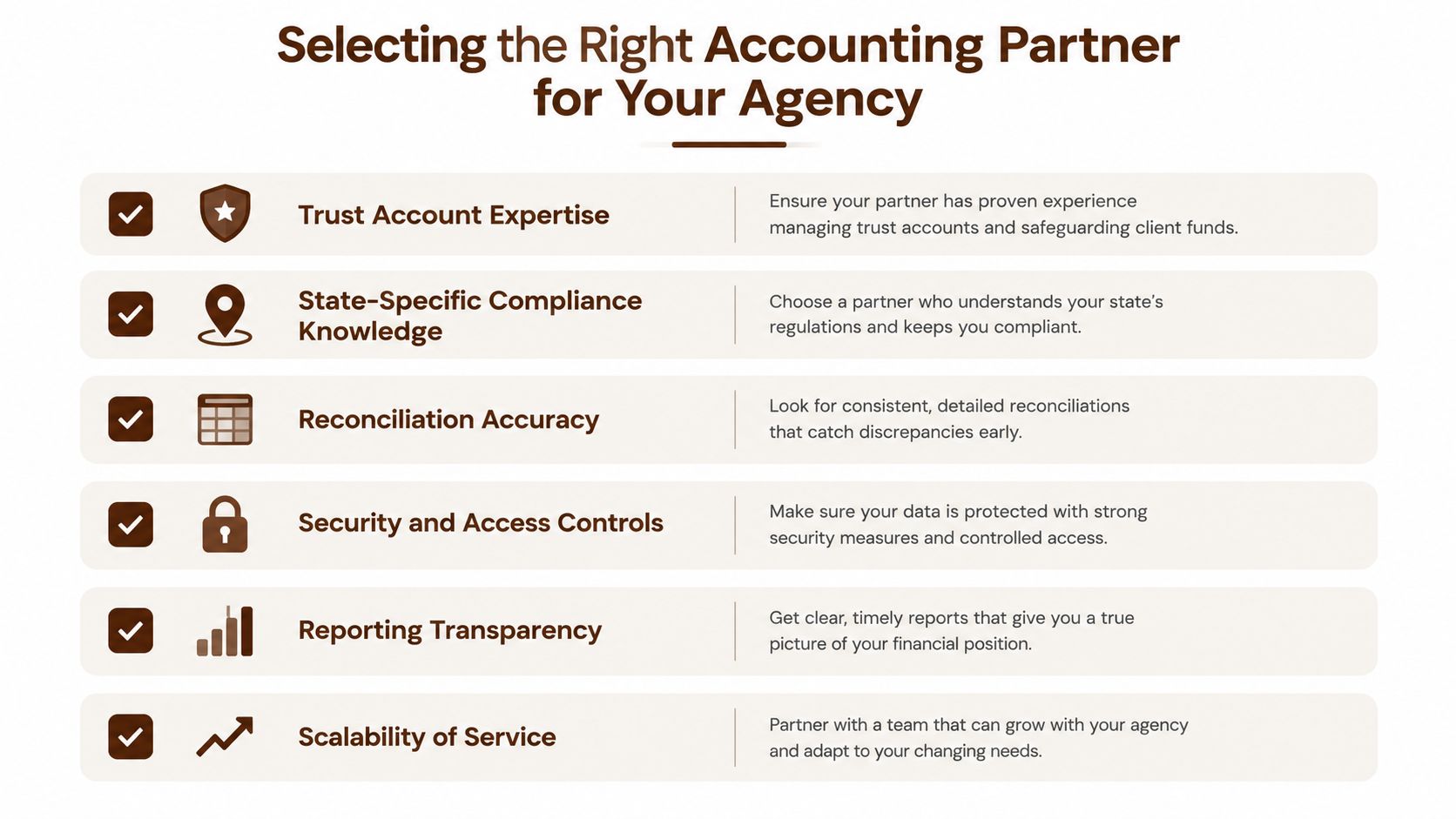
Budget providers often become costly after the first audit query. The true cost appears in rework, missing records, unclear approvals, and control gaps that put trust money at risk. Choose a partner that fits the agency's systems, respects the authority chain, and keeps the file stable without taking control away from the licensee.
Ask about process, not promises
Start with discovery. A serious provider should ask how your trust account runs today, which systems you use, who approves payments, where the backlog sits, and what state obligations apply to your office. If they lead with pricing before they understand the workflow, they are selling labour, not control.
Look for providers who work within client-approved systems and keep the scope documented. That makes the file easier to audit and easier to hand over if staff change. It also keeps authority where it belongs, with the principal and the agency's approved approver chain.
Check continuity, reporting, and access discipline
A good provider should explain how they handle legacy clean-ups, overflow periods, and routine monthly processing without blurring roles. They should also be clear about what happens when a payment looks wrong, who can access the file, and how exceptions are recorded. That is the difference between a service that reduces friction and one that creates another layer of risk.
If a provider cannot explain how they preserve segregation of duties, they are not ready for trust accounting.
For agencies comparing options, Reliance Property Accounts is one provider that works within client-approved systems, manages daily trust routines, and supports audit-ready records. Use that as the benchmark, whether you choose them or another provider.
Strategic Recommendations for Agency Growth and Stability
Solo principals should outsource the routine trust work if they can't maintain daily discipline internally. The goal isn't to remove oversight, it's to stop the account from depending on one exhausted person. If the agency only has one trusted admin operator, that's already a concentration risk.
Growing agencies should use a hybrid model when internal staff can handle oversight but not every transaction. Keep authority with the principal or designated approver, then let the external provider handle reconciliations, bill entry, and overflow. That combination gives you continuity without weakening control.
Multi-branch networks need standardised workflows across states. That means state-specific checklists, documented approval limits, regular close packs, and a clear record of who owns each task. If you can't answer that question on paper, you don't have a scalable process yet.
The strongest recommendation is simple. Stop treating trust accounting like a back-office cost centre and start treating it like a control system. Agencies that do that protect their reputation, reduce audit stress, and make growth less chaotic.
If you want a trust accounting setup that keeps reconciliations current, preserves segregation of duties, and produces cleaner audit-ready records, speak with Reliance Property Accounts. They handle outsourced trust accounting for Australian real estate agencies, including daily routines, payment preparation, and compliance support, so your team can stay focused on running the office without letting the file drift.
